

Bitcoin ETFs shed $1.8B in a week. Is it panic, or a carry trade closing?
Spot bitcoin ETFs took an estimated $669M of net outflows on Nov 20, and Bitcoin is now trading at $61,384.89, up 4.21% over 24 hours. So why are bitcoin ETF outflows happening while the price bounces? The tidy answer is fear, and with the Fear & Greed Index at 9 you can see where that comes from. But fear doesn't explain why the money would leave quietly, on a green day, in a pattern analysts are now calling "structural."
The short answer
Our read is that a good part of the exit looks like a hedged trade being unwound rather than people abandoning Bitcoin. That is a hypothesis, and we'll be clear below about what our data can and can't confirm.
Our news scoring system rated The Block's report that spot bitcoin ETFs shed $1.8B in the past week, with analysts calling the outflows structural, at 9/10 for macro impact and 8/10 for liquidity impact, with a bearish bias. That's about as loud as our scorer gets for a flow story.
One caveat on the numbers. Our ETF flow search returned nothing today, and the market pages we pulled show the net flow chart stuck on "Loading," with no fund-level breakdown. The $669M comes from a published report that also notes BlackRock's IBIT was missing from key flow tables. Treat it as an estimate.
Why are bitcoin ETF outflows happening? The carry trade explained
The trade in plain English
A basis trade, or carry trade, works like this. A fund buys Bitcoin exposure through ETF shares and sells futures against it. Futures usually trade above spot, and the gap, the basis, is the profit. The fund doesn't care whether Bitcoin goes up or down, because the two legs cancel out. It just collects the spread, often with borrowed money to scale it up.
Seen from outside, that fund shows up as an ETF inflow. It looks like conviction, like a big institution buying Bitcoin. It is closer to a bank running a very dull spread business that happens to use Bitcoin as the raw material. A headline from ainvest puts it neatly: "Bitcoin's ETF Bid Was a Carry Trade. The Carry Trade Left."
Why a higher cost of money pushes it out
The basis only pays the gap between what the futures spread earns and what the money costs. If the Fed raises rates, financing gets more expensive and Treasury bills pay more for doing nothing. The spread has to cover a higher bar. When it doesn't, the fund sells the ETF shares, buys back the futures and goes home. The ETF flow figure shows an outflow. Nobody has taken a bearish view on Bitcoin.
We don't have a Fed decision or rate path in the data in front of us, so we won't tell you a hike caused this week's selling. The mechanism works for any rise in the cost of money, and for any squeeze in the basis itself. What we'd want to see to confirm it is the futures basis and funding rates. Both are unavailable to us right now; the funding panels were still "Loading."
What the derivatives numbers do show
The partial evidence leans the way the theory predicts. Derivatives 24h volume is $584.16B against spot at $59.65B, about 9.8x. Working backwards from the stated daily changes (spot down 26.30%, derivatives down 5.52%), yesterday's ratio was roughly 7.6x. Spot trading dried up and derivatives barely noticed.
That fits a market where the leveraged side is doing most of the talking. It doesn't prove a basis unwind, because a plain leveraged bounce looks similar. Perpetual open interest is $299.93B, which is a lot of borrowed conviction. But the shape is consistent with positioning mattering more than fresh buying.
Where people get tripped up
Outflows are not a bearish bet. An ETF outflow means shares were redeemed. If the seller was a basis fund, the Bitcoin exposure was already hedged, so the sale removes a leg of a trade rather than expressing a view. That is why outflows can sit awkwardly beside a price bounce.
Flows also aren't the same as the value falling. Another ainvest report says U.S. spot bitcoin ETFs lost $3.47B in November, while the $24.6B decline in assets was driven by a 21% price drop, not redemptions. Most of the damage to the headline figure is price. The actual money leaving is a fraction of it.
And watch the sample size. Our Hyperliquid leaderboard tracker has logged wallet 0xfc2713... (all-time PnL $37.59M, all-time ROI 118.2%) with a long at 58,086 on Nov 21 and two shorts at 60,240 and 60,114 on Nov 22, each around $300K notional. Read that as one profitable trader selling into a bounce, not as proof of near-term weakness. Next to $669M of ETF outflows, $300K is a rounding error.
What the wider market says
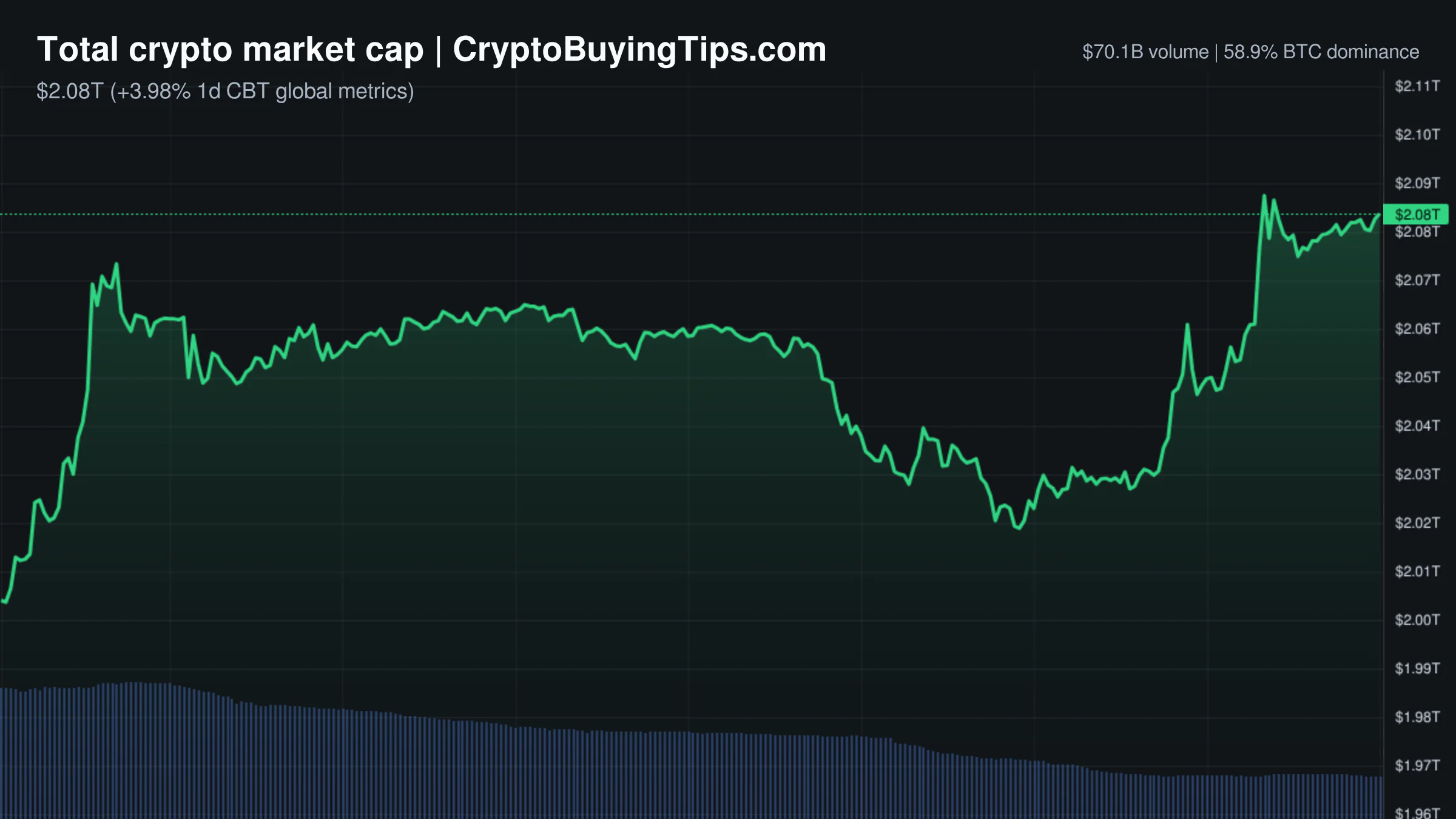
The backdrop doesn't suggest a flood of new money. Total market cap is $2.10T, up 3.49% over 24h (one of our feeds shows a small negative day instead, but every top-five coin is green, so we're using the CoinMarketCap figure). BTC dominance rose to 58.93%.
Stablecoin 24h volume is $60.72B, down 26.81%, almost identical to the fall in spot. If fresh capital were arriving, stablecoin activity would be rising, not shrinking in step with everything else. ETH gas at 0.1 Gwei tells the same story from the on-chain side. A 4% rally with fees near zero is a bounce nobody is rushing to join.
Equities aren't helping. SPY is at $689.81 (-3.64%) and QQQ at $608.45 (-5.67%), so this isn't Bitcoin's private problem. Funds under pressure in one market tend to trim exposure in another, which is one more reason to be careful about reading the ETF line as a Bitcoin verdict.
Panic or structural? What would settle it
A shakeout usually has a signature. Outflows last a few sessions, then reverse once price steadies. The futures basis stays intact. Volume returns on the spot side.
A structural exit looks different. Outflows run for weeks. The basis stays compressed, financing stays expensive, and the same large holders keep reducing. Our earlier coverage of this pattern, where we looked at the ETF exodus analysis, found derivatives volume spiking while the ETF line bled. We also previously covered how ETF outflows and Bitcoin can diverge when leverage props up price. This week's mix of falling spot volume and a rising derivatives share fits that older pattern more than it fits capitulation.
Our position is this: "structural" is a reasonable word for the flow if the carry trade was the bid, because that bid doesn't come back until the economics improve. It is a poor word for sentiment. Extreme fear on a green day is a market that doesn't trust its own bounce, which is sensible, if rarely profitable to say out loud. A week of data can't separate the two stories. Funding rates, the basis and fund-level flows can, and until they load, anyone claiming certainty is guessing more confidently than we are.
Related Tickers
Some links in this article may be affiliate links. We may earn a commission at no extra cost to you — this never influences our analysis or coverage.

Sigrid Voss
Crypto analyst and writer covering market trends, trading strategies, and blockchain technology.
More Articles
Crypto Market Overview | Bitcoin recovers above $60,000 on declining volume while extreme fear persists | November 22, 2026
Bitcoin recovers above $60k amid extreme fear despite declining volume; see our market overview read on the latest…

Venice Token is up 24% while Nvidia sits 48% below its peak. Rotation or a one-off?
The AI trade is cooling while Venice rises 24 percent. Low trading volumes and thin order books are driving price drifts…
Crypto Market Overview | Bitcoin hits two-year lows as fear index drops to 7 and spot volume surges | November 21, 2026
Bitcoin hits two-year lows as fear index drops and spot volume surges, painting a picture of capitulation selling across…

Why bitcoin dominance falls in a crash while altcoins lose just as much
Falling dominance usually suggests money is rotating into altcoins, but the altcoins themselves are currently in the…