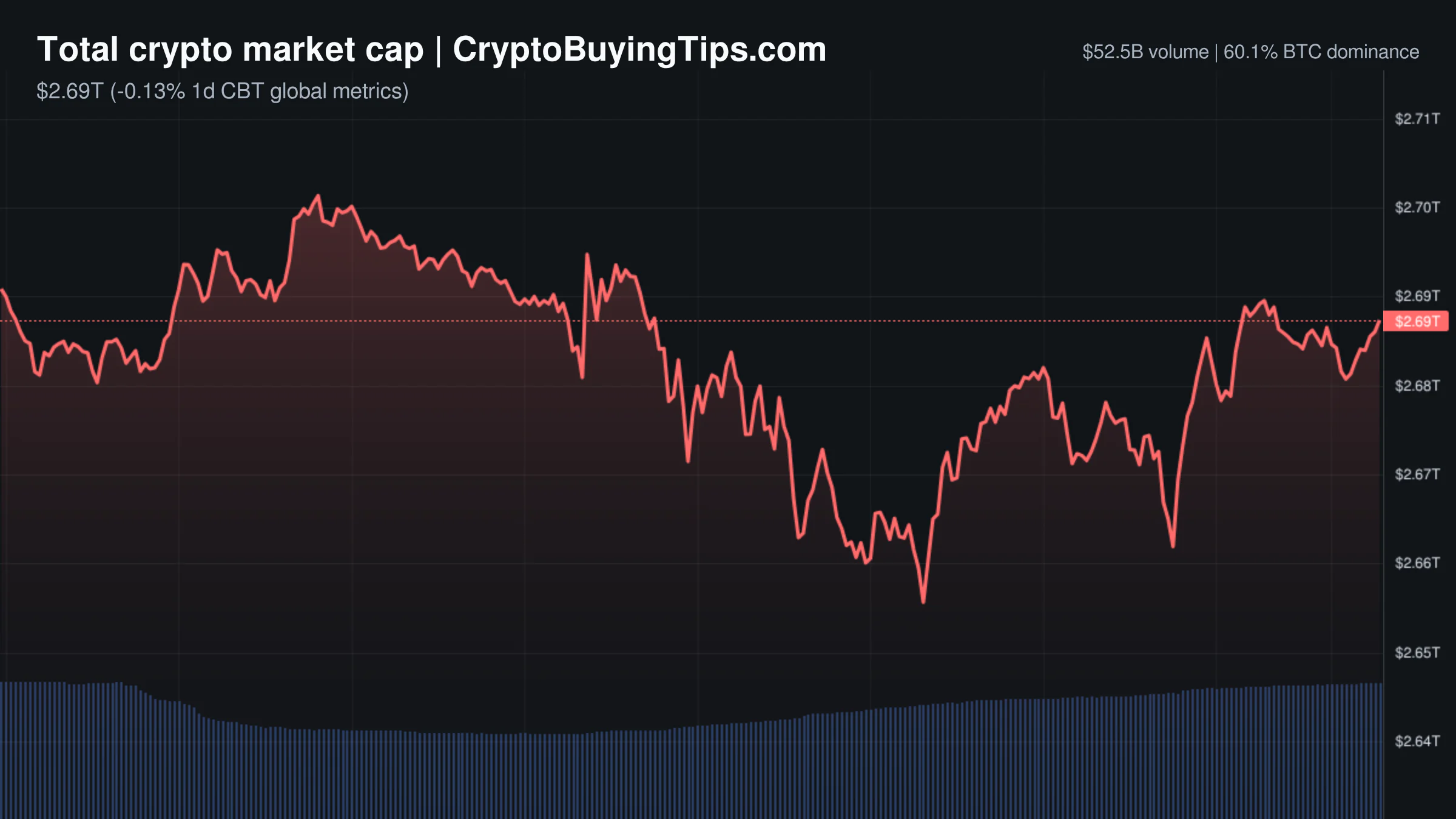
Crypto Market Overview | Derivatives volume dwarfs spot activity amid macro caution and ETF inflows | October 26, 2026
Market overview
The market is currently in a state of suspended animation. Total market cap sits at $2.69 trillion, a negligible dip of 0.11% over the last 24 hours. While the price action looks flat, the plumbing tells a different story. We are seeing a staggering skew toward derivatives. With 24h derivatives volume at $532.20 billion, the leverage market is roughly ten times larger than the spot market. It is a classic casino setup where traders are betting heavily on the direction of the move without actually wanting to own the underlying assets.
Sentiment is a lukewarm 44 on the Fear & Greed Index. This neutrality is mirrored in the Altcoin Season Index, which reads 38. We are neither in a Bitcoin season nor an altcoin season. Instead, we have a stagnant middle ground where Bitcoin dominance remains a ceiling for everything else. Dominance is holding at 60.08%, which effectively starves the broader altcoin market of the liquidity needed for a real breakout.
The macro backdrop is equally cautious. The S&P 500 fell 0.52% to $759.97 and the NASDAQ remained nearly flat. This risk-off tilt in traditional equities usually spills over into crypto, but the market seems more concerned with the upcoming central bank calendar than a few basis points in the SPY. The high concentration of open interest in perpetuals, totaling $341.58 billion, suggests that a sudden move in either direction could trigger a cascade of liquidations.
Bitcoin and Ethereum
Bitcoin is hovering at $80,370.11, down 0.18%. It is fighting a psychological battle at the $80k mark. There is a glimmer of hope in the institutional pipeline, as US spot Bitcoin ETFs broke a two-week losing streak with $301 million in net inflows. However, these inflows have not been enough to push the price above the $81,500 resistance. We previously noted that institutional capital often rotates based on efficiency, and the dominance data agrees that Bitcoin remains the primary safe haven when the macro picture gets blurry.
Ethereum is in a far more precarious position. The price is $2,331.86, down 0.34%. More concerning than the price is the network activity. Gas fees are currently between 0.04 Gwei and 0.07 Gwei. To put it bluntly, the network is a ghost town. When gas fees hit these levels, it suggests a lack of on-chain demand that no amount of "institutional narrative" can hide. This lack of utility is reflected in the ETF flows, where Ethereum saw net outflows of $224.96 million last week.
Top crypto prices
Bitcoin leads the pack at $80,370.11 with a market cap of $1.61 trillion. Ethereum follows at $2,331.86 and a market cap of $284.87 billion. BNB is trading at $741.22 with a market cap of $97.47 billion. XRP sits at $1.29 and a market cap of $81.85 billion.
Solana is one of the few gainers among the majors, trading at $101.54, up 0.35%. TRON is at $0.3302, up 0.43%. Hyperliquid has seen a 1.03% increase to $77.2 with a market cap of $19.58 billion.
News driving today's market
Geopolitical friction is adding a layer of regulatory risk. The Bank of Israel has publicly rebuked Prime Minister Benjamin Netanyahu's suggestion that cryptocurrency could be used to circumvent international sanctions. The central bank's insistence that crypto cannot serve as a tool to dodge sanctions is a stark reminder that governments will not let digital assets undermine their financial statecraft. This clash, occurring just before a national election, highlights the inherent tension between blockchain's permissionless nature and the reality of sovereign power. We previously covered Solana vs bitcoin allocation for more background.
On the institutional side, we are seeing a push toward tokenization. Aviva Investors and Ripple have launched a tokenized share class of a $29 billion sterling fund on the XRP Ledger. This is a meaningful step for XRP as it moves from a speculative asset to a functional rail for real-world assets. It ties directly into the tokenized deposits concept we have followed, where traditional finance attempts to capture the efficiency of the ledger without losing control.
The AI sector is facing a reality check. Elon Musk has warned that over 200 AI neoclouds face a "guppy-level death" as the market consolidates. This warning, paired with SpaceX raising $40 billion in debt for AI chips, suggests that the barrier to entry in AI infrastructure is becoming prohibitively expensive. Small players who promised the world but lack the capital to buy GPUs are likely to be wiped out.
Operational risk also resurfaced today. India's largest crypto exchange admitted to a $16 million loss due to an internal process failure involving a retired wallet. The exchange initially dismissed reports of outflows as a false alarm before admitting the loss. This is a textbook example of the operational fragility that still exists in major exchanges, where a simple administrative error can result in millions of dollars vanishing.
Social intelligence
The social feed is dominated by macro anxiety and security warnings. Goldman Sachs has noted that the Japanese yen is becoming a stronger hedge against AI-driven market shocks. This is an interesting pivot. When traders move into the JPY to hedge against tech volatility, it usually signals a lack of confidence in the "AI trade" that has driven much of the risk-on sentiment this year.
Security remains a persistent headache. Keystone disclosed a website breach that exposed the names and shipping addresses of hardware wallet buyers. While the funds themselves are safe, the exposure of physical addresses opens the door to targeted scams or "wrench attacks." It is a sobering reminder that the weakest link in crypto security is often the human element and the metadata we leave behind.
ETF flow data from social sources confirms the divergence we are seeing. While Bitcoin and XRP saw net inflows last week, Ethereum and Solana suffered outflows. The market is currently favoring the "digital gold" and "institutional rail" narratives over the "smart contract platform" story.
Trading ideas worth watching
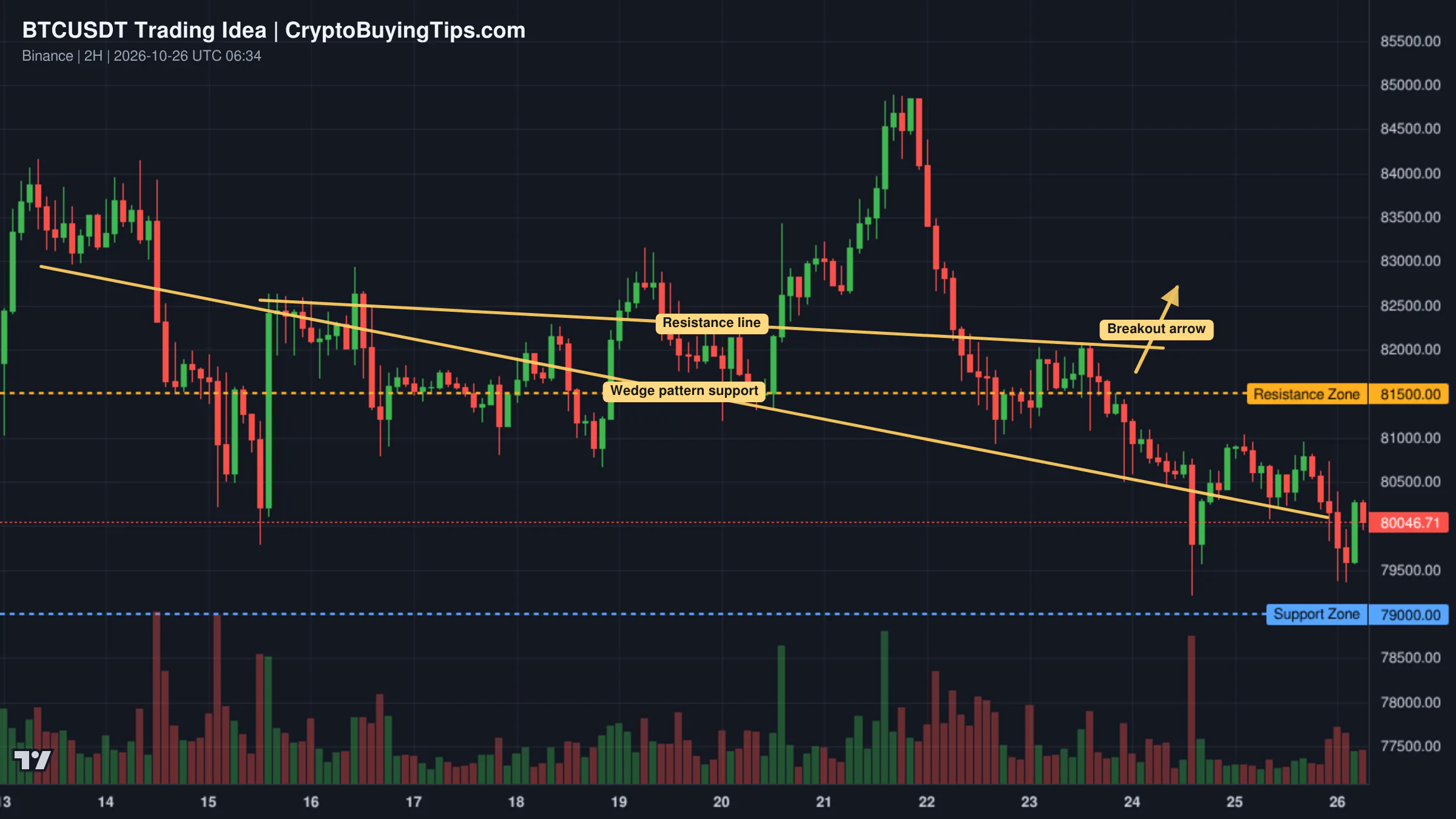
Bitcoin is currently coiling within a descending wedge pattern. The price is making lower highs while finding stubborn support around $79,000. This pattern suggests that a decisive move is coming. A volume-backed close above the upper resistance line at $81,500 would trigger a bullish expansion. However, the current dip below $80k shows that traders are de-risking ahead of the Federal Reserve meeting. The $79,000 level is the line in the sand; if that fails, the wedge breaks to the downside.
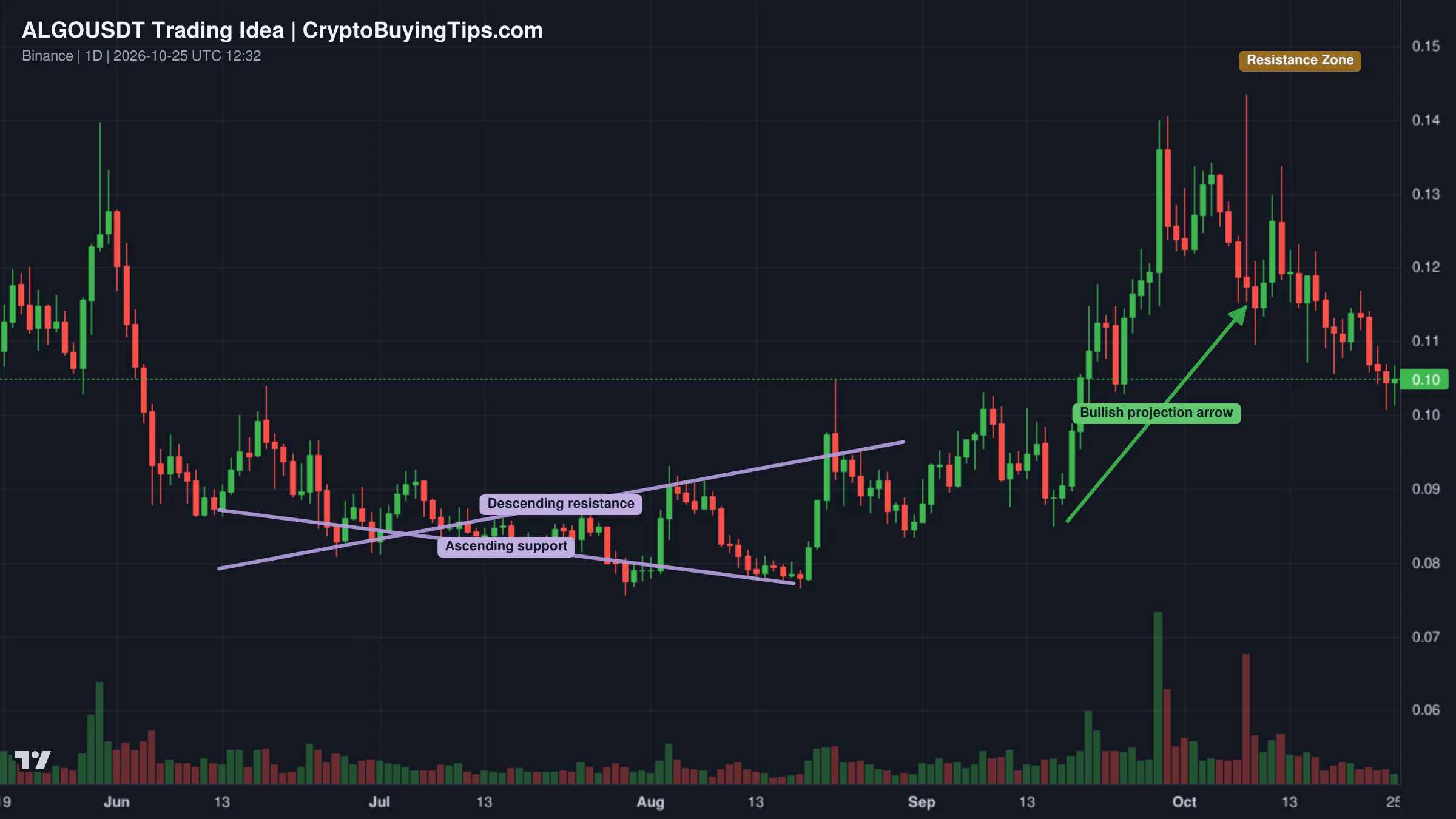
For those with a longer time horizon, Algorand presents an accumulation play. The asset has spent months in a sideways range, with a clear bottom established around $0.0840 to $0.1050. Volume has been rising on the moves up and falling on the retraces, which is a classic sign of accumulation by larger players. The target for a prolonged bullish wave starts at $0.1142, with a stop-loss suggested for a weekly close below $0.0835.
Ethena is showing strong momentum after recovering from its bear-market lows. The price has closed its first green week after finding support, and it is now trading above the long-term levels of April and June 2025. This bullish impulse could continue for months, with targets set at $0.57 and $0.85. The risk here is a prolonged period of sideways movement if the broader market fails to provide a liquidity lift.
Smart Money Signals — Hyperliquid Leaderboard
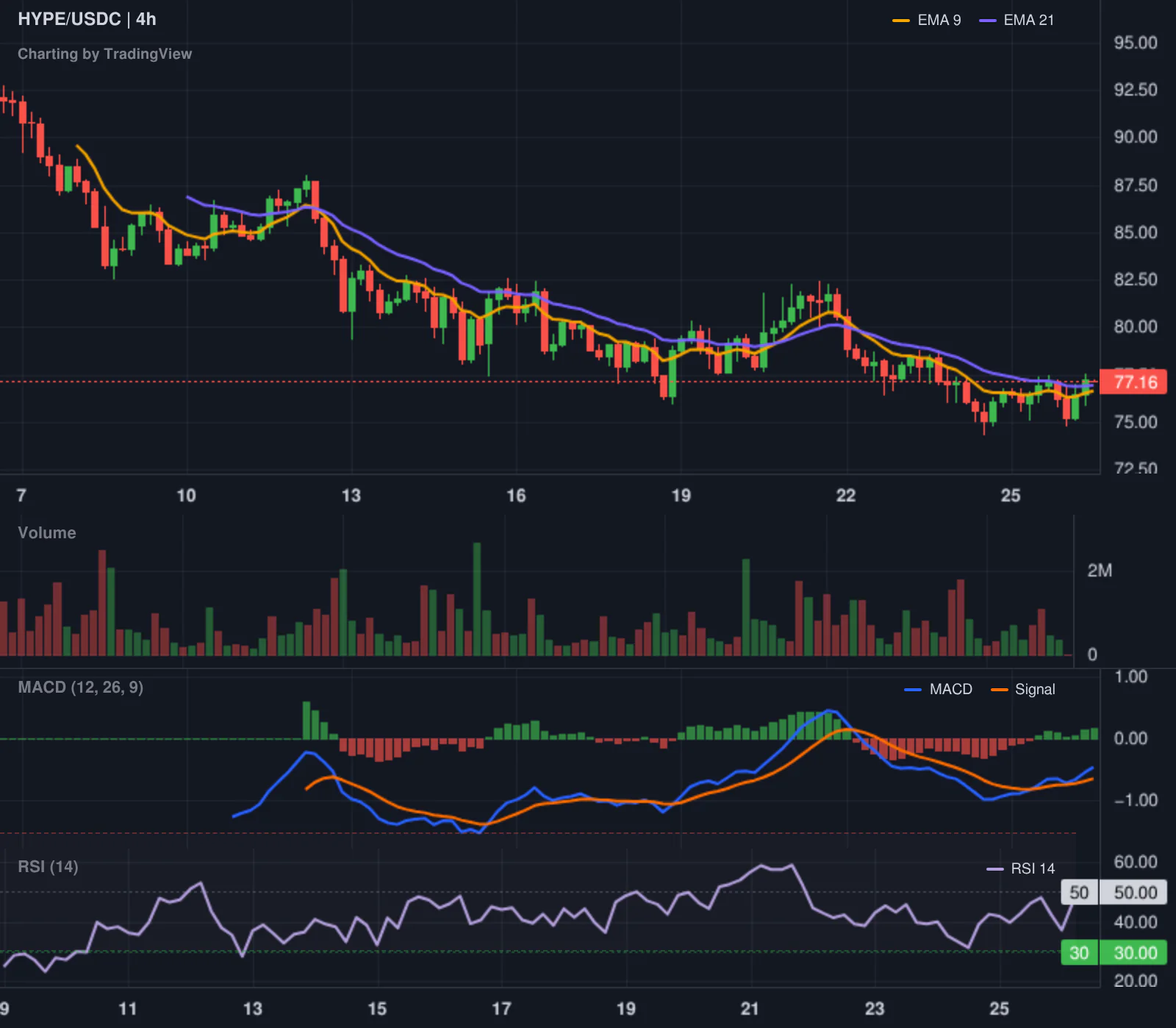
Our leaderboard tracker has flagged a significant move from a top trader (0xb67c4c...), who has an all-time ROI of 119%. This trader has opened a short position in Hyperliquid at an entry price of $75.256. The notional value of the trade is $125,986.
This is a contrarian bet. HYPE is currently up 1.03% on the day, but this trader is betting on a reversal. Given the high derivatives volume across the market, a short from a high-ROI trader suggests that the current rally in HYPE may be overextended or lacks the spot support to sustain higher levels.
Altcoin Spotlight
Solana deserves attention today despite the mixed ETF flows. The news that Hong Kong has named a Nasdaq-listed Solana company as a strategic enterprise is a significant institutional win. The plan to establish validator operations in Hong Kong provides a layer of government-backed legitimacy to the network's infrastructure.
While Ethereum struggles with ghost-town gas fees, Solana continues to position itself as the preferred rail for high-throughput institutional applications. The price is holding at $101.54, and the strategic endorsement from Hong Kong suggests that the network is successfully capturing the "enterprise L1" narrative in Asia.
What to watch next
The coming days are dominated by a cluster of macroeconomic events that will likely end the current period of stagnation. We have interest rate decisions from the Federal Reserve, the European Central Bank, and the Bank of Japan all scheduled for this week. The market is less concerned with the rates themselves and more interested in the commentary from policymakers regarding the December meetings.
We are also watching the earnings reports from Coinbase, Robinhood, and MicroStrategy. These reports will provide a window into the actual health of the retail and institutional crypto trade. If Coinbase reports a significant drop in trading fees, it will confirm the "flat" sentiment we see in the spot market.
The most immediate risk is the massive open interest in perpetuals. With $341 billion on the line, any surprise from the Fed could trigger a violent deleveraging event. We expect the market to remain choppy until the central bank decisions are digested and the "BibiCoin" regulatory noise settles.