
Brazil is banning prediction markets and the CFTC is starting a war over the same tech
Brazil just decided that platforms like Polymarket are essentially illegal gambling, and they are moving fast to shut them down. It is a move that feels like a throwback to the early days of crypto, where governments react to things they don't understand by simply banning them. But this isn't just about Brazil. In the US, the CFTC is locked in a legal battle with New York over whether these "event contracts" are legal financial instruments or just unregulated betting. For anyone trying to figure out are prediction markets legal in usa, the answer is a messy, expensive, and very loud "it depends on who is suing whom."
The fight over what a bet actually is
The core of the problem is that prediction markets don't look like traditional betting. If you bet on a football game at a bookie, you are giving money to a company that takes the other side. In a decentralized prediction market, you are trading a contract with another person. If you think a certain candidate will win an election, you buy a "Yes" token. If the event happens, that token becomes worth $1. If it doesn't, it goes to zero.
Brazil's regulators see this as a clear-cut case of illegal gambling. They aren't interested in the nuance of "automated market makers" or "liquidity pools." To them, if you are risking money on a future outcome, it is a bet, and if you don't have a state-issued gambling license, you are breaking the law.
Why the CFTC is fighting back in the US
In the States, the conflict is more about power and jurisdiction. The CFTC (Commodity Futures Trading Commission) claims that prediction markets are essentially "swaps" or "futures contracts." This means they fall under federal oversight.
When New York sued Coinbase and Gemini over their event contracts, alleging they were illegal gambling, the CFTC stepped in. Not because they love prediction markets, but because they don't want state-level gambling laws to override federal financial regulations. If every state has a different rule about what constitutes a "bet" versus a "derivative," the entire US financial system becomes a fragmented mess.
I've watched this pattern since 2019. Regulators love to fight over who gets to control the money, and the users are usually the ones caught in the crossfire.
Are prediction markets legal in usa and how do they survive?
If you are asking are prediction markets legal in usa, you have to look at the workaround. Most of these platforms use "geofencing" to block US IP addresses. This is why so many people use VPNs to access them. I always tell people that if they are moving funds around to bypass regional blocks, they should at least secure their primary assets. I personally use a Ledger Nano Gen5 for my long-term holdings because it gives me an E Ink touchscreen and the security of a CC EAL6+ chip for about $99. It is a lot safer than leaving funds on a platform that might get banned by a government overnight.
The real question is whether the "decentralized" part of DeFi actually works. If a platform is truly decentralized, there is no CEO to arrest and no office to raid. But as we saw with the UK's recent raids on P2P traders, governments are getting better at finding the people behind the screens.
The bigger risk for the market
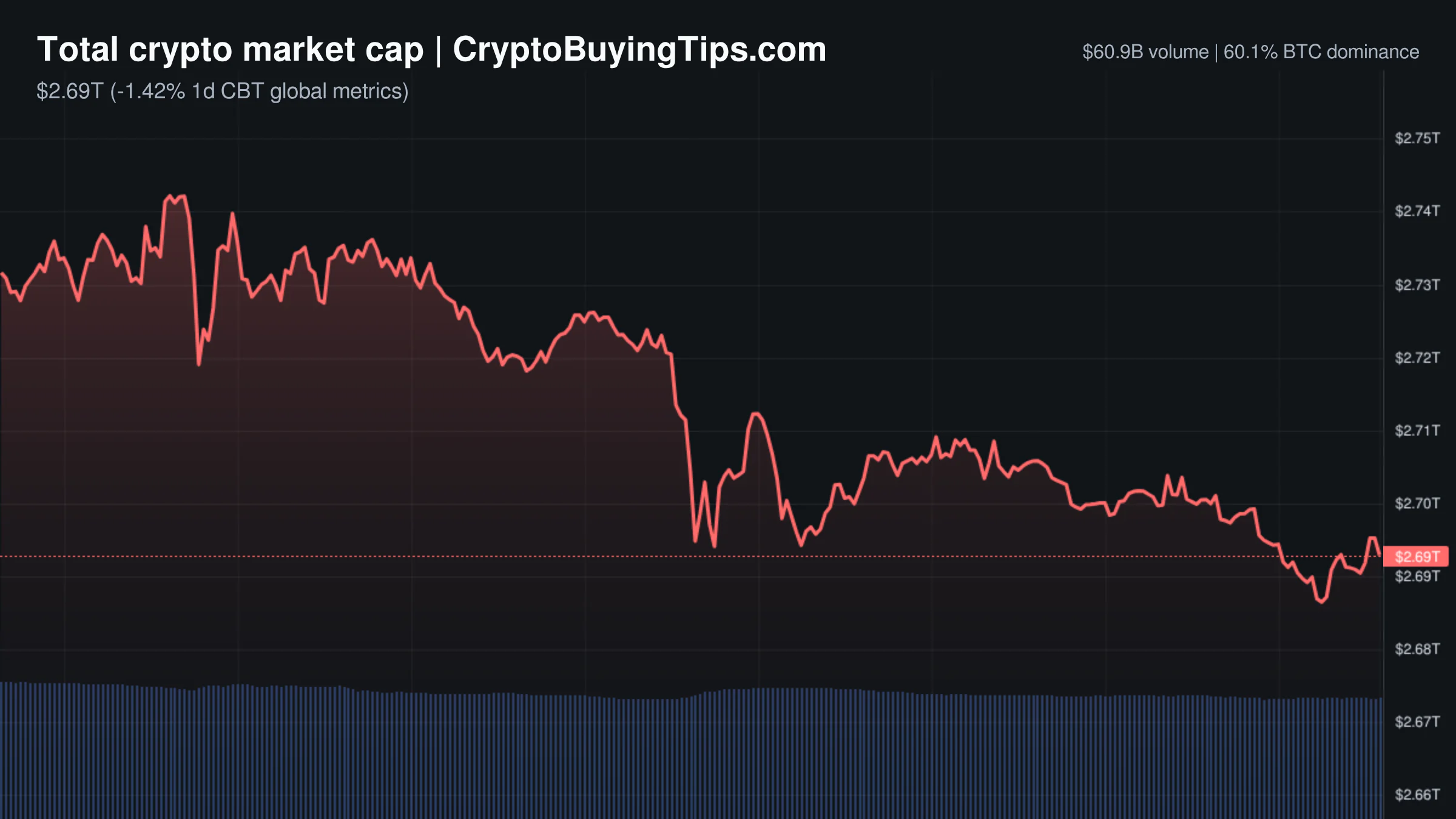
Right now, the global crypto market is in a weird spot. Total market cap is sitting around $2.59T, but trading volume is crashing. Derivatives volume is down nearly 40% in 24 hours. When you combine this lack of momentum with a wave of bans in places like Brazil, it creates a "risk-off" environment.
I'm worried that this regulatory war will push prediction markets even further into the shadows. When legitimate platforms get banned, users move to unregulated, unverified mirrors. That is where the real scams happen.
My take on the outcome
I think the CFTC will eventually win the jurisdictional battle in the US, but that doesn't mean prediction markets will become "legal" for the average person. It just means they will be regulated as high-risk financial derivatives rather than casino games.
Brazil's ban is a warning. It shows that "decentralized" is often just a word we use until a government decides to block the DNS or freeze the on-ramps. If you are playing in these markets, just remember that the code might be immutable, but the laws of the land still apply to your physical body.
Some links in this article may be affiliate links. We may earn a commission at no extra cost to you — this never influences our analysis or coverage.

Sigrid Voss
Crypto analyst and writer covering market trends, trading strategies, and blockchain technology.
More Articles
Crypto Market Overview | Derivatives volume dwarfs spot activity amid regulatory uncertainty and institutional outflows | October 24, 2026
Derivatives volume dwarfs spot activity amid regulatory uncertainty and institutional outflows, showing market…

Fidelity outflows and Ethereum OG dumps suggest a hidden exit
Another day of market data suggesting everything is fine until you look at the outflows and OG dumping. Institutional…
Crypto Market Overview | Leveraged bets surge amid regulatory clarity and institutional inflows | October 22, 2026
The market shows divergence between spot interest and leveraged bets amid regulatory clarity; see our overview here.

Volume is surging but prices are flat. Here is where the trigger is
Volume spikes while prices remain stubbornly flat; this divergence suggests an underlying battle between leveraged…