

The market is trading $1 trillion in leverage and it is a problem
The sheer volume of capital moving through derivatives, a staggering $996.27B compared to spot's $112.74B, forces us to ask about the difference between spot and derivatives volume. Most people see a price rip and a "Greed" reading of 73 on the Fear and Greed index and assume there is a wave of new buyers entering the market. The data tells a different story. We are not seeing a massive influx of people buying the actual assets; we are seeing a massive influx of people betting on the price of those assets using borrowed money. We previously covered related angles in derivatives volume warning and derivatives volume surging.
How does the difference between spot and derivatives volume work?
To understand the risk, you first have to understand what these numbers actually represent. Spot trading is straightforward. When you trade on the spot market, you are exchanging one asset for another. If you buy Bitcoin on a spot exchange, you pay the price, the Bitcoin is transferred to your wallet, and you own it. Our current data shows spot volume at $112.74B. This represents actual capital moving into the underlying assets.
Derivatives are different. You aren't buying the asset; you are buying a contract that derives its value from the asset. Whether it is a perpetual swap or a future, you are essentially placing a bet on whether the price will go up or down. You can do this with very little capital by using leverage, which allows you to control a large position with a small deposit.
The gap here is absurd. While spot trading is the foundation of the market, the derivatives volume of $996.27B shows that the tail is now wagging the dog. Our news scoring system rated this story 10/10 for novelty because the volume discrepancy has reached a point where the "market" is no longer a collection of investors, but a collection of leveraged positions.
Why the volume gap suggests a leverage trap
When spot volume leads the way, it suggests genuine accumulation. It means people are willing to lock up their cash to hold the asset for the long term. When derivatives volume dwarfs spot volume, the price action is driven by speculation and hedging.
This creates a fragile environment. In a spot-driven market, if the price drops 5%, the people who bought the asset still own it. They might be unhappy, but they aren't forced to sell unless they choose to. In a derivatives-driven market, a 5% drop can hit the liquidation price of thousands of highly leveraged traders.
This is where the "leverage trap" happens. When those positions are liquidated, the exchange automatically sells the underlying asset to cover the loss. This pushes the price down further, which triggers more liquidations. It is a cascading effect that can turn a minor correction into a vertical crash in minutes.
How derivatives dominance affects market stability
The current market structure is heavily skewed. Our global metrics put Bitcoin dominance at 58.314485072869516. While Bitcoin remains the primary driver, the way that dominance is being expressed is through leverage.
Our signal scanner flagged the high derivatives volume relative to spot as an elevated systemic risk indicator. When you see nearly a trillion dollars in derivatives volume against just over a hundred billion in spot, you are looking at a market that is essentially a house of cards built on margin.
The risk is not that the bullish narrative is wrong, but that the positioning is too crowded. If the market moves against the dominant leveraged side, the resulting liquidation event will be disorderly. We've seen this cycle before. The market climbs a wall of worry, traders move from spot buying to 20x leverage, and then the floor drops out because there isn't enough actual spot demand to absorb the forced selling.
What we are watching next
We aren't calling for a crash, but we are calling for caution. The divergence between spot and derivatives is too wide to ignore. If you want to track whether this move is sustainable, stop looking at the total volume and start looking at the ratio between spot and derivatives.
We are watching for two specific triggers:
- A significant spike in funding rates, which would show that the cost of holding these leveraged longs is becoming unsustainable.
- A drop in BTC dominance that happens alongside a derivatives volume crash, suggesting the leverage is being flushed out.
Until spot volume begins to catch up to the derivatives activity, our read is that the current price action is a speculative exercise rather than a fundamental shift in value. It is a fine line between a bull market and a liquidation event, and right now, the market is walking that line with a very heavy backpack of debt.
Some links in this article may be affiliate links. We may earn a commission at no extra cost to you — this never influences our analysis or coverage.

Sigrid Voss
Crypto analyst and writer covering market trends, trading strategies, and blockchain technology.
More Articles
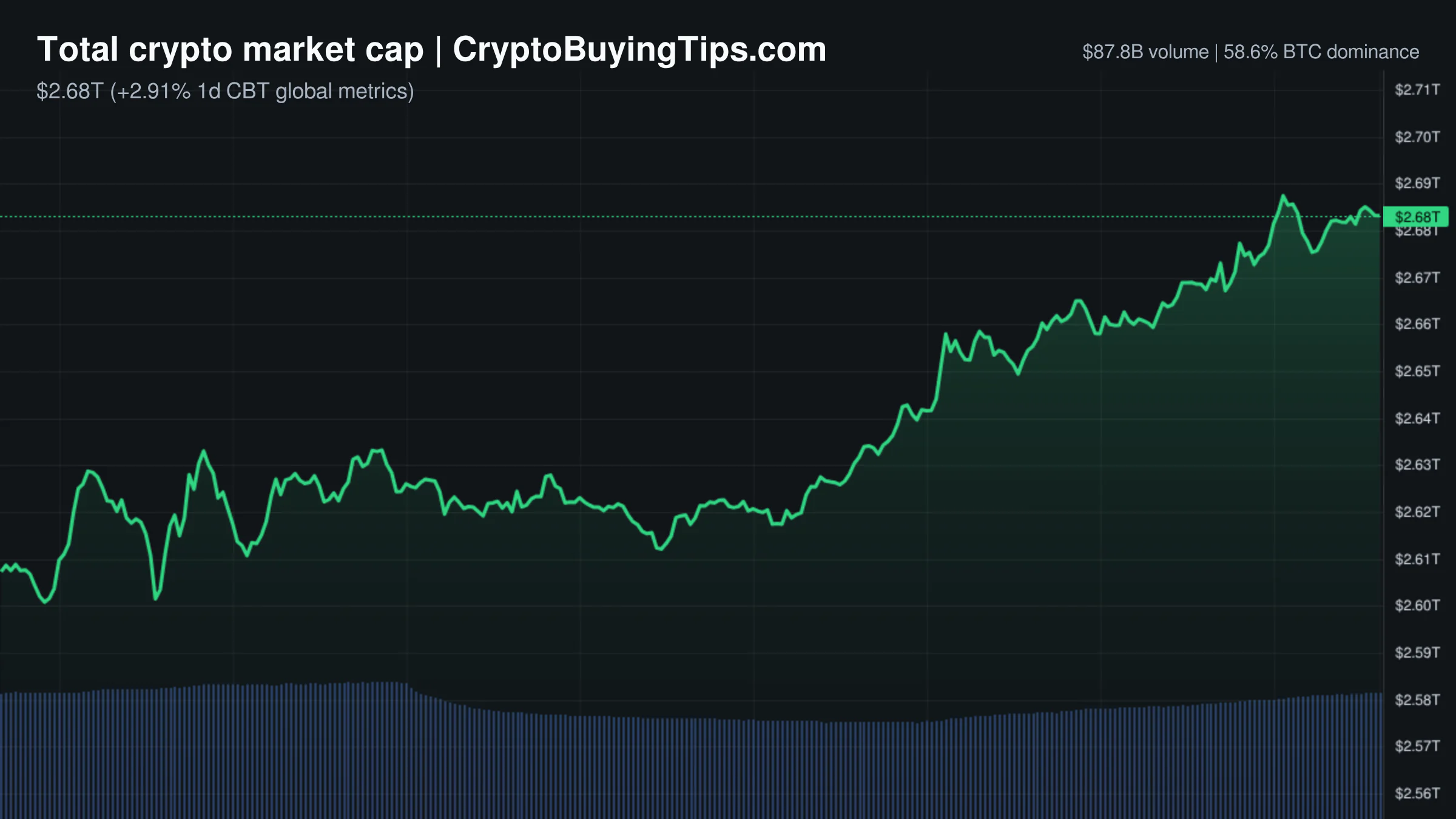
Crypto Market Overview | Leveraged bets dominate as regulatory shifts clash with geopolitical friction | September 18, 2026
The total market cap sits at $2.70T as leveraged bets dominate; see our read on crypto's regulatory clashes and…
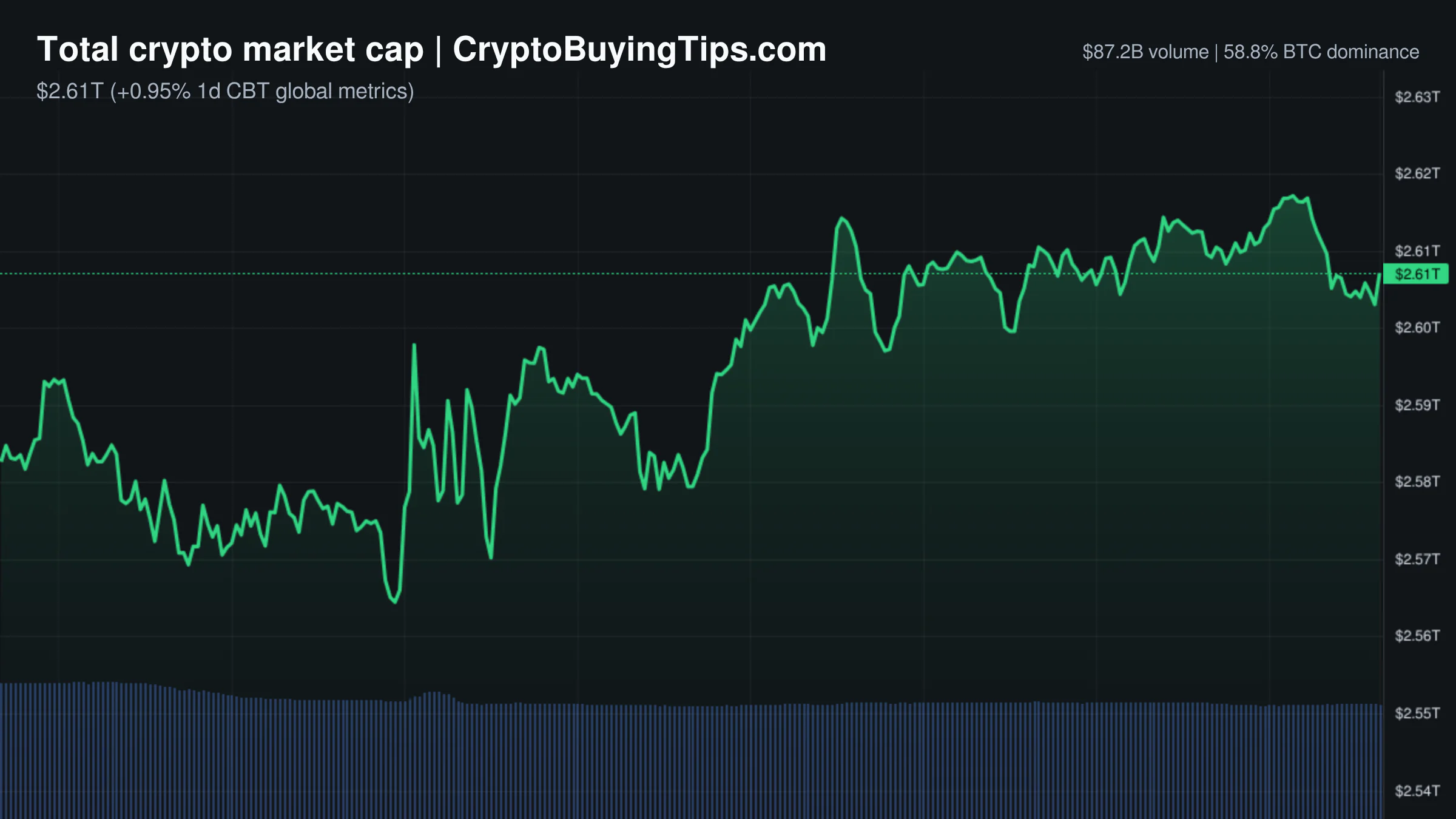
Crypto Market Overview | Fed rate hikes meet derivatives volume despite spot outflows and ETF redemptions | September 17, 2026
Fed rate hikes meet derivatives volume despite spot outflows and ETF redemptions Crypto market overview analysis for…

BlackRock and Visa are now validators, and Circle just built a walled garden for banks
Another layer built for banks means less room for general DeFi mischief. Circle’s Arc mainnet appears designed not as a…
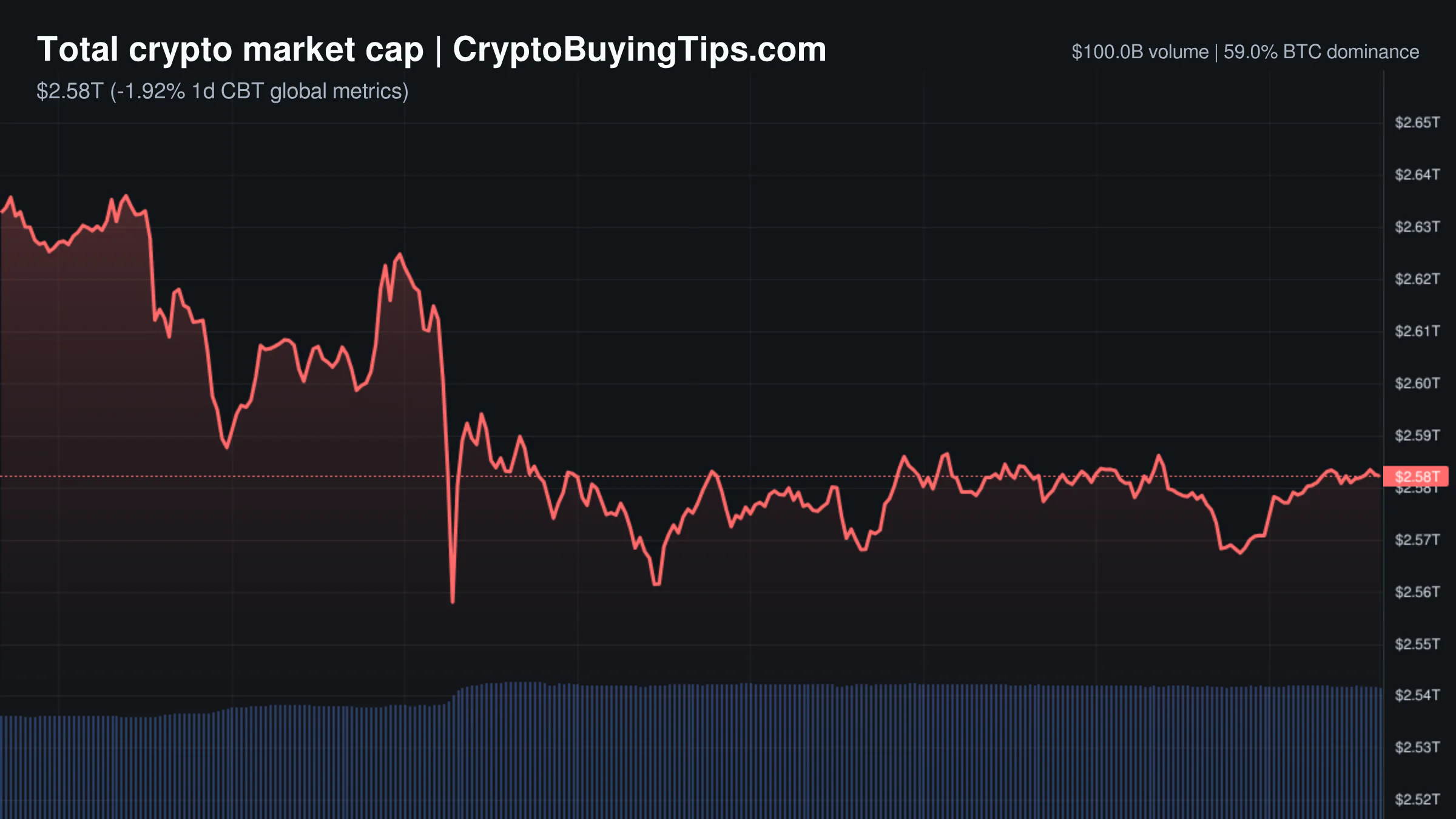
Crypto Market Overview | Regulatory setbacks and macro jitters trigger leveraged sell-off | September 16, 2026
Market jitters and regulatory setbacks caused a leveraged sell-off as total market cap dropped 4.34% despite high…