
Crypto Market Overview | Derivatives volume surges amid banking integration and regulatory tension | October 12, 2026
Crypto Market Overview | Derivatives volume surges amid banking integration and regulatory tension | October 12, 2026
Market overview
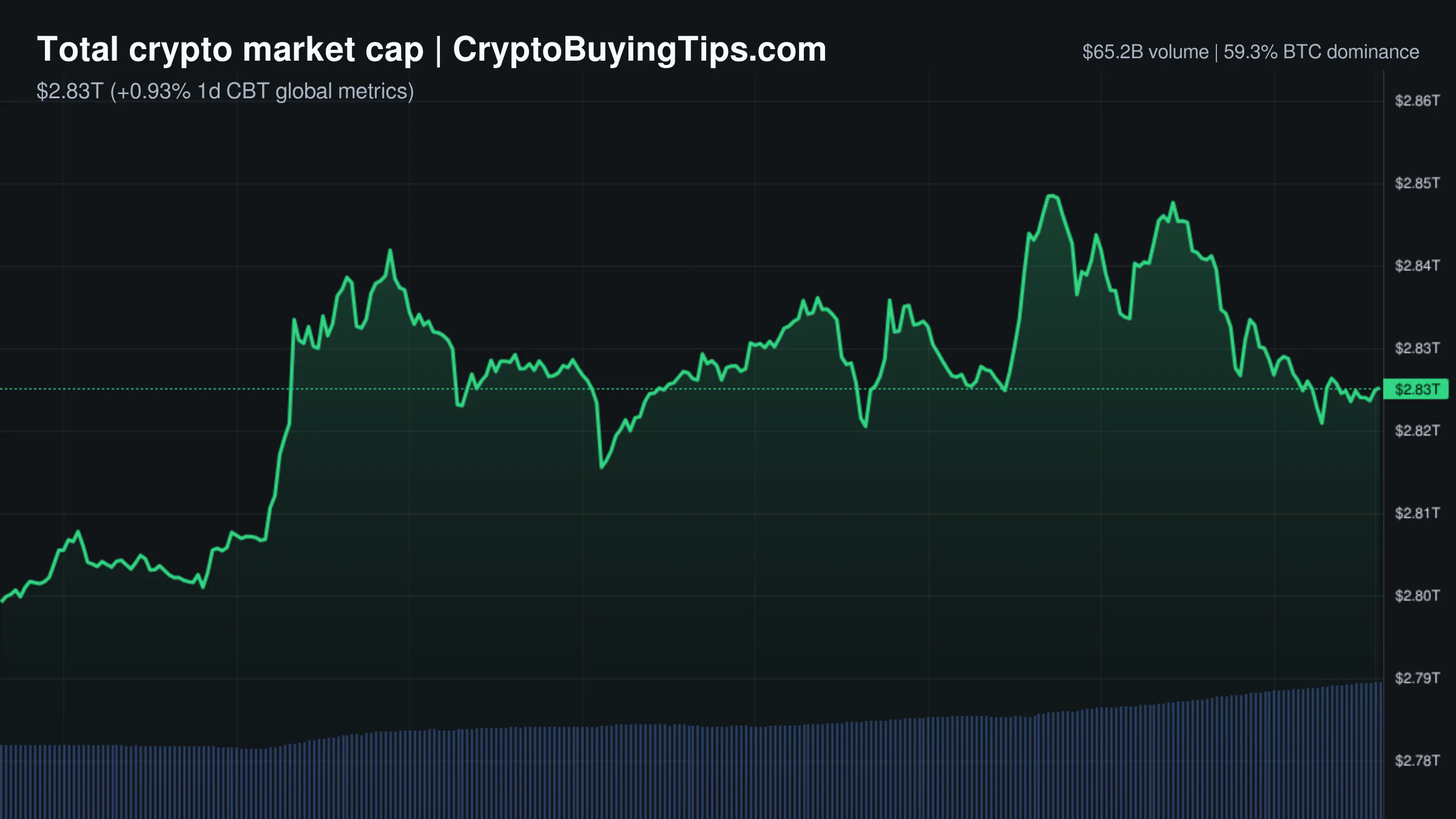
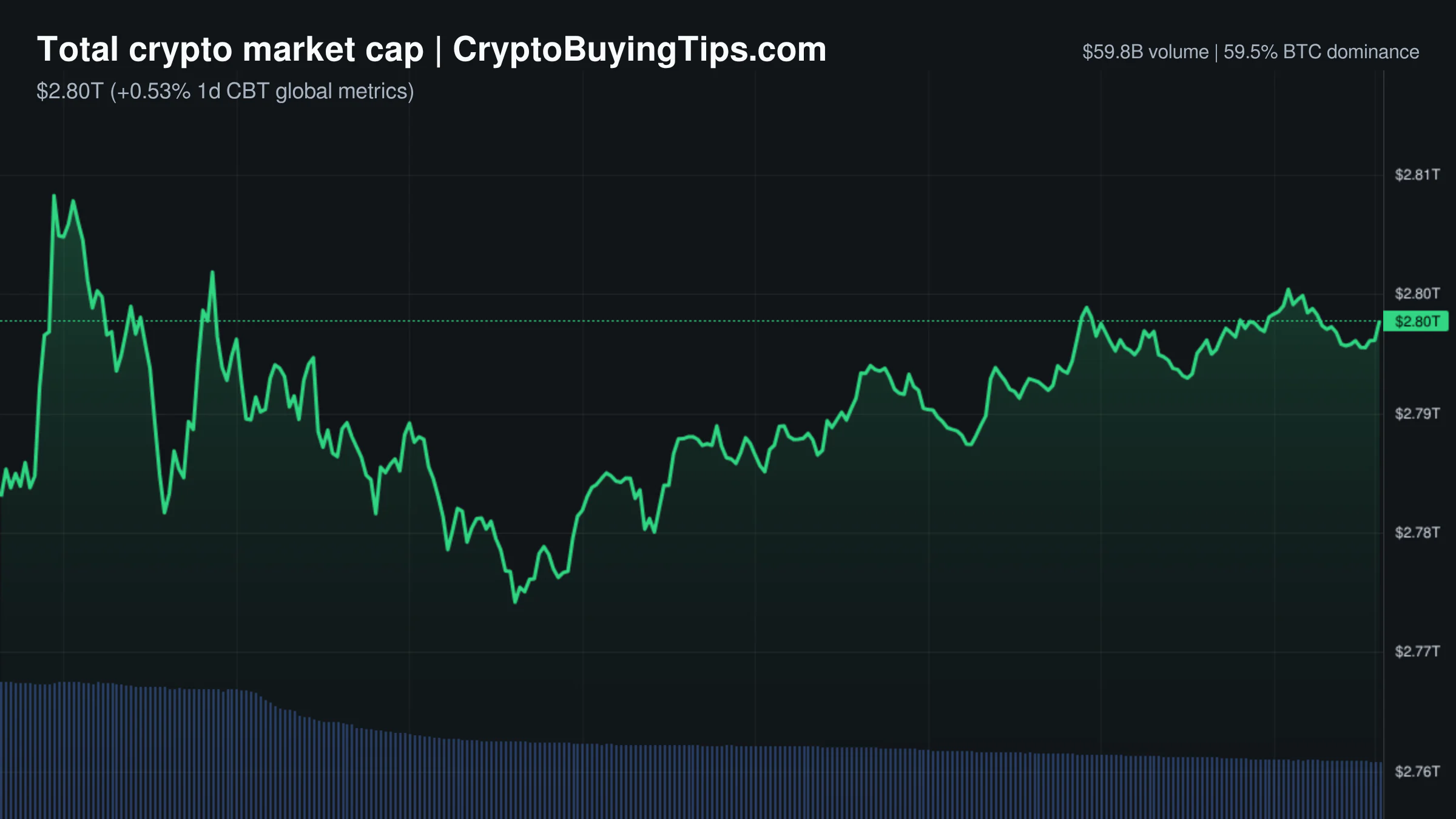
The market is currently operating in a state of high-activity indifference. Total market capitalization sits at $2.82T, down 1.87% over the last 24 hours, yet trading volume has spiked by 57.82% to reach $65.04B. This divergence is explained by the derivatives market, where volume exploded by 88.32% to $589.43B. We are seeing a scenario where the betting volume is massive, but the actual price movement is muted. It is essentially a high-stakes poker game where the players are increasing their bets on every hand, but the pot is barely growing.
Bitcoin dominance remains high at 59.48%, suggesting that while there is plenty of activity, the appetite for risk in smaller assets is still cautious. Stablecoin dominance is at 9.11%, which indicates that capital is not fleeing the ecosystem but is instead sitting on the sidelines in USDT and USDC. This is a neutral posture. The Fear and Greed Index confirms this at 57, and the Altcoin Season Index is almost perfectly split at 51. The market is waiting for a catalyst that can move it out of this sideways grind.
The macro backdrop provides a slight tailwind. The S&P 500 is up 0.60% and the NASDAQ is up 0.49%. Usually, this risk-on sentiment in traditional equities spills over into crypto, but the current correlation is weak. The volume surge in derivatives suggests that traders are positioning for a move, but they are doing so with leverage rather than spot accumulation. This makes the current price action fragile.
Bitcoin and Ethereum
Bitcoin is trading at $83,419.25, a modest gain of 0.62%. The asset is currently trapped in a tight range, fighting to reclaim the $84,000 to $85,000 zone. The massive increase in derivatives volume suggests a build-up of open interest that could lead to a violent move in either direction. We are seeing a tug-of-war between those expecting a breakout to $90k and those who believe the recent breakdown from $87k is the start of a deeper correction.
Ethereum has performed better on a percentage basis, rising 2.20% to $2,553.05. There is a notable volatility gap here. Implied volatility for ETH is 52.52, significantly higher than Bitcoin's 39.39. This suggests that traders expect more aggressive swings from Ethereum in the short term. Interestingly, ETH gas fees are extremely low, with fast transactions costing only 0.09 Gwei. This is a bit of a joke given the surge in trading volume. It tells us that the activity is almost entirely concentrated on centralized exchanges and derivatives platforms. The actual network is quiet, meaning the price action is being driven by speculators rather than on-chain utility.
Top crypto prices
The top of the market shows a mix of steady holds and modest gains. BNB is at $750.32, up 0.50%, while XRP has climbed 1.08% to $1.4. Solana is showing strength, rising 2.14% to $111.57. TRON remains flat at $0.3314, up 0.29%. Hyperliquid continues its climb, trading at $86.74, up 2.21%.
News driving today's market
The narrative is currently split between institutional integration and regulatory tightening. In South Korea, Jeonbuk Bank has reportedly started issuing Bitcoin-backed business loans. This is a structural shift. When a commercial bank accepts BTC as collateral for won-denominated lending, it moves the asset from a speculative token to a recognized financial tool. This provides a fundamental floor for the price, as it creates a real-world use case for holding the asset.
At the same time, the Financial Stability Board is sounding the alarm. The FSB has flagged systemic risks associated with stablecoins and AI ahead of the G20 meeting, warning that oversight mechanisms remain immature. This creates a tension in the market. We have banks in Asia integrating Bitcoin while global watchdogs are warning about the plumbing of the stablecoin market. The regulators and the bankers are clearly reading different books.
In Europe, the mood is more restrictive. French lawmakers are pushing for a rule that requires holders of crypto wallets over $112,000 to declare their assets or face fines. This is a direct attack on self-custody. When G7 nations begin targeting specific wallet thresholds, it usually leads to a temporary dip in liquidity as holders scramble to reorganize their holdings. We have seen similar patterns before where stablecoin dominance in crypto rises because traders prefer the perceived safety of stables over the regulatory risk of holding volatile assets in a wallet.
Other institutional signals are bullish. Morgan Stanley is preparing for tokenized equities in early 2027, and Standard Chartered has launched custody for Ripple's RLUSD on the XRP Ledger. These moves suggest that the infrastructure for traditional finance to enter the space is being built regardless of the short-term regulatory noise. We previously covered how dominance data agrees that institutional money has been consolidating into the majors, and these custody deals are the next logical step.
Social intelligence
On-chain data is highlighting a record for tokenized stocks, which have hit a market cap of $3.9 billion. The concentration is interesting. BNB Chain leads with $1.2 billion, followed by Ethereum and Solana. This confirms that the RWA (Real World Asset) narrative is not just a talking point; it is actually attracting capital. The fact that BNB Chain is leading this specific sector suggests a strong appetite for the ecosystem's integration of traditional assets.
However, there is a security red flag emerging. Reports of tampered ledgers in Europe, following attacks in Asia, have surfaced. A security firm claims to have found a $94 billion bug in XRP, though they were only awarded a $250k bounty. While the "billion-dollar bug" narrative is often exaggerated, any report of ledger tampering is a reminder that the security of these networks is not absolute.
Macro-watchers are focusing on the upcoming week. CPI and PPI inflation data, along with remarks from Fed Chair Warsh, will likely dictate the next move for risk assets. The market is currently in a holding pattern, and these data points will decide if the current neutral sentiment shifts toward fear or greed.
Trading ideas worth watching
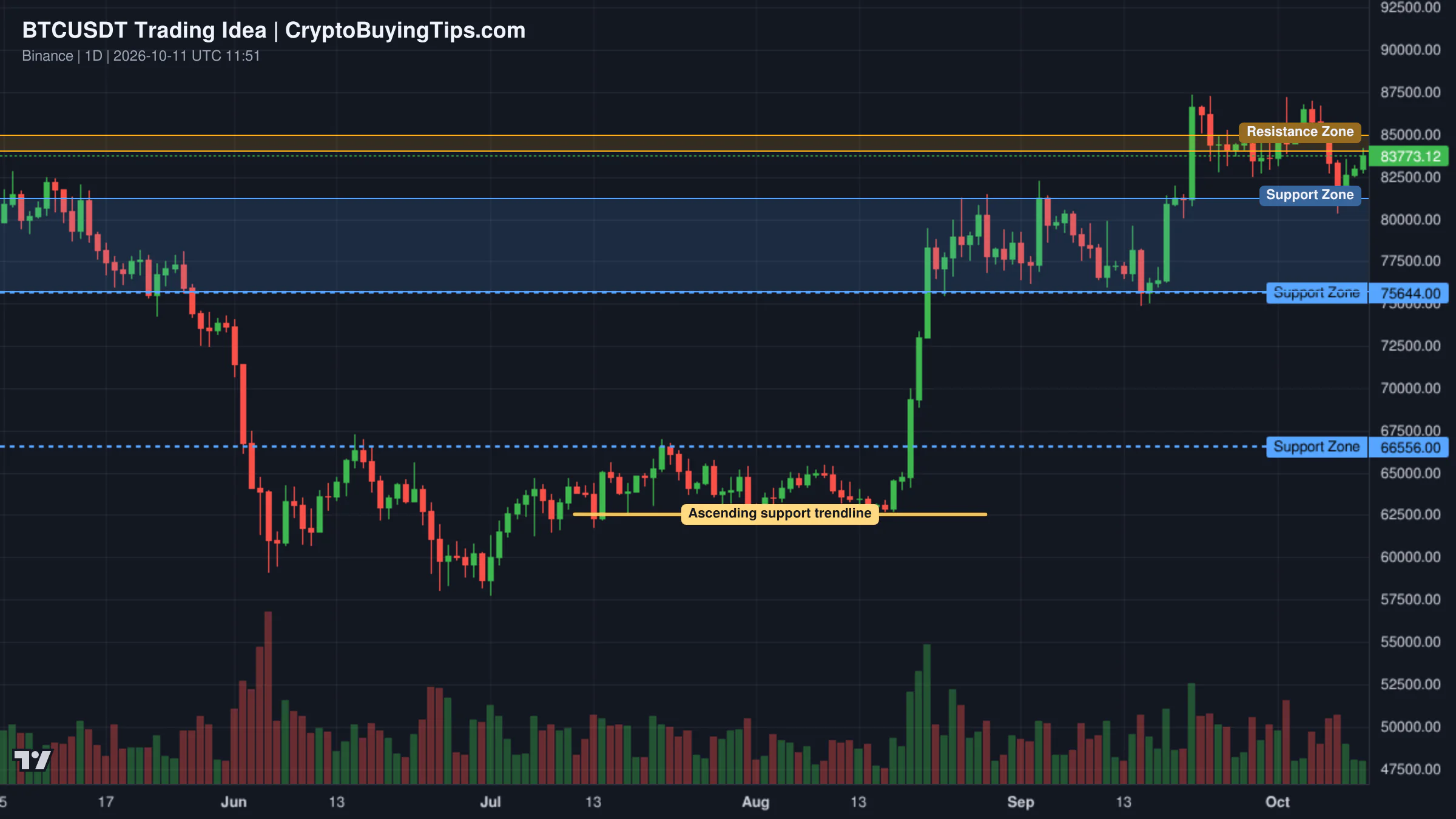
The technical outlook for Bitcoin is currently a mess of conflicting signals, which is typical for a market in a range. One prominent view is that the short-term structure has weakened. BTC has broken below a rising trendline and slipped out of its $84,000 to $87,000 consolidation range. The immediate resistance now sits at $84,000 to $85,000. If the price fails to reclaim this zone, the next major support is $81,270. A daily close below that level could trigger a slide toward $75,644.
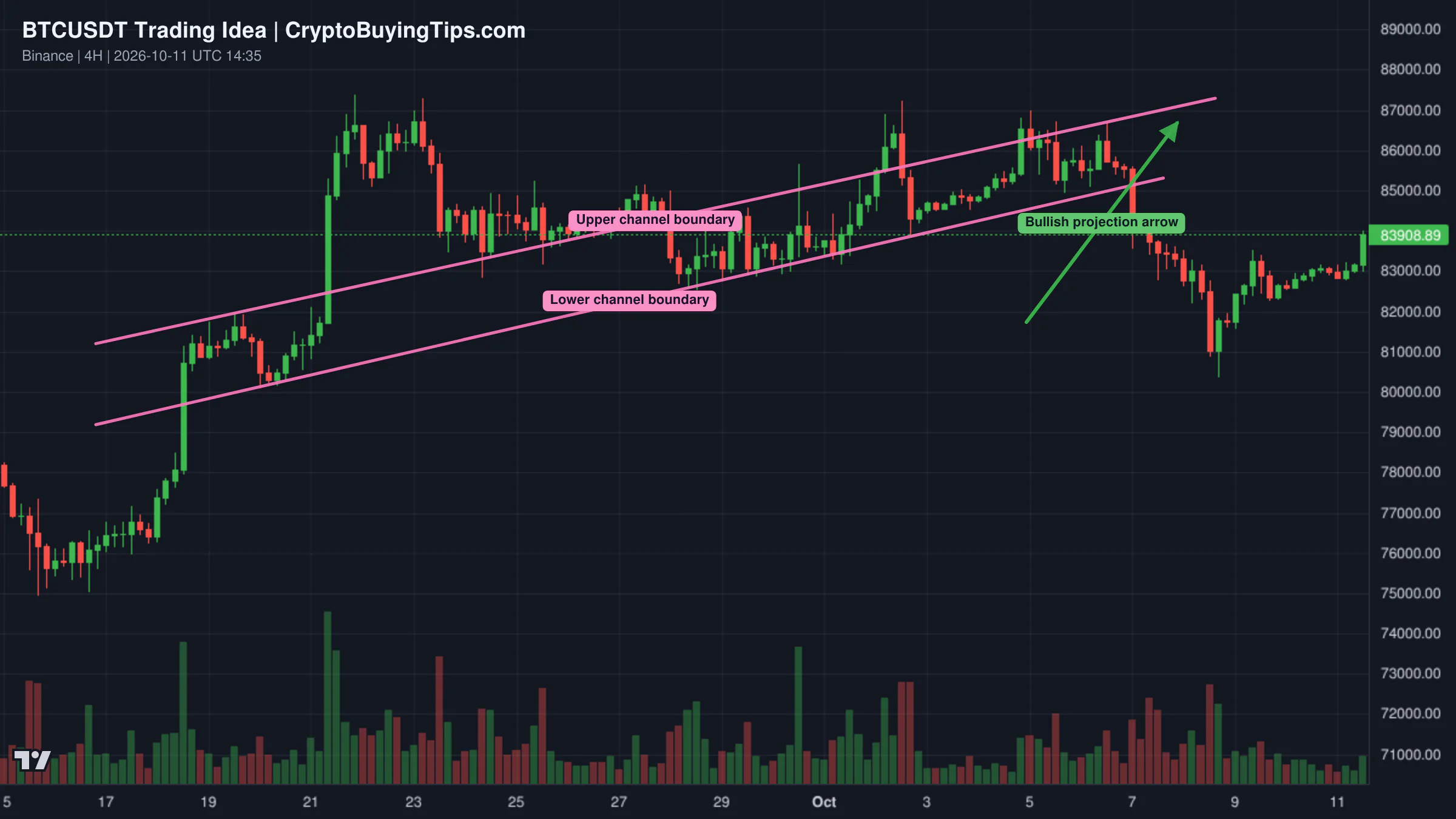
A more optimistic take focuses on the 4-hour chart, where a key demand zone exists between $79,000 and $80,000. This area aligns with the lower boundary of an ascending channel. The setup suggests a potential liquidity sweep into this zone, which would then trigger a bullish reversal toward targets of $90,000 to $93,000. This play requires patience, as it relies on a dip to find support rather than a breakout.
Finally, there is the triangle compression theory. BTC is navigating a symmetrical triangle, oscillating between descending resistance and ascending support. The projected path favors a breakout above the $86,400 ceiling. Support is held at $82,800. This setup is the most neutral of the three, as it simply acknowledges that the market is compressing and a move is imminent.
Altcoin Spotlight
Hyperliquid deserves attention as it maintains its position in the top 10 with a price of $86.74. Its 2.21% gain today is small, but its overall trajectory reflects the market's current obsession with high-performance trading infrastructure. As derivatives volume continues to dwarf spot activity, the platforms that can handle this volume with low latency become the real winners. HYPE is not just a token; it is a bet on the continued "casino-fication" of the crypto markets.
What to watch next
The immediate focus is on the $84,000 level for Bitcoin. Reclaiming this zone would invalidate the current bearish trendline breakdown and likely spark a rally toward $90k. If it fails, we should expect a test of the $80,000 demand zone.
On the macro side, the inflation data this week is the only thing that truly matters. If CPI comes in higher than expected, the current neutral sentiment will likely flip to fear, and the massive open interest in derivatives will lead to a cascade of liquidations. If the data is cool, the institutional rails being built by banks in South Korea and the UK will provide the fundamental justification for a new leg higher. For now, the market is just holding its breath.
Some links in this article may be affiliate links. We may earn a commission at no extra cost to you — this never influences our analysis or coverage.

Sigrid Voss
Crypto analyst and writer covering market trends, trading strategies, and blockchain technology.
More Articles

BTC and ETH ETFs are bleeding while XRP is the only institutional winner
The narrative suggests endless accumulation, yet ETF outflows signal that big players have paused their spending spree.…
Crypto Market Overview | volume collapse amid regulatory focus on event contracts | October 11, 2026
Crypto market overview shows volume collapse amid regulatory focus on event contracts, with spot and derivatives…

StarkNet is ripping but the altcoin season narrative is a lie
StarkNet's recent surge has the usual crowd convinced an altcoin season has arrived; our data suggests this rally is…
Crypto Market Overview | Liquidity vanishes as spot volume drops while derivatives remain bloated | October 10, 2026
Spot volume drops while derivatives remain bloated in today's crypto market overview; see what our data shows about…