
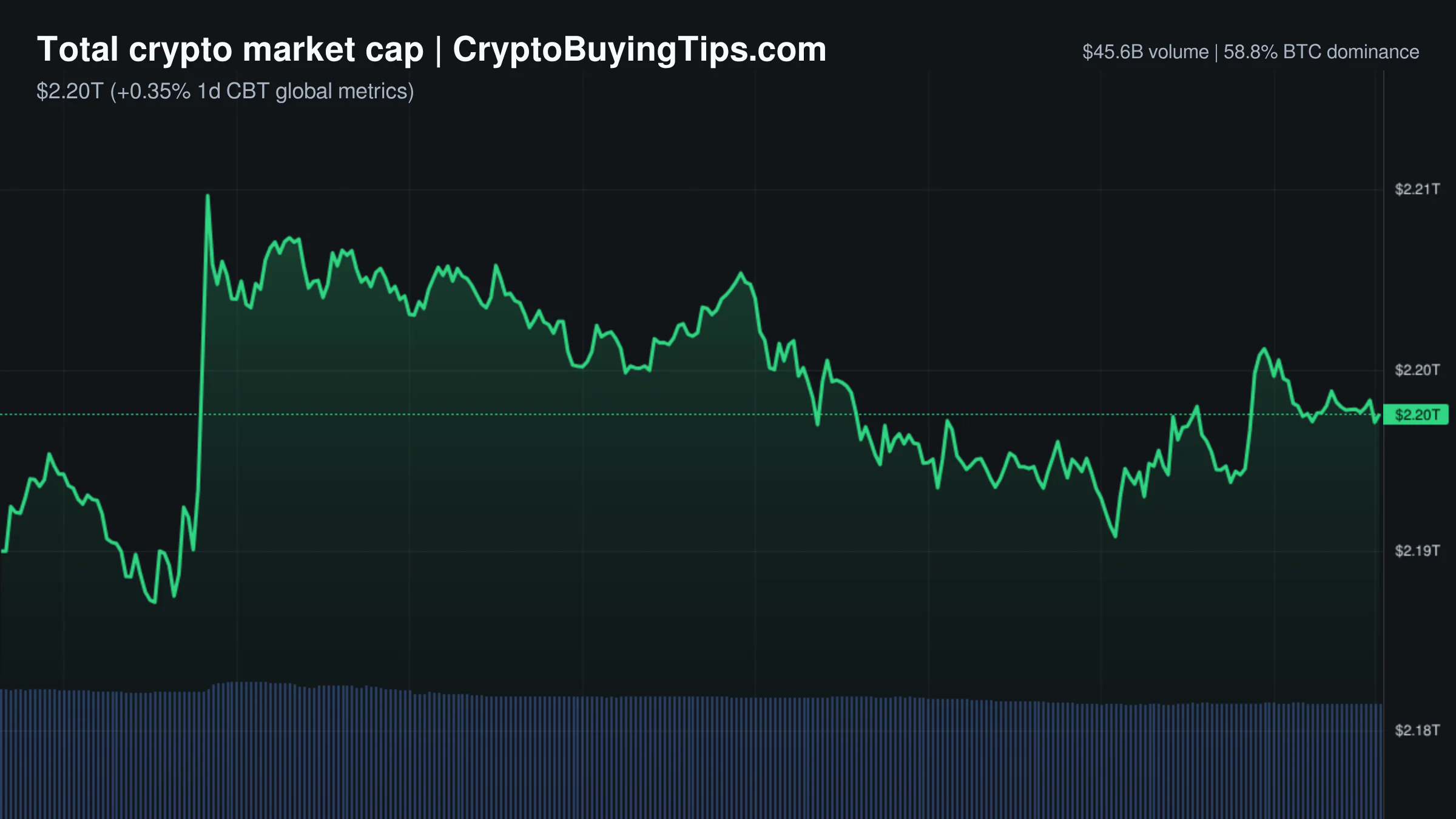
Crypto Market Overview | Leverage dominates despite regulatory news failing to spark spot volume | August 19, 2026
Crypto Market Overview | Leverage dominates despite regulatory news failing to spark spot volume | August 19, 2026
Market overview
The market is currently operating in a state of profound contradiction. Price action is slightly positive, yet the underlying activity suggests a collective reluctance to commit actual capital. Total market capitalization sits around $2.2 trillion, but the trading volume tells the real story. Spot volume has dropped nearly 9% in the last 24 hours to $45.62 billion, while the derivatives market is operating on an entirely different scale. With derivatives volume ranging between $515 billion and $517 billion, the leverage-to-spot ratio is roughly 11 to 1. This is not a market driven by organic accumulation. It is a high-stakes casino where price movements are dictated by leveraged positioning rather than a genuine shift in asset ownership.
Sentiment remains neutral, with the Fear and Greed Index at 41. This apathy is mirrored in the broader macro environment. The S&P 500 fell 0.68% and the NASDAQ dropped 1.69%, creating a risk-off backdrop that usually drags crypto down. Instead, the market is idling. Bitcoin dominance is stagnant at 58.78%, and the Altcoin Season Index remains in the neutral zone between 32 and 46. There is no rotation into alts because there is no conviction. Capital is simply huddling in Bitcoin while waiting for a catalyst that actually moves the needle.
The lack of on-chain conviction is most evident in the Ethereum network. Gas fees have collapsed to between 0.04 and 0.06 Gwei. While low fees are a boon for the retail user, they are a disaster for a network that claims to be the global settlement layer for finance. It suggests a near-total absence of on-chain demand. The market is essentially a ghost town on the spot and on-chain side, while the perpetuals markets are overflowing with bets.
Bitcoin and Ethereum
Bitcoin is currently hovering at $64,370.79, managing a modest 0.36% gain. The price is trapped in a tight range, and the lack of volatility is starting to feel oppressive. The current price action is less about bullish momentum and more about a lack of aggressive selling. With dominance flatlining, Bitcoin is not actively stealing liquidity from altcoins, but it is the only asset that institutional players seem to trust during this period of macro instability.
Ethereum has performed slightly better in percentage terms, rising 1.15% to $1,918.1. However, this move is hollow. As noted, the network activity is non-existent. When gas fees hit these lows, it indicates that the "utility" narrative for Ethereum is currently on hiatus. The price rise appears to be a sympathy move or a result of minor leveraged longing rather than a fundamental shift in network usage. We have previously noted how dominance data agrees that capital is consolidating into Bitcoin, and today's stagnation confirms that Ethereum is not yet the primary beneficiary of any renewed interest.
Top crypto prices
Bitcoin holds the top spot at $64,370.79. Ethereum follows at $1,918.1. BNB is trading at $601.96, while XRP sits exactly at $1. Solana has shown some relative strength, climbing 1.94% to $77.26. TRON remains flat at $0.3324. Hyperliquid is the notable laggard among the top ten, dropping 2.27% to $58.42.
News driving today's market
The dominant narrative is a sudden, almost comical, about-face from the SEC. After cancelling a meeting meant to vote on a new framework, the regulator abruptly proposed "Regulation Crypto Assets." This proposal includes exemptions that would allow crypto projects to raise up to $5 million over four years or $75 million annually without full securities registration. It also introduces a safe harbor that could allow an asset to separate from the investment contract used to sell it.
In a normal market, this would be a massive de-risking event. The fact that the market is only reacting with a yawn is telling. We previously discussed the SEC safe harbor implications, and the current price action confirms that traders are skeptical of regulatory promises that arrive without a legislative mandate like the Clarity Act. The SEC is essentially trying to build a bridge while the official government blueprints are still missing.
Other structural wins are appearing in the accounting world. The Financial Accounting Standards Board (FASB) has proposed that certain stablecoins be treated as cash equivalents. This requires holders to have direct issuer redemption rights and one-to-one liquid reserves. This is a significant step toward institutional legitimacy for USDT and USDC, as it removes a major accounting hurdle for corporate treasuries.
On the institutional front, Metaplanet is doubling down on its Bitcoin treasury strategy by taking a 96% stake in Super League in a deal involving 2,100 BTC. This move highlights a growing trend of companies treating Bitcoin as a primary reserve asset rather than a speculative bet. Meanwhile, FalconX and Interstice are connecting the institutional Canton network to Ethereum and Solana, which should eventually improve liquidity flow between private institutional markets and public chains.
Not everything is positive. The Trump family's crypto firm, World Liberty, is facing scrutiny because its USD1 stablecoin is accepted by WorldClaw, which offers AI models from Chinese companies flagged as security risks by the U.S. government. This adds a layer of geopolitical risk to the stablecoin sector that the FASB news cannot entirely offset.
Social intelligence
On-chain data reveals some significant movements. Multicoin Capital recently deposited 172,710 HYPE (roughly $10.15 million) into Coinbase Prime. Given the price drop in Hyperliquid today, this deposit looks like preparation for a sale.
The Wyoming Stable Token Commission has officially migrated its Frontier Stable Token (FRNT) to Chainlink CCIP, replacing its LayerZero bridge. This move followed a security review and marks a rare instance of a U.S. government entity replacing its blockchain infrastructure specifically on security grounds. It is a quiet but meaningful endorsement of Chainlink's cross-chain capabilities over other bridging solutions.
We also saw some predatory activity in the altcoin markets. A newly created wallet received 9.3 million KTA and 2 billion GALA via cross-chain bridges, only to immediately dump them for ETH. This single move caused KTA to crash 37% and GALA to drop 15%. It is a reminder that in the absence of real liquidity, a single whale can effectively delete the daily gains of a small-cap project.
Finally, Binance founder CZ has been discussing the real-world utility of stablecoins, specifically in the Philippines. He suggests that blockchain could reduce remittance fees from the current 5 to 10% range to nearly zero. While this is a long-term narrative, it aligns with the FASB's move to treat stablecoins as cash, suggesting a convergence between regulatory acceptance and practical utility.
Trading ideas worth watching
The current Bitcoin setup is a battleground of conflicting interpretations. One analyst suggests we are seeing a symmetrical triangle top. The theory is that BTC is testing a potential reversal zone and cumulative short liquidation leverage. If it fails to break the upper trendline, a decline toward $64,000 is expected. A break below $64,000 could trigger a deeper slide toward the $63,380 level. The stop loss for this bearish view is a close above $65,140.
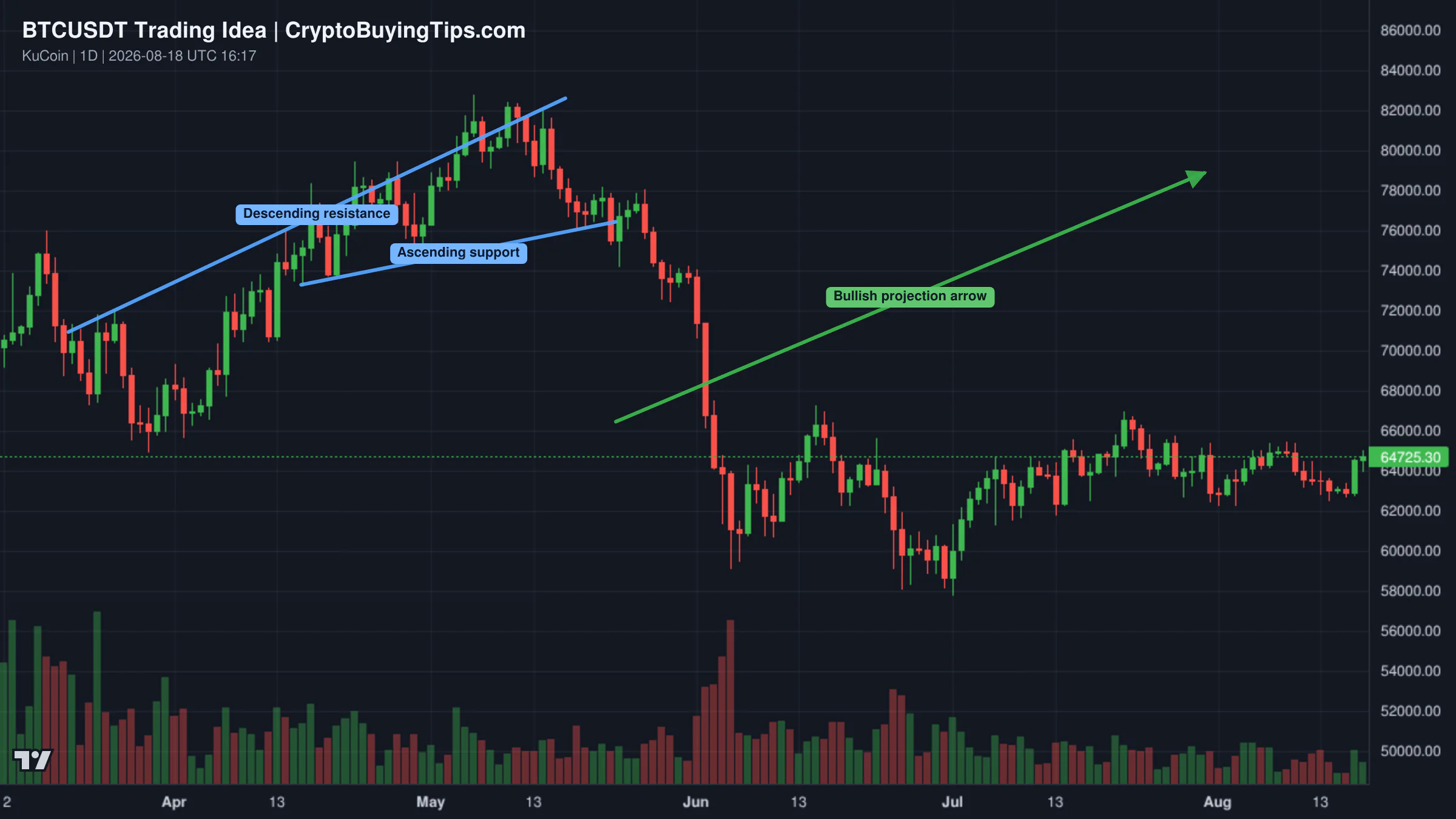
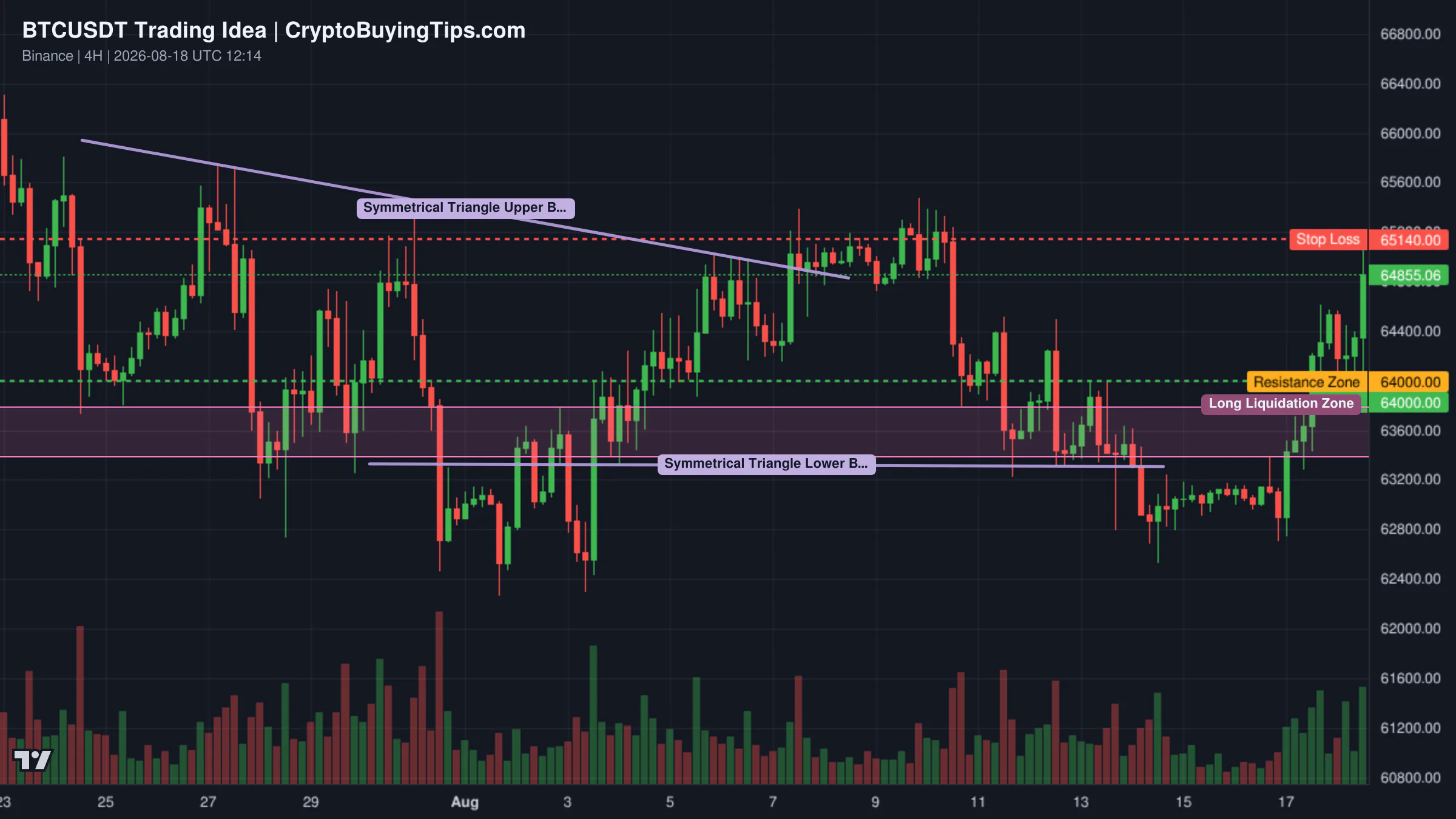
A more optimistic view argues that the current sideways movement is actually a sign of strength. This perspective suggests that when the market consolidates in a tight range, it often leads to a prolonged growth cycle. The argument here is that buyers are becoming anxious and are positioning for a breakout. The key level is the 0.236 Fibonacci extension at $64,000. A daily close above this level would be seen as a bullish confirmation, potentially leading to massive growth within days.
A third, more aggressive setup predicts a "support flush." This analysis points to a rejection off local resistance near $64,260. The projection is a multi-wave markdown: an initial drop to $63,600, a fake-out bounce to $64,000, and a final acceleration down to test the primary support floor at $62,700. This trader is looking to short in the $64,300 to $64,600 zone, with a stop loss at $65,000.
What to watch next
The immediate focus is the $64,000 level for Bitcoin. It is the line in the sand for both the bulls and the bears. If we hold this level despite the NASDAQ's weakness, it suggests a decoupling from traditional risk assets. If we slide through it, the "support flush" to $62,700 becomes the most likely scenario.
We also need to watch the Ethereum gas fees. A network with nearly zero activity cannot sustain a price rally for long. If ETH continues to rise while gas remains at 0.05 Gwei, the move is entirely driven by leverage and is prone to a violent correction.
Finally, the SEC's "Regulation Crypto" is a proposal, not a law. The market is waiting to see if this is a genuine shift in policy or a strategic distraction. Until the Clarity Act or similar legislation passes, any regulatory "safe harbor" is a fragile thing. The gap between the SEC's words and the market's reaction is the most important metric to follow this week.
Some links in this article may be affiliate links. We may earn a commission at no extra cost to you — this never influences our analysis or coverage.

Sigrid Voss
Crypto analyst and writer covering market trends, trading strategies, and blockchain technology.
More Articles
Crypto Market Overview | Leveraged bets drive gains amid diverging us regulatory paths | September 19, 2026
Leveraged bets drive crypto gains amid diverging us regulatory paths; see our market overview on BTC, ETH, and macro…

The market is trading $1 trillion in leverage and it is a problem
The market is trading $1 trillion in leverage and it is a problem. The sheer disparity between spot volume ($112.74B)…
Crypto Market Overview | Leveraged bets dominate as regulatory shifts clash with geopolitical friction | September 18, 2026
The total market cap sits at $2.70T as leveraged bets dominate; see our read on crypto's regulatory clashes and…
Crypto Market Overview | Fed rate hikes meet derivatives volume despite spot outflows and ETF redemptions | September 17, 2026
Fed rate hikes meet derivatives volume despite spot outflows and ETF redemptions Crypto market overview analysis for…