
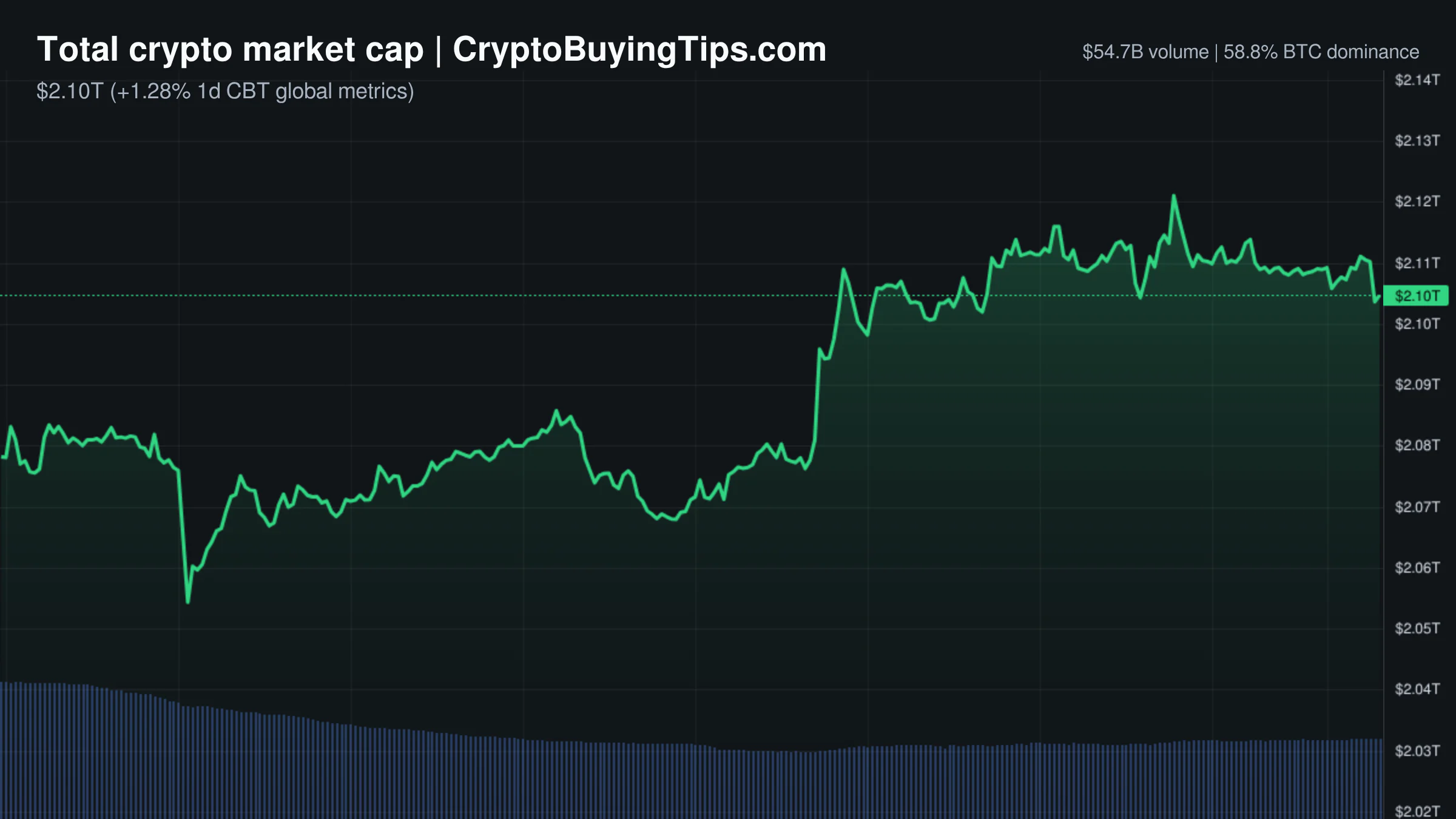
Crypto Market Overview | Low conviction price bounce as volume drops and extreme fear persists | November 27, 2026
Crypto Market Overview | Low conviction price bounce as volume drops and extreme fear persists | November 27, 2026
Market overview
The Fear & Greed Index reads 11 out of 100, extreme fear, on a day when the five largest coins are all higher. Sentiment and price rarely disagree this openly. Either the bounce isn't trusted or the index is slow to catch up, and the volume data leans toward the first explanation.
The two main aggregators don't agree on direction. CoinGecko shows total crypto market cap at $2.10T and down 1.19% over 24 hours. CMC shows the same $2.10T but up 1.21%. The coin-level moves on CMC's front page (every top-seven asset positive) fit the CMC reading better, but the discrepancy is worth keeping in mind before anyone calls the day a clean rally.
What both sources agree on is thin trading. CoinGecko puts 24h volume at $58.4B. CMC has it at $54.62B, down 33.24%, with stablecoin volume down 32.91% to $56.06B. That stablecoin figure is larger than total volume, which is almost certainly a counting difference between categories, but it is an oddity. Derivatives volume on CMC is $560.15B, down 37.65%, roughly 10.3 times spot volume by our calculation ($560.15B / $54.62B), or about 91% of combined spot and derivatives turnover. A GSR primer linked on CMC's derivatives page puts the long-run derivatives share near 79%, so leverage is carrying more of price discovery than usual. Perpetual swap open interest is $268.69B, about 12.8% of total market cap, against $954.94M in dated futures. Positioning is almost entirely perpetuals.
The practical reading is that a rise on falling turnover is a low-conviction move. Leverage volume contracted slightly more than spot did, so this isn't a short squeeze in progress, and it isn't spot accumulation either. Funding rates and liquidation totals did not load in today's data, which removes the two best tools for judging whether the leveraged crowd is leaning one way. We won't guess.
Dominance tells a steadier story. Bitcoin dominance is 58.79% on CoinGecko and 58.77% on CMC, up 0.05%. Ether is at 9.99%, just under the 10% line. Stablecoins (USDT plus USDC) hold 11.55% of the market, a sizeable pile of sidelined capital. Total2 (everything excluding Bitcoin) is $866.3B and Total3 (excluding Bitcoin and Ether) is $656.2B. The Altcoin Season Index reads 58 on one measure and 63 on CMC's 90-day version; both are neutral, neither season. In traditional markets, SPY is $716.7 (-0.29%) and QQQ is $633.93 (-0.65%), figures that likely predate the Thanksgiving holiday closure.
Bitcoin and Ethereum
Bitcoin trades at $61,555.72, up 1.49%, with a market cap of $1.23T. Two TradingView authors place the recent low near $57,300 before buyers pushed price back toward $61,600. The bounce has been sharp, but it arrived with volume down by a third, and the macro backdrop in the same TradingView write-up is not friendly. One author cites $453M of US spot Bitcoin ETF outflows, a seventh consecutive negative session, bringing November's total to a record $5.39B. We can't verify those figures against a fund-flow feed today, so they stay attributed to the author, but the direction of travel is consistent with the stablecoin picture. The same write-up cites Kaiko data showing $12B of net stablecoin redemptions over 30 days, and CryptoQuant reporting a $9B contraction in USDT market cap over 60 days, its largest since 2022. It also notes that redemptions have slowed, with supply down just 0.4% since November 13.
Implied volatility is moderate for Bitcoin. Volmex has it at 53.38, which is not the number you'd expect to see next to a sentiment reading of 11. Ether is higher at 67.74, about 14 points above Bitcoin. Ethereum is at $1,721.37, up 1.33%, with a market cap of $210.10B. It is lagging Bitcoin slightly on the day, and its dominance sits at 9.99%.
The network itself is quiet. Gas costs 0.07 Gwei on slow and standard, 0.08 on fast, with confirmations around 45 seconds. Fees that low mean almost nobody is competing for block space, and Ethereum is currently the sort of place you could hold a quiet meeting. Low fees are good for users and poor evidence of demand. Add the smaller-than-Bitcoin bounce and the heavier implied volatility, and Ether looks like the more fragile of the two if risk appetite wobbles.
Bitcoin's block production added a small oddity. A Cointelegraph post, citing Galaxy's Alex Thorn, notes a gap of over 98 minutes between blocks 977,697 and 977,698, the longest since July. That is mining variance, not a market signal.
Top crypto prices
The CMC front page snapshot, stamped 12:00 UTC on November 27, shows broad but uneven gains. Bitcoin is at $61,555.72 (+1.49%), Ethereum at $1,721.37 (+1.33%) and BNB at $562.56 (+2.02%). XRP is at $0.9748 (+2.45%), with a market cap of $61.91B. Solana is at $72.96 (+3.09%), market cap $43.21B. TRON is at $0.3038 (+0.22%), the laggard of the group, with a market cap of $28.88B.
Hyperliquid is the standout at $65.75, up 8.36%, with a market cap of $16.56B. The pattern is mild but readable: BNB, XRP and Solana beat Bitcoin, Ether slightly trailed it, and TRON barely moved. The CMC20 index is up roughly 1.55% against about 1.45% for the CMC100, so large caps lead the wider basket by a small margin. That is a tidy rotation story, and a thin one, since it comes without volume to back it.
News driving today's market
The heaviest theme is regulatory tightening, mostly outside the US. KuCoin said it will delist Monero on November 30, the second major platform to drop the privacy coin this month after MEXC suspended spot trading and removed perpetual futures. According to Cointelegraph, XMR fell 10.5% to $449.98 by 7:00 p.m. UTC Thursday, extending a slide from about $625 on November 3. The driver is the EU's Anti-Money Laundering Regulation, which from July 10, 2027 bars regulated firms from handling anonymity-enhancing coins. That matters for market structure because delistings remove venues, and fewer venues mean thinner books on the next bad day. It also lifts the cost of holding privacy coins on exchanges, though self-custody stays legal. We previously covered the wider EU tightening in our piece on mica crypto regulation.
The EU theme continues at the central bank. The FT-reported choice of BIS chief Pablo Hernández de Cos as the next ECB president is bearish in the desk's scored context, because he has favored tokenized bank deposits over stablecoins and warned against banks holding bitcoin. Spain, separately, is moving to let its financial intelligence unit freeze crypto accounts, with fines for noncompliant firms. None of these items moves price by itself. Together they point toward a European regulatory setup friendlier to bank-issued money than to private tokens, which is a slow headwind for stablecoin growth in the region.
Japan's Financial Services Agency published a discussion paper weighing tighter oversight of DeFi and self-custodial wallets, including whether front-end providers for decentralized exchanges should be regulated. It's a discussion paper, not a rule, but the question of who is responsible for a protocol that claims to have no operator remains unanswered everywhere. China, Japan, South Korea and ASEAN also plan a working group on digital payments and crypto regulation, which scores neutral for now.
Not everything is restrictive. Banco B3, tied to Brazil's stock exchange, will issue a real-pegged stablecoin backed one to one by reais, with other institutions able to join at launch. Injective has asked the SEC to open stock trading to order-book systems, arguing current rules favor one type of blockchain trading design. Regulators listening to the case is one thing; volume turning up is another, and we've previously shown how little the latter follows the former in our look at SEC safe harbor volume data.
The macro item with the most near-term bite is a Cointelegraph report on economist Robin Brooks warning of a December "meltdown" if the Federal Reserve fails to deliver dovish cues before the FOMC blackout period. Crypto has been trading as a liquidity asset, and a hawkish surprise would hit a market already short of turnover.
Social intelligence
The curated feed is dominated by political commentary, which is a fair reflection of what is moving risk assets this week. Posts from @DeItaone relay US President Donald Trump saying he was briefly concerned by Wednesday's steep equity selloff. The Nasdaq fell more than 4% intraday before recovering to close only slightly lower, and Trump also said the market reacted well to Jensen Huang's reinstatement as Nvidia CEO. For crypto, the useful detail is the size of Wednesday's intraday swing. A 4% Nasdaq plunge that fully reverses is the sort of volatility that tends to leave leveraged traders cautious, which fits the light volume.
Other posts from the same account carry Trump's remarks on G20 attendance, including uncertainty over whether Putin will come. Geopolitical headlines like these have little direct pricing power but can change risk appetite quickly when markets are thin. The Cointelegraph post on Bitcoin's 98-minute block gap, mentioned above, is on-chain trivia with no obvious trading consequence. Block times are random, and a long gap now and then is expected.
Trading ideas worth watching
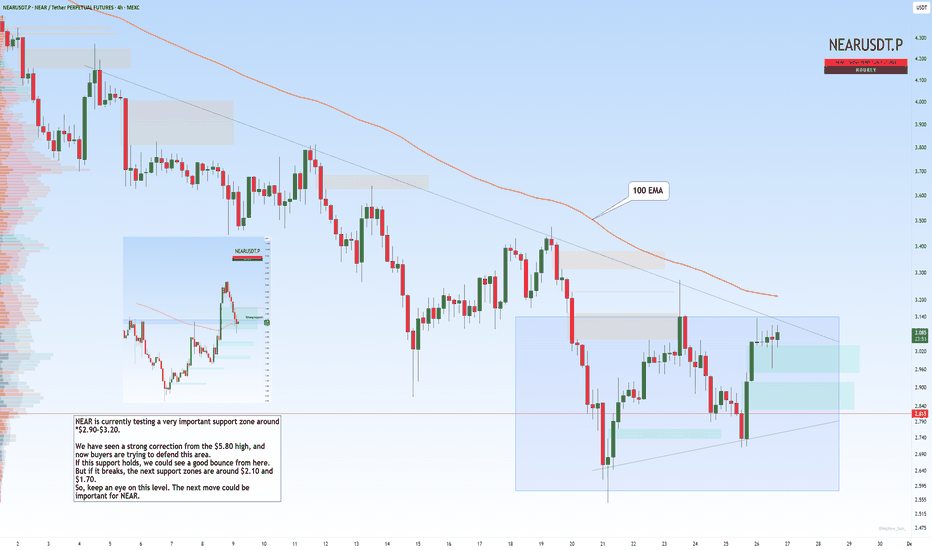
The first idea is a NEAR setup on the four-hour chart from TradingView author CRYPTOMOJOTA. [NEAR](https://go.cryptobuyingtips.com/NEAR?utmsource=dailyOverview) has bounced off support at $2.65 to $2.70 and is heading toward $3.10 to retest a descending trendline. Price is still below the 100 EMA (a moving average of the last 100 candles) and the downtrend is intact. The author watches $3.10 to $3.15 and sees a clean break opening $3.30 to $3.40, while rejection could send price back to $3.00 and possibly $2.85. The author is explicitly waiting for a confirmed breakout before turning bullish, which is the right instinct. Our data doesn't include a current NEAR price, so we can't say where it sits against these levels. The relevance to today's tape is the volume question: a breakout through resistance on contracting market-wide turnover is the kind that tends to fail.
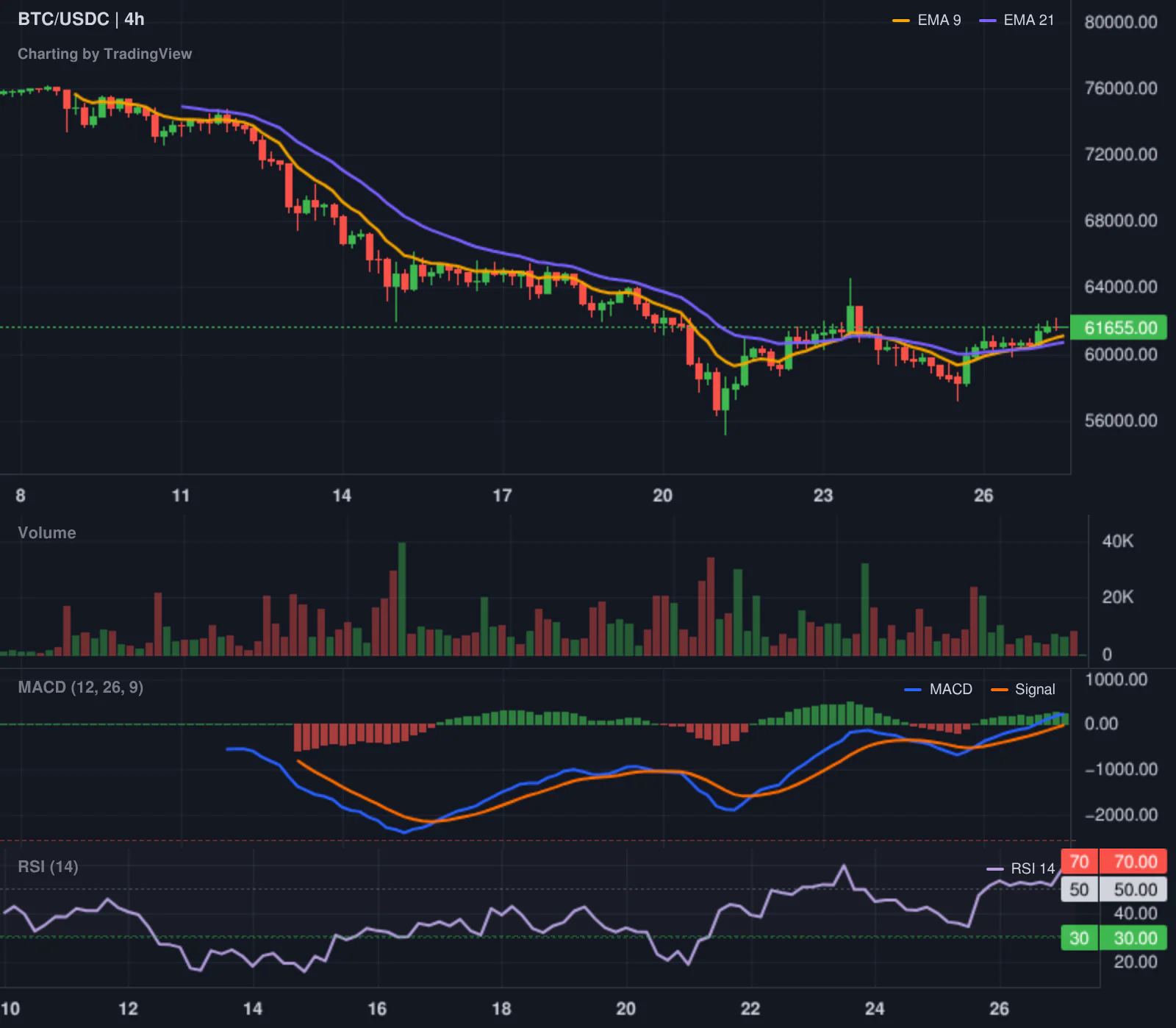
The second idea, a one-hour Bitcoin chart from pejman_zwin, asks whether a $7B options expiry could feed a short squeeze toward $63K. The author argues that with US equities closed for Thanksgiving, Bitcoin could build its own short-term momentum after recovering from $57,300 toward $61,000, and cites slowing stablecoin redemptions and rising new USDT addresses as reasons for cautious optimism. The counter-evidence is in the same write-up. Galaxy Research reportedly sees only 2 of its 13 historical bottom signals met, whale and shark holdings are down about 150K BTC, and reported downside volatility is 46% against 19% on the upside. The excerpt we have doesn't state an invalidation level, so treat $63K as an upside objective rather than a complete trade plan. A squeeze needs crowded shorts, and funding data is unavailable today to confirm that.
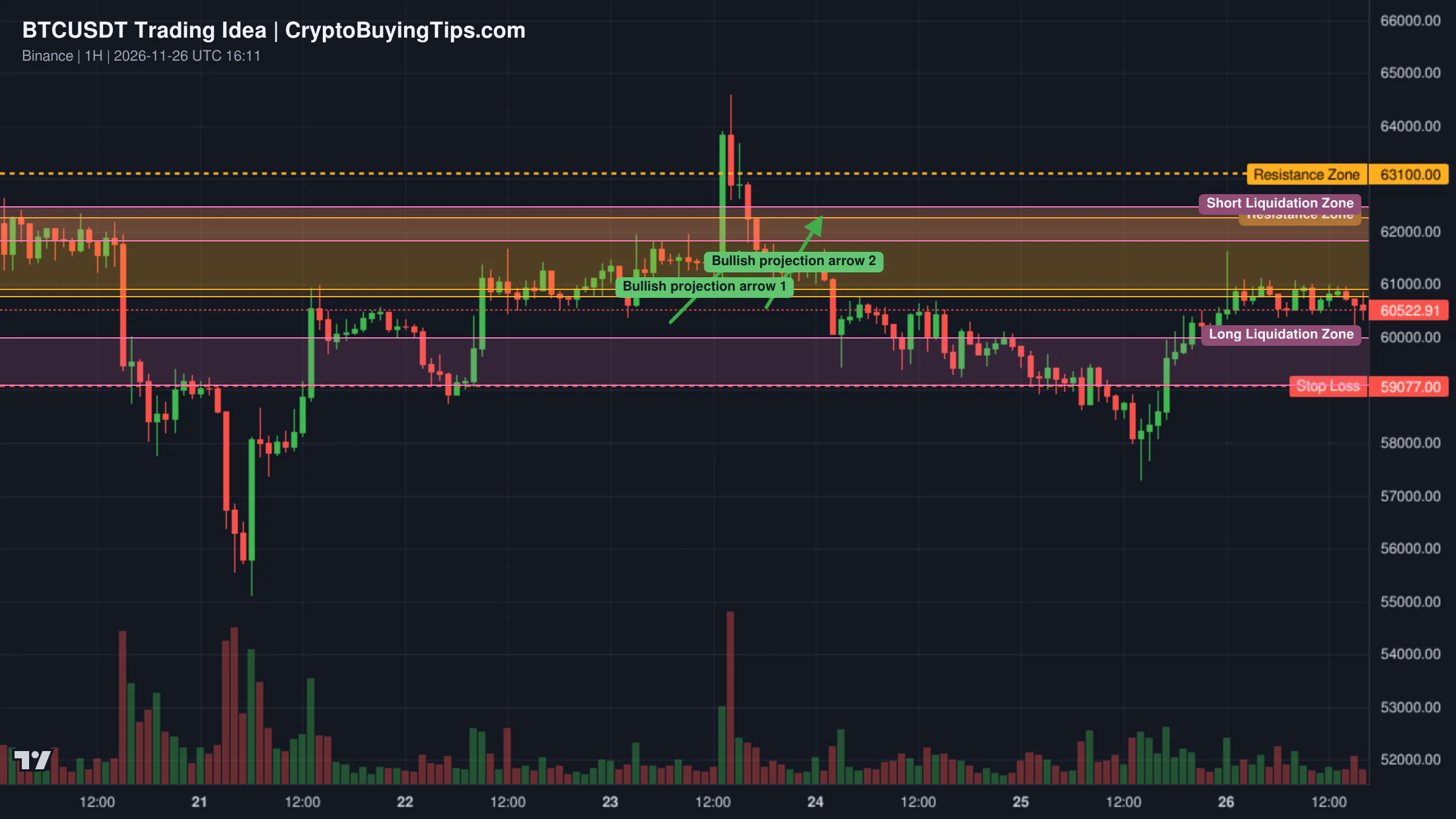
The third idea is a one-hour BTCUSDT chart from ArmanShabanTrading, which is bearish despite the bullish label in the feed. The author's earlier downside targets of $57,700 and $57,300 were hit, partially filling a fair value gap (a price imbalance on the chart that traders expect to be revisited). Buyers then lifted price toward $61,600. The $60,750 to $62,600 supply zone is the key area, and Bitcoin at $61,555.72 is inside it. If sellers defend it, the author watches $60,000, $59,300, $58,000 and $57,000. A break and hold above $62,600 weakens the bearish case and opens $64,600 and $65,200. The two Bitcoin ideas disagree on direction and agree on the level, which is as honest a map of the day as any.
Smart Money Signals — Hyperliquid Leaderboard
Our Hyperliquid leaderboard tracker flagged a short on Bitcoin from wallet 0xf382f4..., opened at $60,638 on November 26 at 03:43 UTC with a notional of $250.0K. The signal confidence is 75, and the wallet has an all-time PnL of $1.74M. The signal text describes the wallet's ROI as 113% over 30 days, while the data field lists 112.7% as all-time, so the exact window is unclear.
Against today's $61,555.72, the position is about 1.5% underwater by our calculation ($917.72 / $60,638), assuming it is still open, which the signal does not confirm. At $250K it's a modest size for a wallet with that record, and it could be a directional bet or a hedge. One wallet is an anecdote, not consensus. It does line up with the bearish supply-zone idea above, which is mildly interesting and not much more.
Altcoin Spotlight
Hyperliquid's HYPE is up 8.36% to $65.75, the largest move in the top ten, with a market cap of $16.56B. The data doesn't explain why. CMC's navigation shows it now tracks Hyperliquid ETFs, but nothing in the provided context ties today's move to a specific catalyst. The irony is hard to miss: the token of a derivatives venue is rallying on a day when derivatives volume across the market fell 37.65%. Whether that reflects market share gains for the platform or just a strong day for a mid-cap with a loyal following, the data doesn't say. Relative strength on a weak-volume day deserves a watch, not a conclusion.
What to watch next
The first thing to watch is volume. A bounce that holds on falling turnover is a weak signal, and if spot volume doesn't recover while perpetual open interest stays near $268.69B, price discovery stays in the hands of leverage. The second is Bitcoin's reaction to the $60,750 to $62,600 zone. A hold below $62,600 keeps the bearish map alive with $60,000 as the first test, and a clean break above would shift attention to $64,600.
Flows come next. If the ETF outflow streak cited by the TradingView author continues, the bounce will have to fight institutional selling, and the next stablecoin supply readings should show whether redemptions are truly slowing. Stablecoin dominance at 11.55% is a useful gauge of how much capital is waiting. The Fed matters too, since Robin Brooks' warning about the pre-FOMC blackout puts the December meeting at the center of risk sentiment. On the regulatory side, KuCoin's Monero delisting takes effect November 30, with withdrawals closing December 31, and the next Asian and European regulatory moves are likely to keep pressure on stablecoin and DeFi headlines.
Ahead of all that, there is the simple question of whether an index reading of 11 and a green board can coexist for long. One of them tends to give way.
Some links in this article may be affiliate links. We may earn a commission at no extra cost to you — this never influences our analysis or coverage.

Sigrid Voss
Crypto analyst and writer covering market trends, trading strategies, and blockchain technology.
More Articles

Ethereum's implied volatility is 67 and Bitcoin's is 55. Here's how to read that
The market is currently pricing more drama into Ethereum than Bitcoin. With Ethereum's implied volatility at 67 and…
Crypto Market Overview | Leverage drives a 3% bounce as ETF outflows and extreme fear persist | November 26, 2026
Crypto market overview: Bitcoin and Ethereum bounce as leverage drives a 3% rise, even as extreme fear persists and US…

Bitcoin ETFs bled $4.94B in November, so Fidelity filed for a Chainlink one
Bitcoin ETFs lost nearly 5 billion dollars in November, so Fidelity decided the best response was to add Chainlink to…
Crypto Market Overview | Extreme fear and falling volume as Bitcoin slips below $60,000 amid heavy ETF outflows | November 25, 2026
Bitcoin slips below $60,000 as extreme fear and falling volume hit the crypto market. Heavy ETF outflows and a broad…