

Ethereum gas fees are at a standstill. Here is why that is actually a warning
The reading that ETH gas fees are at 0.12 Gwei might suggest everything is quiet, but our read suggests it's actually a warning sign. For a beginner, seeing a transaction cost a few cents feels like a victory. After the 2021 era, where a single NFT mint could cost as much as a decent dinner, this looks like a gift. But in on-chain analysis, a bargain usually suggests a lack of buyers. If you are wondering why are ethereum gas fees so low, the answer is rarely about efficiency. It is usually about demand.
The difference between low fees and lack of demand
Gas is the cost of computational effort on the network. It is essentially a bid for space in the next block. When thousands of people fight to swap a token or mint a project, the price goes up. When the network is empty, the price drops. Our market data tools show ETH Gas at 0.12 Gwei, providing a live case study on the difference between network efficiency and network demand.
Low gas prices are not proof that smart contract activity has dried up entirely, but they do signal that the "World Computer" is currently idling. There is very little competition for block space. This is the digital equivalent of a ghost town; it is great for the few people living there, but worrying for the mayor. If Ethereum is intended to be the global settlement layer for the internet, having no one fight for a spot in the block is a problem.
We've seen this pattern before. We previously covered Ethereum gas fees and usage and noted that near-zero costs often mask a lack of retail interest. When fees stay this low for too long, it suggests that the average user has either stopped interacting with the main chain or has moved entirely to other rails.
When low fees mask structural pressure
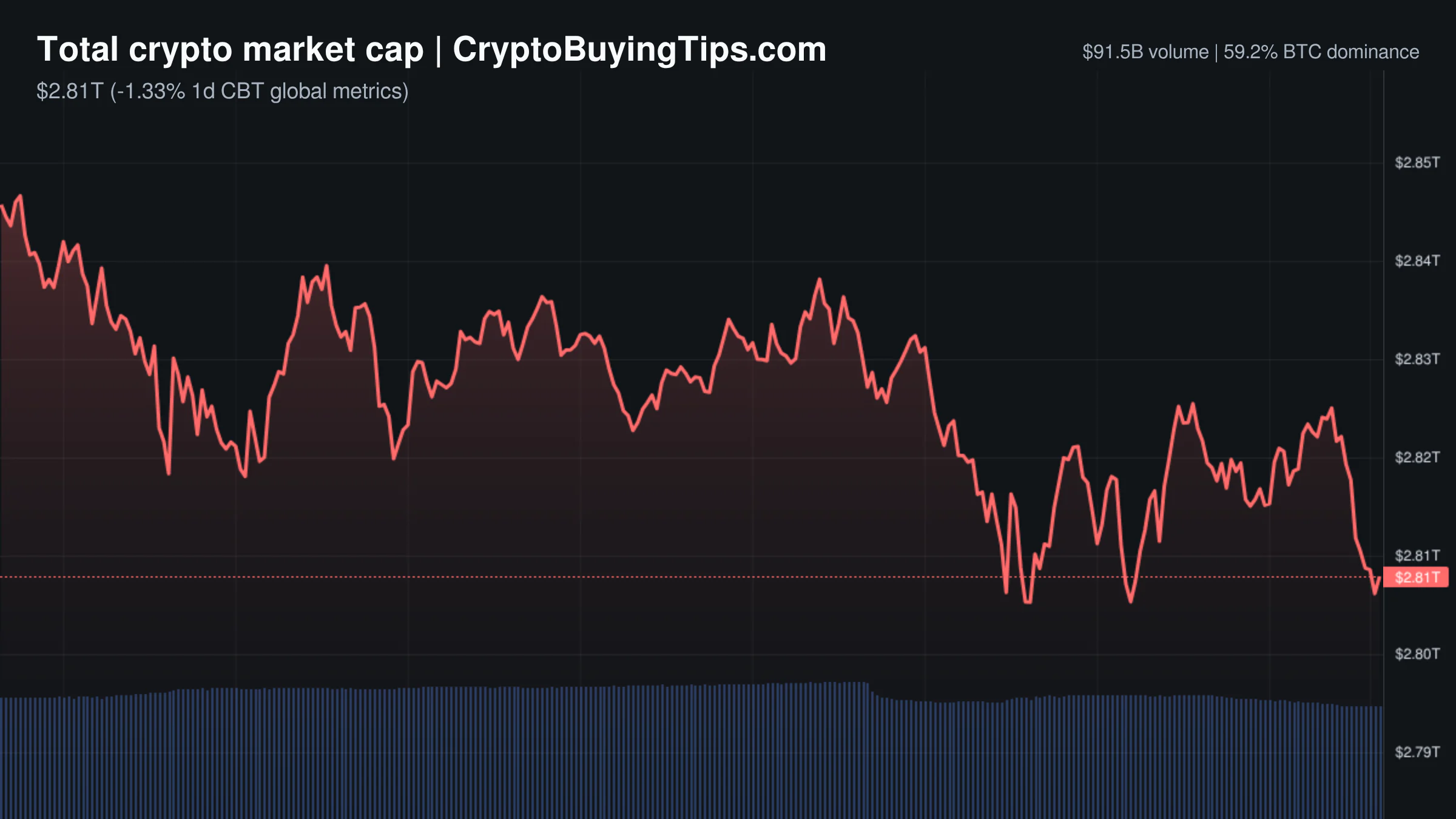
To understand the risk, we have to look beyond simple gas metrics. We must observe total market cap changes versus derivatives volume to gauge true capital flow. Currently, the total market cap sits at $2.79T. On the surface, the asset value remains high, but the on-chain activity does not reflect that value.
This creates a divergence. We see a massive amount of capital held in the asset, but very little of that capital is actually being used to power the network's native utility. This is where the "Ghost Chain" paradox comes in. The network is technically functional and cheaper than ever, yet it feels empty.
Some argue that this is just the result of Ethereum layer two scaling solutions taking the load off the main chain. While L2s do move activity away from Layer 1, a complete standstill on the main chain suggests a broader collapse in retail demand. If the L1 is just a dormant vault for whales while retail plays on L2s, the economic security and utility of the main chain change.
How does why are ethereum gas fees so low relate to broader crypto cycles?
The low fee environment is a lagging indicator of where the "action" is. When we pair these fees with a derivatives volume of $1.00T, the picture becomes clear. Much of the current market activity is happening off-chain or via leveraged speculation. People are betting on the price of ETH without actually using the Ethereum network.
Our news scoring system rated this story 8/10 for liquidity impact because it highlights a dangerous disconnect. We have a situation where the financial instrument (the token) is being traded heavily, but the underlying product (the network) is being ignored. This is common in the middle of cycles where speculation outpaces actual utility.
When retail traders return in force, they don't just trade perpetuals on an exchange. They swap tokens, they bridge assets, and they interact with smart contracts. That behavior creates congestion. That congestion drives up gas. Therefore, 0.12 Gwei is not a sign of a "perfected" network. It is a sign that the retail engine is off.
What we're watching next
We are looking for a divergence between price and gas. If ETH price rips higher while gas remains at these basement levels, it confirms that the move is driven by institutional hedging or exchange-based speculation rather than organic growth.
The trigger we want to see is a sustained move back above 10 or 20 Gwei. That would signal that users are actually returning to the main chain to do work. Until then, we view these low fees as a symptom of a network that is idling while the speculators play in the sidelines.
Related Tickers
Some links in this article may be affiliate links. We may earn a commission at no extra cost to you — this never influences our analysis or coverage.

Sigrid Voss
Crypto analyst and writer covering market trends, trading strategies, and blockchain technology.
More Articles
Crypto Market Overview | leveraged bets dwarf spot volume amid institutional outflows and regulatory pressure | October 8, 2026
Leveraged bets dwarf spot volume amid institutional outflows and regulatory pressure, detailing market dips in BTC and…

Moody's and central banks are legitimizing stablecoins while retail panics
The plumbing gets an upgrade, apparently without asking permission first. Stablecoin volume rises while overall market…
Crypto Market Overview | volume spikes amid institutional inflows despite quantum fears | October 7, 2026
Crypto market overview shows volume spikes amid institutional inflows despite quantum fears; see how ETF flows contrast…

What is stablecoin dominance and why it is the most ignored lead indicator in crypto
The market seems greedy on paper, but our data suggests otherwise; stablecoin dominance acts as the true measure of…