
Crypto Market Overview | leveraged bets dwarf spot volume amid institutional outflows and regulatory pressure | October 8, 2026
Crypto Market Overview | leveraged bets dwarf spot volume amid institutional outflows and regulatory pressure | October 8, 2026
Market overview
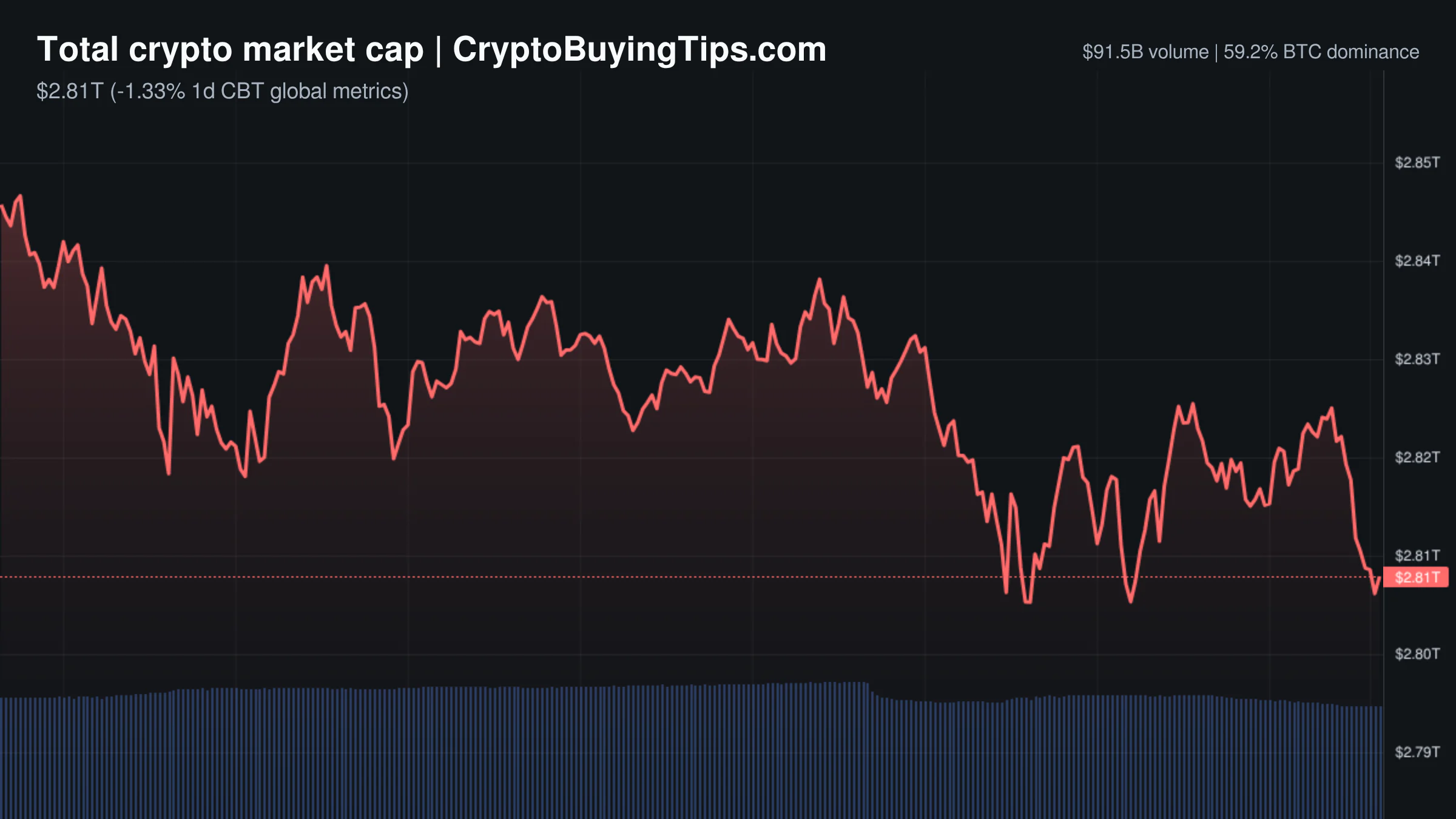
The crypto market is currently a casino where the house is the only one not sweating. The total market cap has dipped to $2.80T, down 4.08% over the last 24 hours, but the real story is the staggering disconnect between spot and derivatives activity. Spot volume has withered to $91.45B, while derivatives volume is surging at $761.60B. This means leveraged bets are now 8.3 times larger than actual asset purchases. When the tail wags the dog this aggressively, price action becomes a function of liquidation cascades rather than fundamental value.
Sentiment is holding a precarious neutral at 58 on the Fear and Greed Index. This neutrality is less a sign of stability and more a sign of indecision. Bitcoin dominance remains flat at 59.29%, which suggests that while the market is sliding, Bitcoin is simply the least offensive option available. We have seen this pattern before; when risk aversion takes hold, capital consolidates into the largest asset while altcoins are left to drift. Our previous analysis on how the dominance data agrees with institutional rotation into BTC remains relevant here.
The macro backdrop is equally uninspiring. The S&P 500 and NASDAQ are both trading in the red, reflecting a general risk-off mood in traditional finance. With stablecoin dominance sitting at 9.19%, there is a decent amount of capital on the sidelines, but it is not rushing back in. The market is effectively waiting for a catalyst that doesn't involve another regulatory warning or a government wallet moving millions of tokens for no stated reason.
Bitcoin and Ethereum
Bitcoin is trading at $82,658.89, down 1.26% in 24 hours. The price action is being weighed down by institutional exits. Data from SoSoValue shows that US spot Bitcoin ETFs saw $487 million in net outflows on October 7, with BlackRock’s IBIT leading the exodus with $208 million. This is a sharp contrast to the narrative of permanent institutional adoption. It appears the "big money" is taking profits or hedging against macro uncertainty.
Ethereum is in a worse position, priced at $2,547.65 and down 1.24%. Spot Ethereum ETFs are also bleeding, with $161 million in net outflows, largely driven by BlackRock’s ETHA. Beyond the price drop, the network itself feels like a ghost town. Gas fees are sitting between 0.18 and 0.21 Gwei. While low fees are great for the user, they indicate a total collapse in on-chain transactional demand. People aren't building or trading on the mainnet; they are just holding or selling.
The relationship between the two is currently one of shared misery, though Bitcoin's dominance prevents it from falling as far as the rest of the market. The lack of a strong bid in ETH suggests that the rotation out of altcoins is not just a temporary dip but a structural shift in how portfolios are being managed in this phase of the cycle.
Top crypto prices
Bitcoin (BTC) is at $82,658.89, down 1.26%. Ethereum (ETH) is at $2,547.65, down 1.24%. BNB (BNB) is holding up relatively well at $765.35, down only 0.24%. XRP (XRP) has taken a harder hit, falling 3.36% to $1.4. Solana (SOL) is down 2.83% at $114.33. TRON (TRX) is the outlier among the top assets, gaining 0.83% to reach $0.3360. Hyperliquid (HYPE) has dropped 3.44% to $86.47.
News driving today's market
Regulatory pressure is returning to the foreground. The European Securities and Markets Authority (ESMA) has given crypto firms a three-month deadline to exit non-compliant stablecoins. This is a direct hit to liquidity. If firms are forced to dump non-MiCA compliant assets by January 2027, we can expect significant volatility in the stablecoin pairs that dominate the market. This creates a fragmented liquidity environment where some assets are "safe" and others are radioactive. We previously covered SEC safe harbor implications for more background.
In contrast, there are signs of genuine institutional utility. Samsung is integrating USDC to overhaul cross-border remittances for 82 million Galaxy users. This is one of the few pieces of news that actually matters for long-term adoption because it puts a stablecoin into the hands of millions of non-crypto users. Similarly, Tether is exploring a tenge-pegged stablecoin with the National Bank of Kazakhstan. When central banks start signing memorandums with Tether, the "regulatory crackdown" narrative starts to look a bit inconsistent.
The infrastructure is also maturing. Coinbase has integrated Deribit, giving US institutional clients a regulated path to global derivatives. This should improve liquidity depth for BTC and ETH. However, this institutionalization is a double-edged sword. While it adds liquidity, it also brings the volatility of traditional finance. This is evident in the news that Greece is preparing to levy a 10% capital gains tax on cryptocurrency. Taxation is the ultimate momentum killer for retail traders.
Security concerns are also surfacing. Europol has warned that quantum computers threaten exposed private keys. While this sounds like science fiction, the warning is an urge for developers to begin post-quantum migrations now. It is a slow-burn risk, but it adds to the general sense of unease in the market.
Social intelligence
The social mood is a mix of panic and technical warnings. On X, @WuBlockchain highlighted the massive ETF outflows, which is the primary driver of the current bearish sentiment. When BlackRock is the one leading the withdrawals, retail traders tend to follow suit.
There is also a growing conversation about the intersection of AI and security. Ethereum researcher Justin Drake has warned that AI and mathematical advances could break ECDSA wallet security within months, potentially before quantum computers even become a threat. He suggested moving assets to fresh addresses with unexposed public keys. This creates a new kind of anxiety; it is no longer just about price, but about whether the keys themselves are safe.
On the protocol side, Ripple is reportedly becoming a player in financing leveraged ETFs. This is an interesting pivot for XRP, as it moves the asset further into the realm of complex financial engineering and away from its original "payment rail" identity.
Trading ideas worth watching
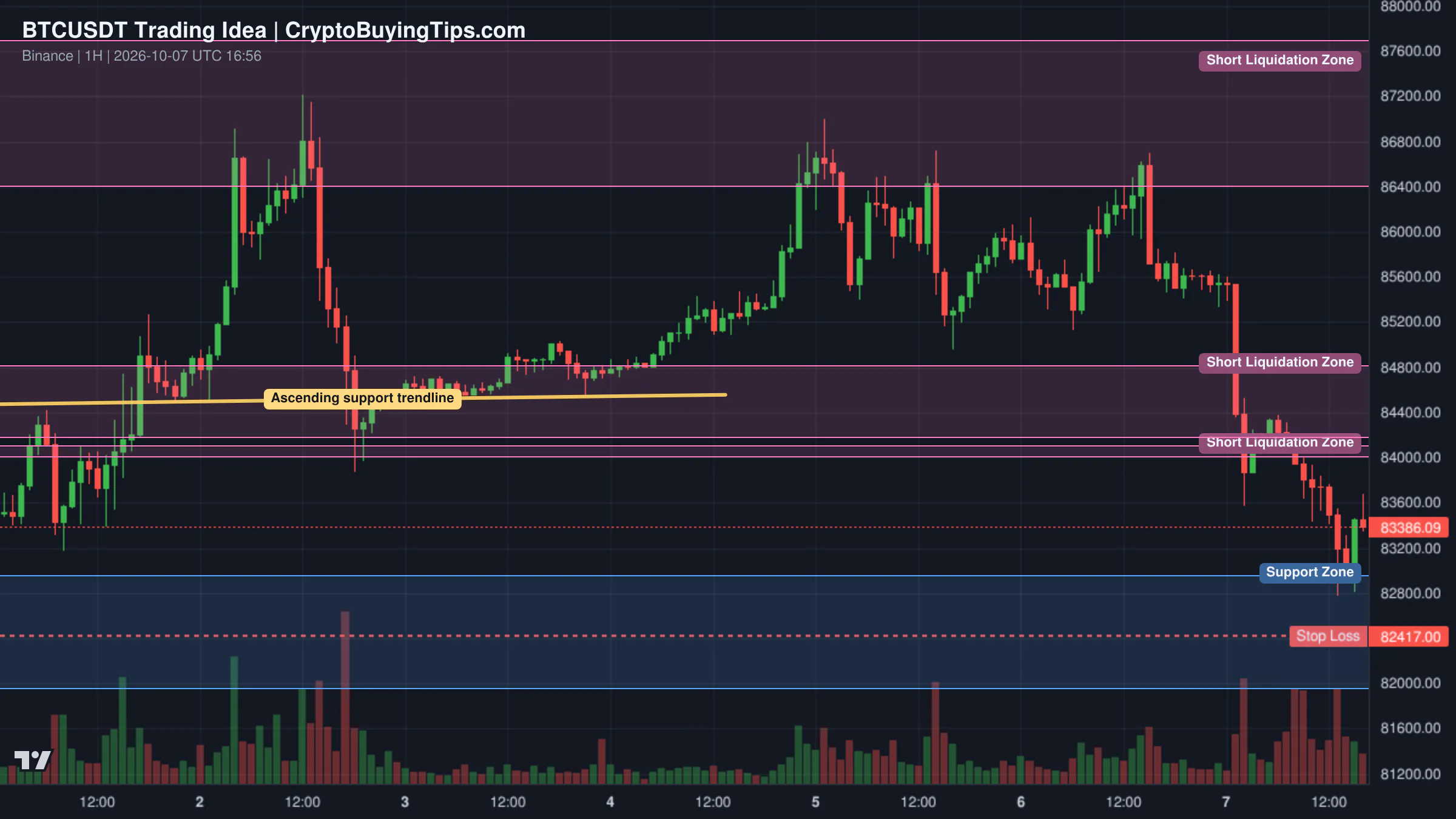
Bitcoin is currently testing a support zone between $81,950 and $82,960. Technical analysis from pejman_zwin suggests that the recent bearish move may have completed a five-wave structure. If the bulls can reclaim $84,000, there is a path toward $84,500. The key level to watch is $84,000; a break above this would signal a short-term recovery. However, a drop below $82,417 would invalidate the bullish setup and likely trigger more liquidations.
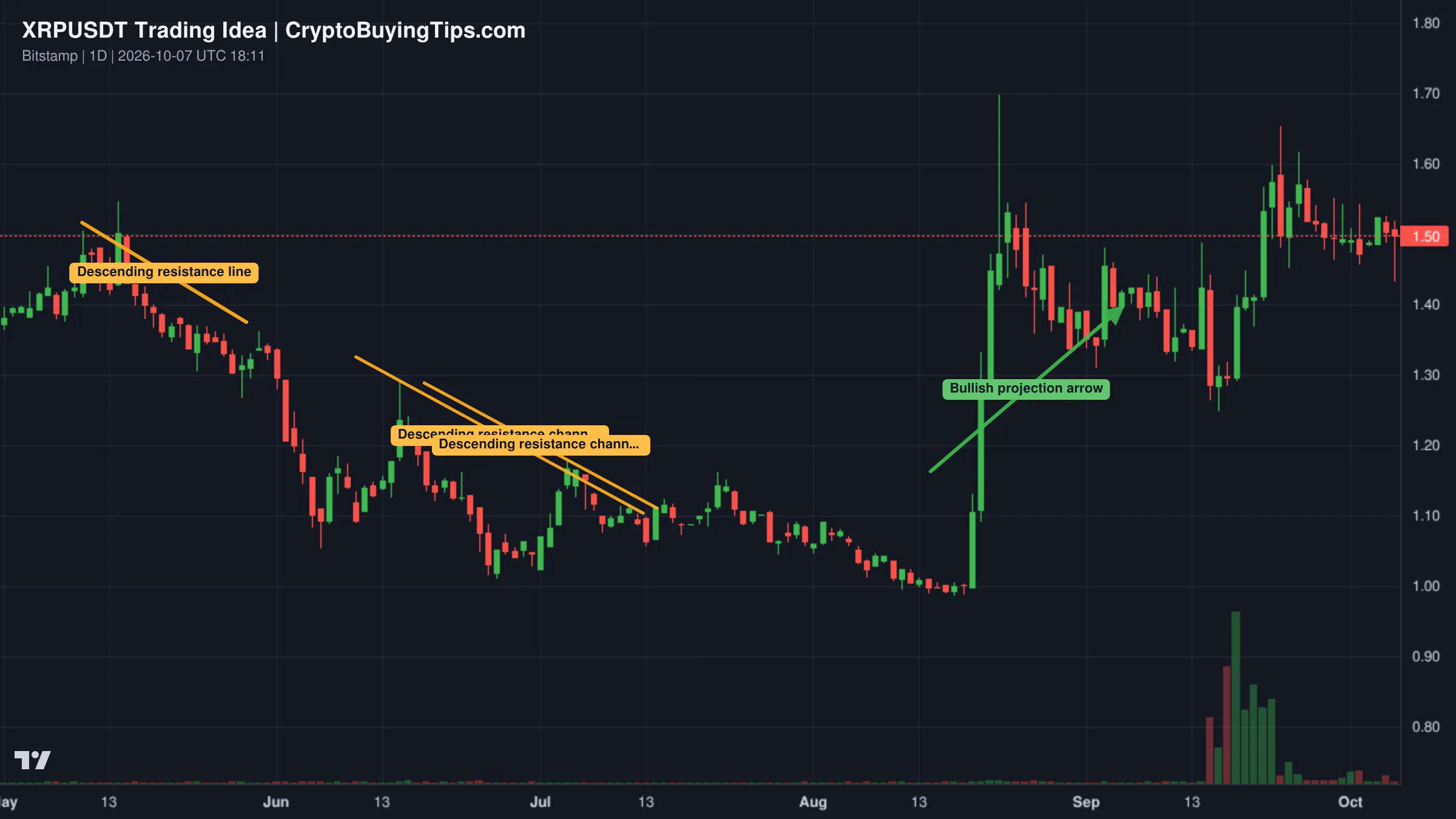
For XRP, the outlook is more sideways. Analysis from MasterAnanda indicates that as long as the price stays above $1.14, the long-term structure remains bullish. The recent jump was supported by the highest volume ever seen for the asset, which suggests the move was not a fake-out. The current price of $1.4 is healthy, but the lack of volume on recent dips suggests a lack of conviction from buyers.
NEAR is showing a strong bullish continuation. It has been rising since February 2026 and is currently challenging resistance again. While buying at the top of a move is risky, a successful break to a new higher high could be a leading indicator for the broader market. Some analysts argue that if NEAR continues its ascent, it could signal a path for Bitcoin to push past $100,000.
Smart Money Signals — Hyperliquid Leaderboard
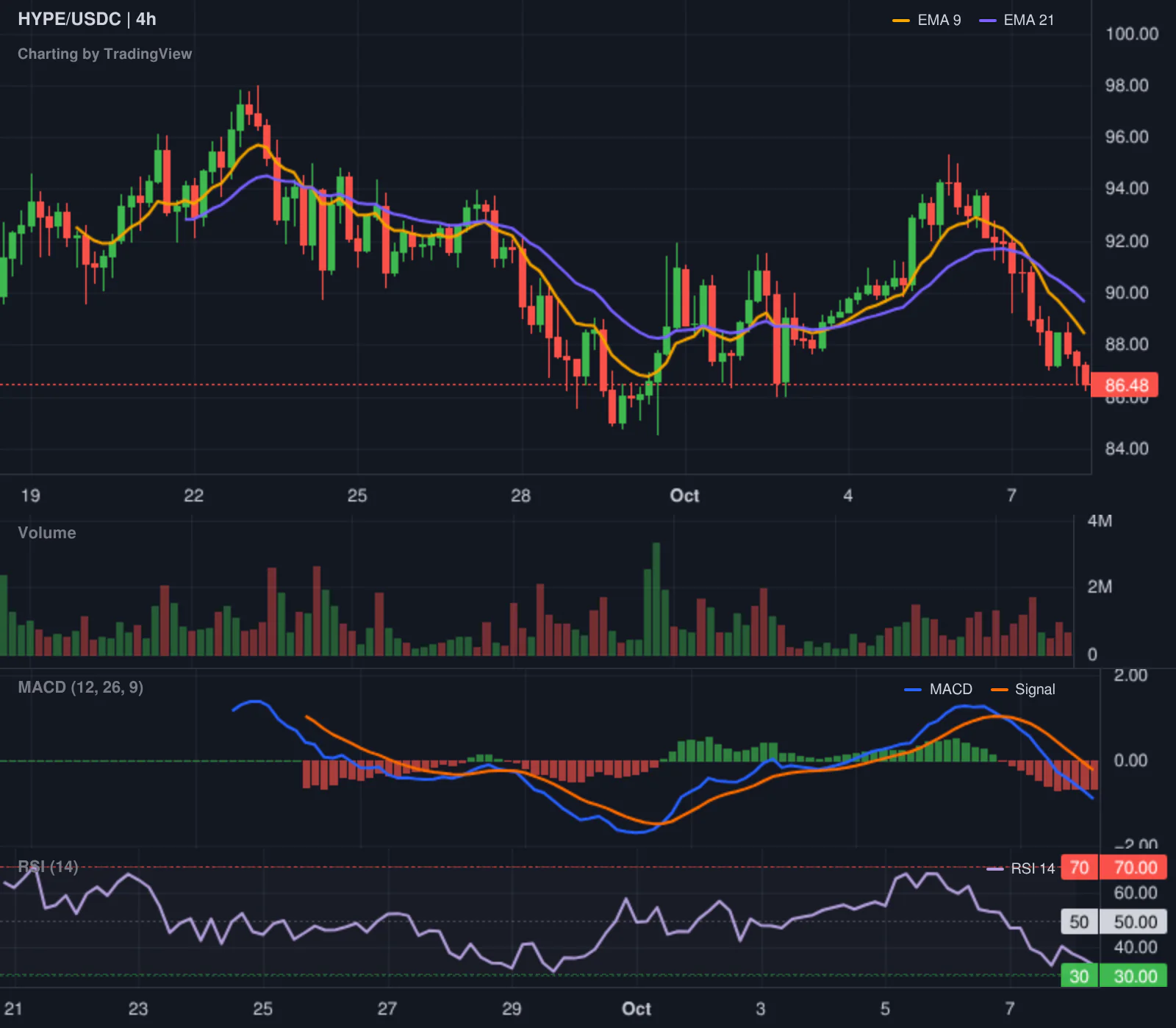
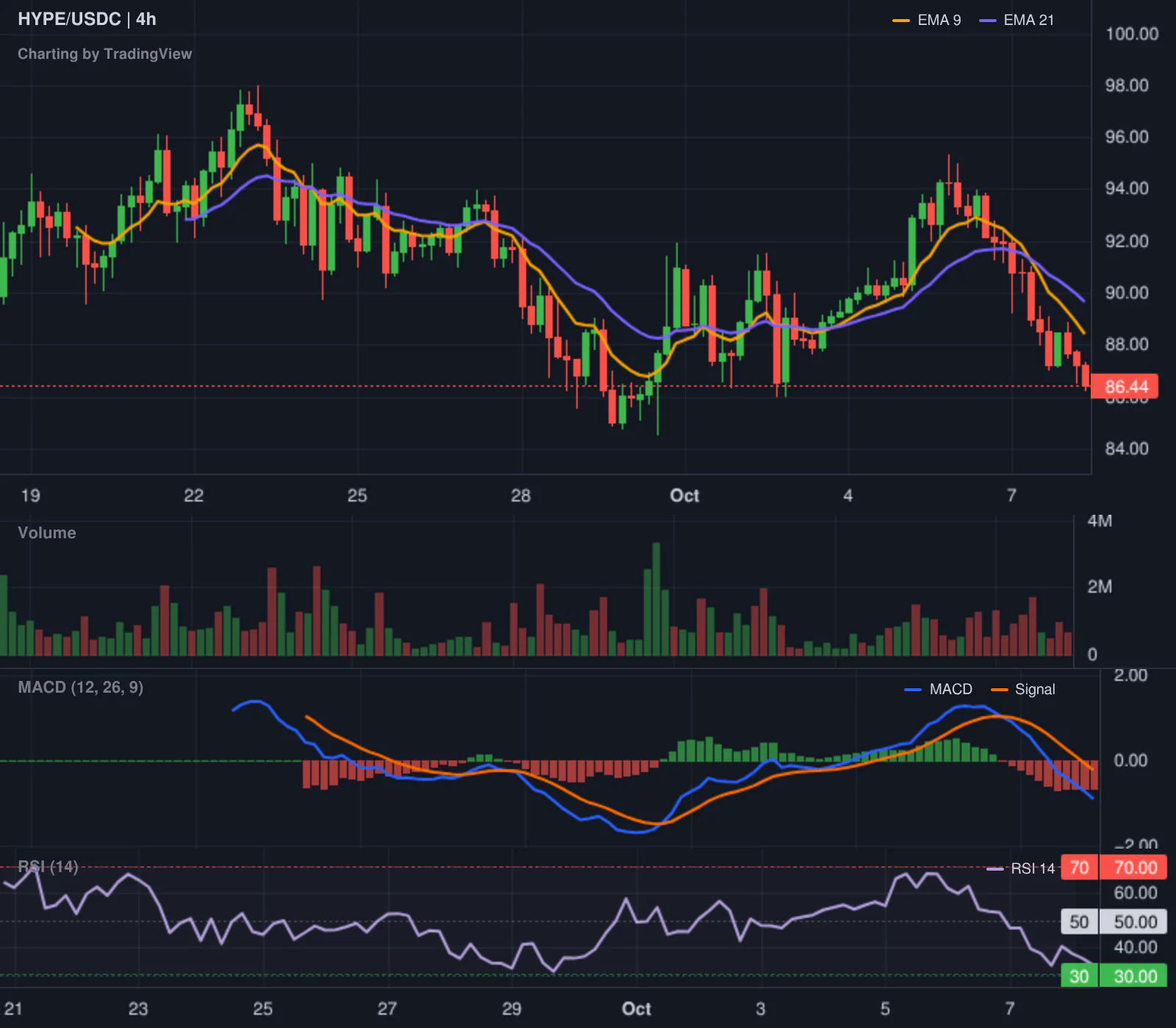
Our leaderboard tracker is showing some aggressive positioning in HYPE. A top trader, 0xb67c4c..., who has an all-time ROI of over 500%, has been flipping positions rapidly. They opened a long position at $90.809 with a notional value of $10.4K, shortly after closing a short position at $92.846 with a much larger notional of $28.6K.
This suggests the trader believes the local top is in and is now betting on a bounce. Given the high confidence score of 70, this flip is worth noting, although HYPE remains highly volatile and susceptible to the general market dip.
Altcoin Spotlight
NEAR deserves attention today because of its resilience. While most of the top 100 are sinking, NEAR is attempting to maintain a bullish structure. Its ability to turn green after a red start to the day indicates a level of internal strength that is missing from ETH or SOL. If it can break its current resistance, it may become the primary vehicle for the next altcoin rotation.
What to watch next
The immediate focus is on the ETF flow data. If the outflows from BlackRock and Fidelity continue for another three days, we can expect Bitcoin to test the $80,000 psychological floor. The market cannot ignore the fact that the institutional "safe harbor" is currently leaking capital.
In the medium term, the ESMA stablecoin deadline is the biggest looming risk. The three-month window to exit non-compliant assets will likely create a slow-motion liquidity crisis for certain pairs. Traders should audit their stablecoin holdings to ensure they are not holding assets that will be banned in the EU by January.
Finally, keep an eye on the AI-driven security warnings. If major exchanges start announcing "post-quantum" or "AI-resistant" wallet upgrades, it will be a sign that the industry is taking the Europol and Justin Drake warnings seriously. Until then, the market remains a high-leverage game of musical chairs.
Some links in this article may be affiliate links. We may earn a commission at no extra cost to you — this never influences our analysis or coverage.

Sigrid Voss
Crypto analyst and writer covering market trends, trading strategies, and blockchain technology.
More Articles

Moody's and central banks are legitimizing stablecoins while retail panics
The plumbing gets an upgrade, apparently without asking permission first. Stablecoin volume rises while overall market…
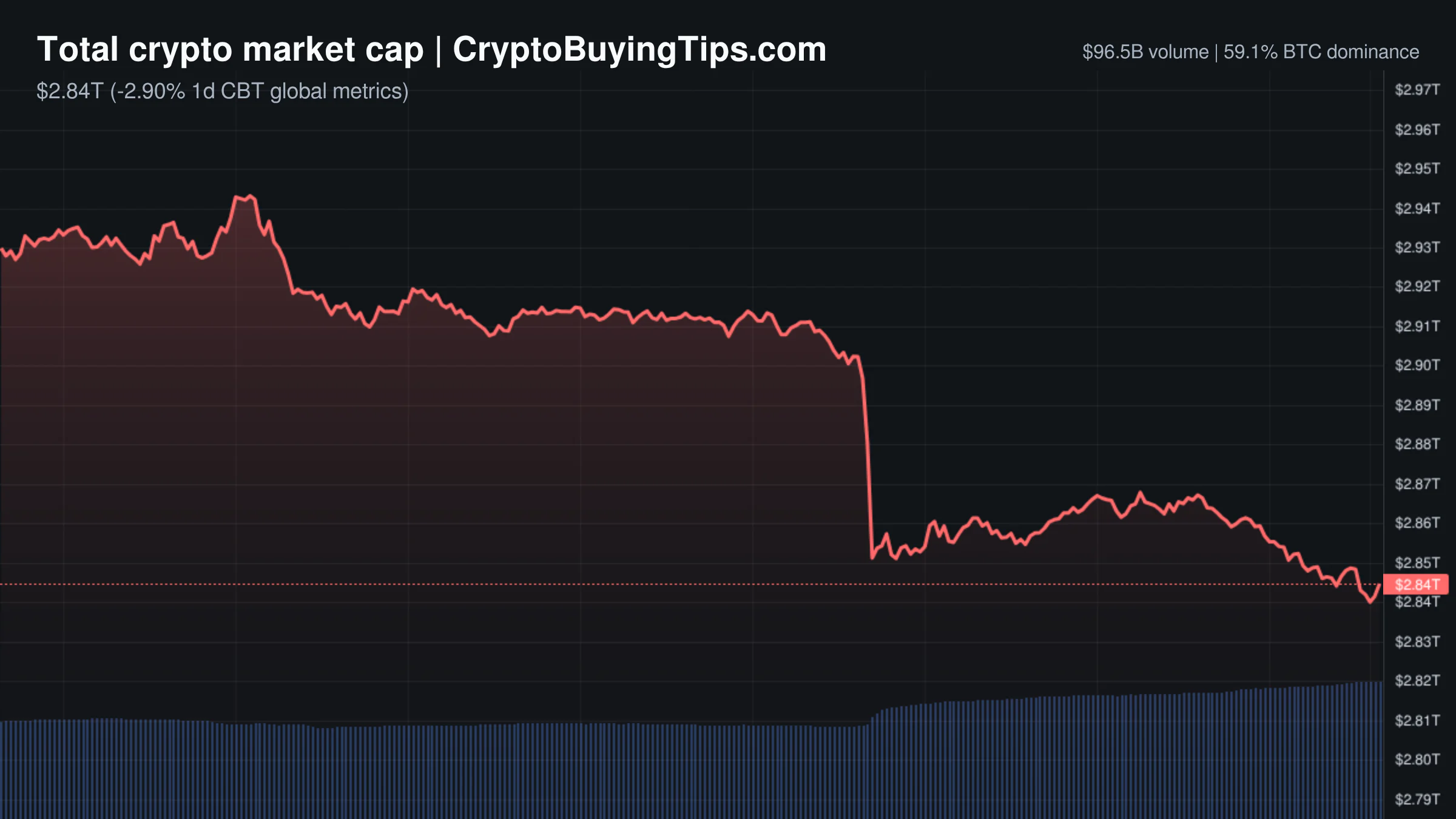
Crypto Market Overview | volume spikes amid institutional inflows despite quantum fears | October 7, 2026
Crypto market overview shows volume spikes amid institutional inflows despite quantum fears; see how ETF flows contrast…

What is stablecoin dominance and why it is the most ignored lead indicator in crypto
The market seems greedy on paper, but our data suggests otherwise; stablecoin dominance acts as the true measure of…
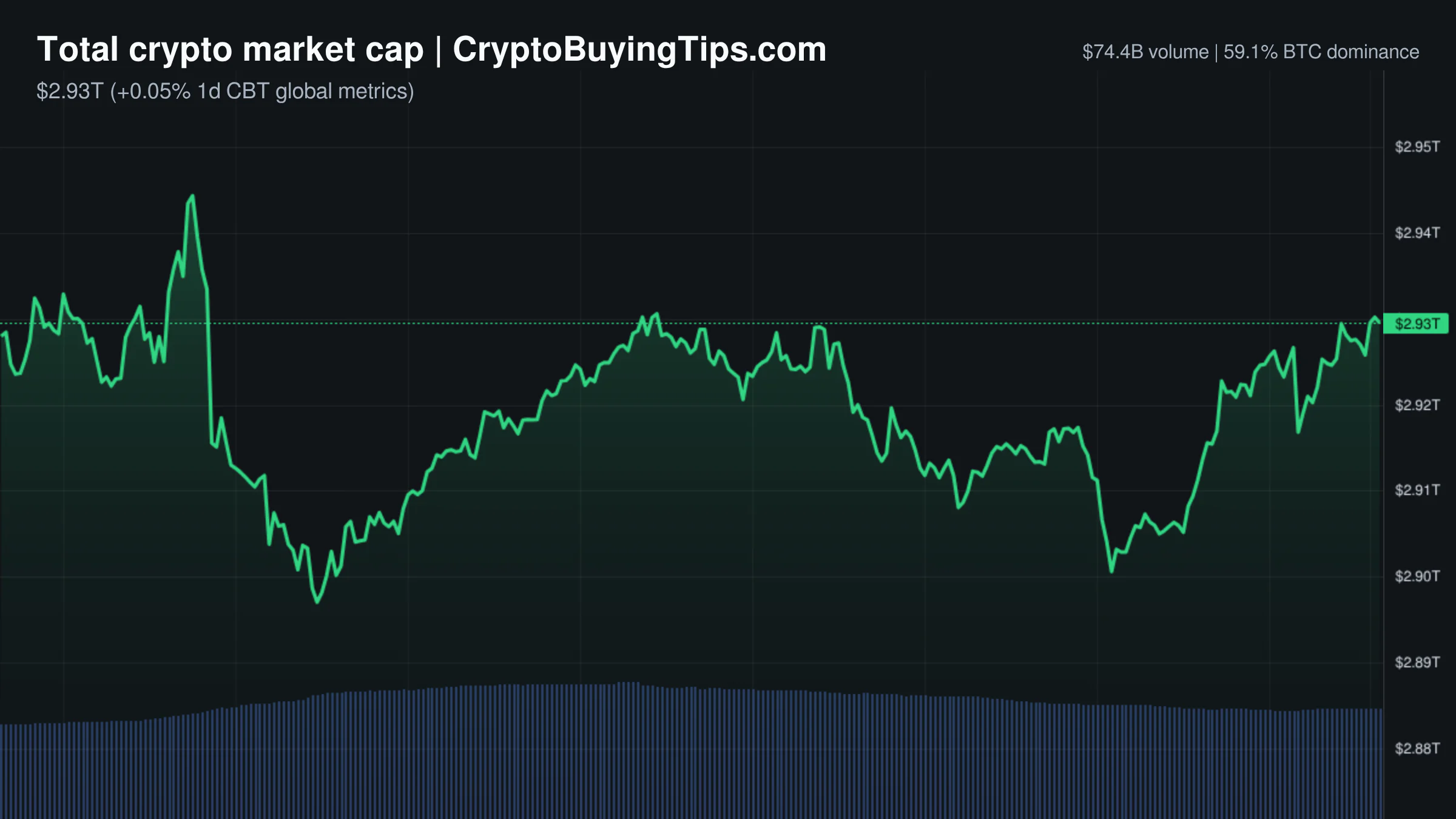
Crypto Market Overview | Leveraged derivatives volume dwarfs spot trading amid institutional infrastructure developments | October 6, 2026
Leveraged derivatives volume dwarfs spot trading at $2.93T market cap; see how institutional infrastructure developments…