

Speculators are ditching altcoins for tokenized Tesla stocks
The total 24h volume of $69.56B shows that market participation has contracted sharply, leading us to question what is drawing liquidity away from established altcoin plays. While the broader market feels like a ghost town, a strange divergence is appearing in the data. Traders are moving away from traditional coins and into synthetic assets that track real-world equities. If you are seeing a sudden surge in interest for assets that look like stocks but live on a blockchain, you are witnessing the rise of tokenized assets. But before you swap your portfolio for a digital version of a car company, you need to understand what are tokenized stocks in crypto and why this rotation is happening now. We previously covered AI czar market bets for more background.
How does what are tokenized stocks in crypto work?
At its simplest, tokenization is the process of turning a real-world asset into a digital token on a blockchain. In the case of stocks, this usually means a third party holds the actual share in a traditional brokerage account and issues a token that represents a claim to that share [info.arkm.com]. Our signal scanner flagged the divergence between high DEX volume and low altcoin momentum, suggesting that capital is no longer chasing the "next big project" but is instead seeking exposure to known quantities like Tesla or Nvidia.
The total crypto market cap sits at $2.74T, yet much of that value is locked in assets that do nothing but exist. Tokenized stocks offer a way to bring the equity market into the DeFi ecosystem. There are two main ways this happens. Some are issuer-sponsored, where the company itself puts the security on-chain [investor.gov]. Others are custodial, where a wrapper is placed around the stock. The latter is what we are seeing most of on decentralized exchanges. You aren't buying a share of Tesla from Elon Musk; you are buying a digital contract that mimics the price of Tesla.
Tracking capital flow: the synthetic asset pull
The data shows significant activity in specific tokenized platforms, suggesting a preference for yield-bearing exposure to blue-chip assets over speculative gains. We are seeing this play out on Hyperliquid, where the architecture allows for the listing of synthetic assets using an exponentially weighted moving average of recent on-chain mark prices [bitcoin.com]. This means the token doesn't need a 1:1 physical backing in real-time to trade, as it relies on a pricing oracle to keep the value aligned with the actual stock.
Our DEX trending tokens data reveals the scale of this shift. The Paimon Polymarket SPV Token, for example, saw a 24h volume of 184581041.32414594. This is the kind of liquidity that used to flow into mid-cap altcoins during a bull run. Instead, it is flowing into synthetic wrappers. We previously covered how Aave is letting you borrow USDC against Nvidia stocks, and the current volume spike suggests that the "crypto-only" era is effectively over. Traders are bored of chasing vaporware and are now using DeFi rails to bet on the S&P 500.
How does market rotation manifest in the data?
We observe a clear shift in risk appetite. While some altcoins like ALEO show 30d gains of 264.5291%, these moves are increasingly isolated. They are "niche" rips rather than a broad market recovery. The broader global market cap change over 24 hours was -3.489188492056436%, which tells us that the average altcoin is still bleeding. Our news scoring system rated this story 7/10 for liquidity impact because it represents a structural change in how speculators use their capital.
The rotation is moving from "coin" speculation to "synthetic" speculation. In a typical altcoin season, money flows from Bitcoin to Ethereum and then down into smaller projects. Now, the money is skipping the middleman. Speculators are using their stablecoins to buy tokenized versions of stocks because the volatility is more predictable than a random Layer 2 token with a roadmap that has been "coming soon" since 2022.
What we are watching next
The primary risk here is the "wrapper" problem. When you own a tokenized stock, you are trusting the smart contract and the custodian. If the custodian vanishes or the contract is exploited, your "share" of Tesla is just a useless string of code on a ledger. It is a far cry from the legal protections of a traditional brokerage account.
We are keeping an eye on stablecoin dominance and the volume of these synthetic assets. If the rotation accelerates, we will see a permanent decline in altcoin volume as traders realize they can get the same volatility from a tokenized stock without the risk of the project founder disappearing to a beach in Bali. For now, the data suggests a market that is tired of its own clichés and is looking for a way back to the real world, even if that way is through a synthetic wrapper.
Some links in this article may be affiliate links. We may earn a commission at no extra cost to you — this never influences our analysis or coverage.

Sigrid Voss
Crypto analyst and writer covering market trends, trading strategies, and blockchain technology.
More Articles
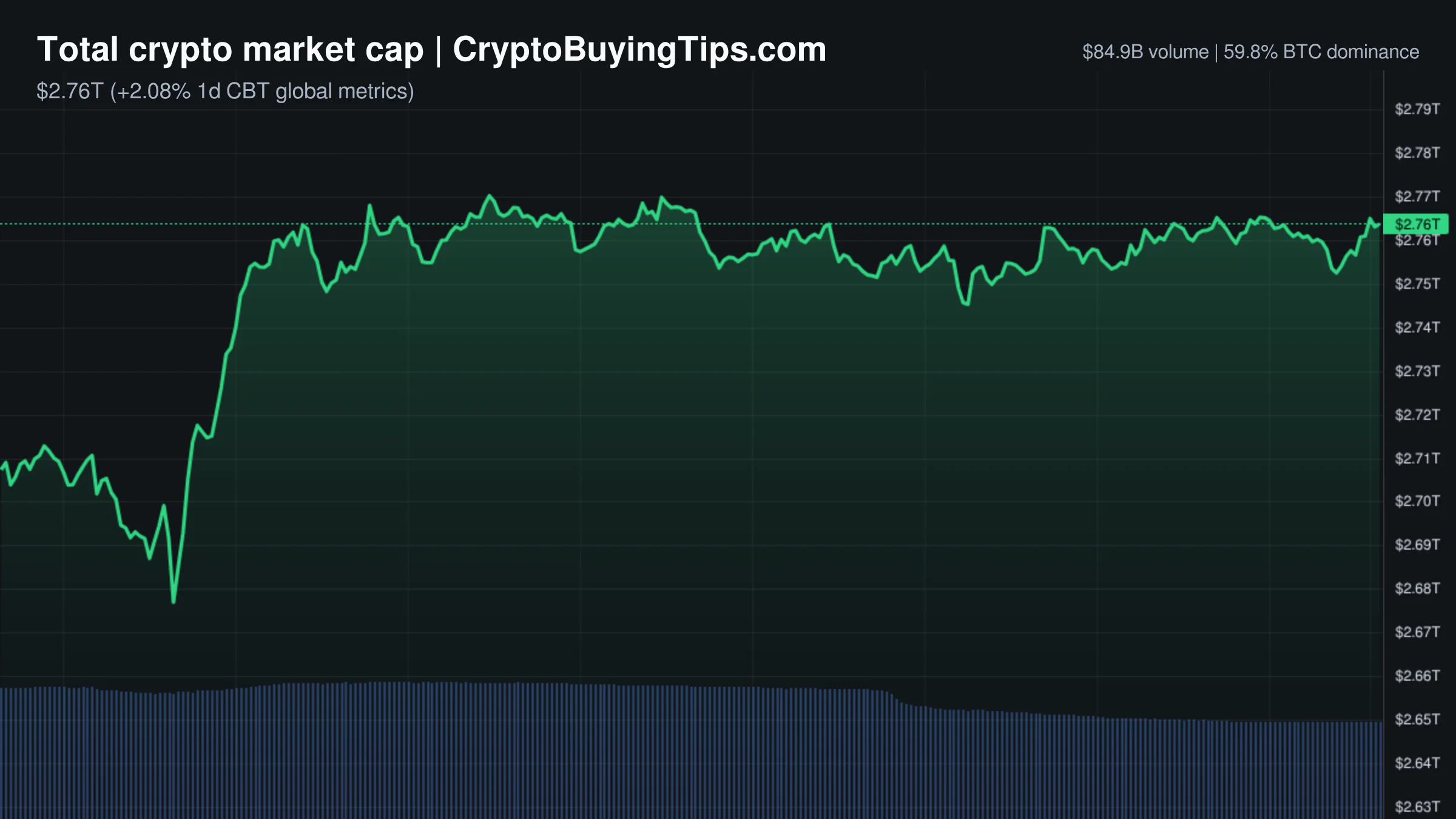
Crypto Market Overview | prices climb despite falling trading volume and stablecoin activity | October 16, 2026
Prices climb despite falling trading volume and stablecoin activity; see our market overview for context.

Wall Street is building its own rules while Congress argues
Wall Street seems to have decided waiting for Congress isn't worth the time. Major players like Mastercard are building…
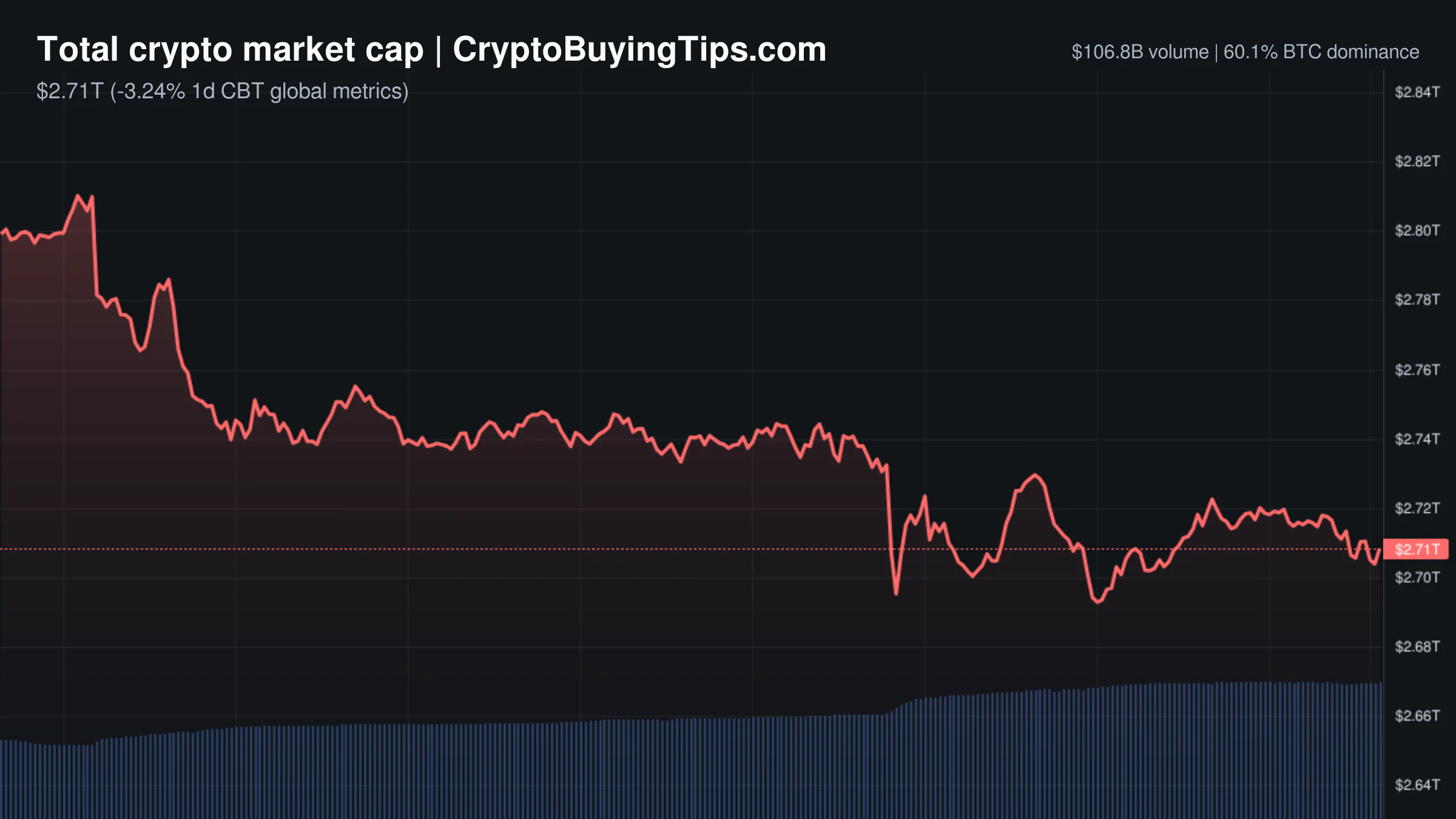
Crypto Market Overview | leveraged flush amid macro headwinds and institutional rails buildout | October 15, 2026
The crypto market sees leveraged flushing amid macro headwinds; see our read on institutional rails building out now.

Price is down but volume is ripping. This is a high-conviction flush
The market dropped nearly four percent while volume surged by over forty-four percent; this suggests the usual bleed is…