
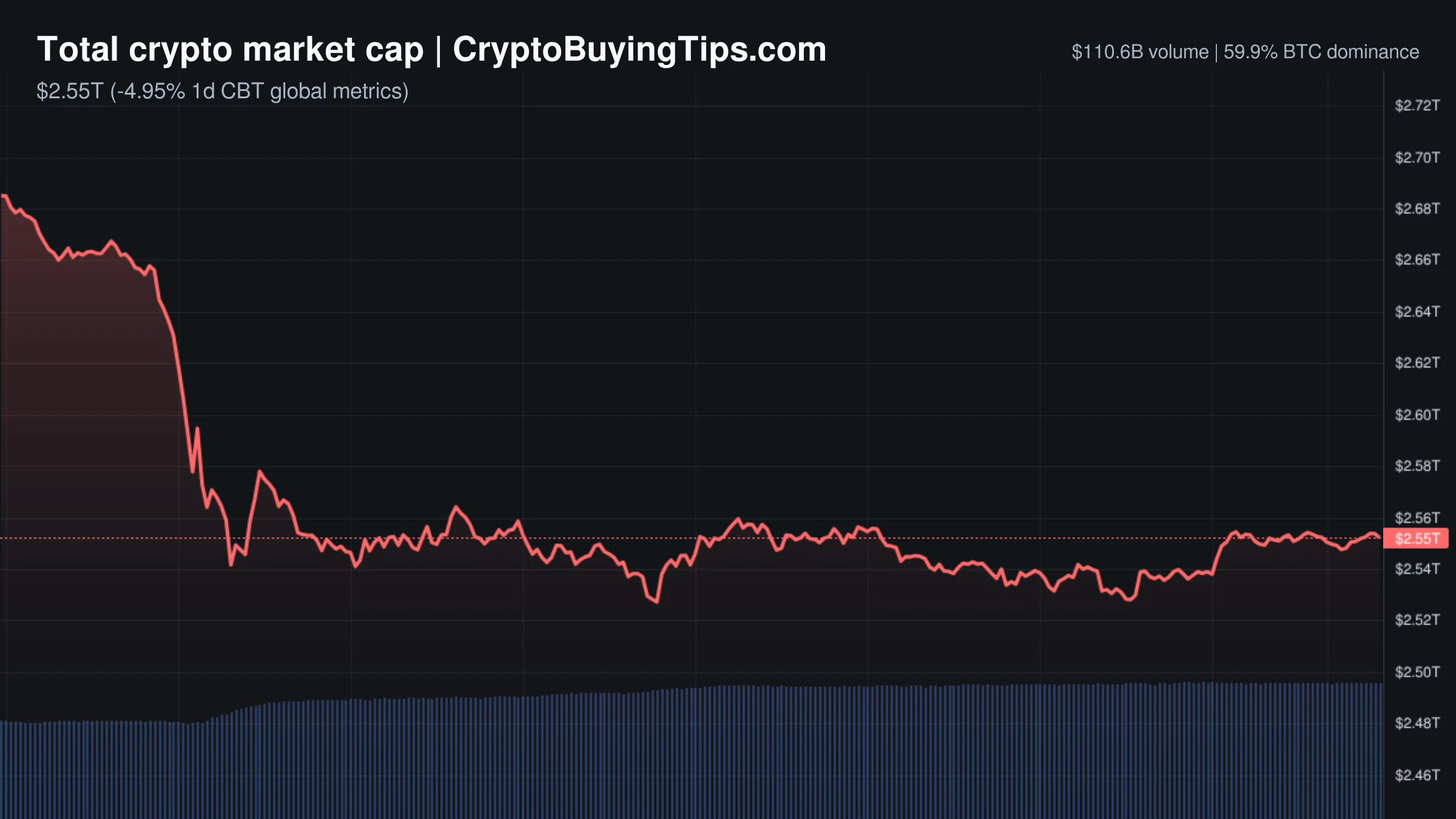
Crypto Market Overview | Systemic shocks and institutional selling drive broad selloff | November 6, 2026
Crypto Market Overview | Systemic shocks and institutional selling drive broad selloff | November 6, 2026
Market overview
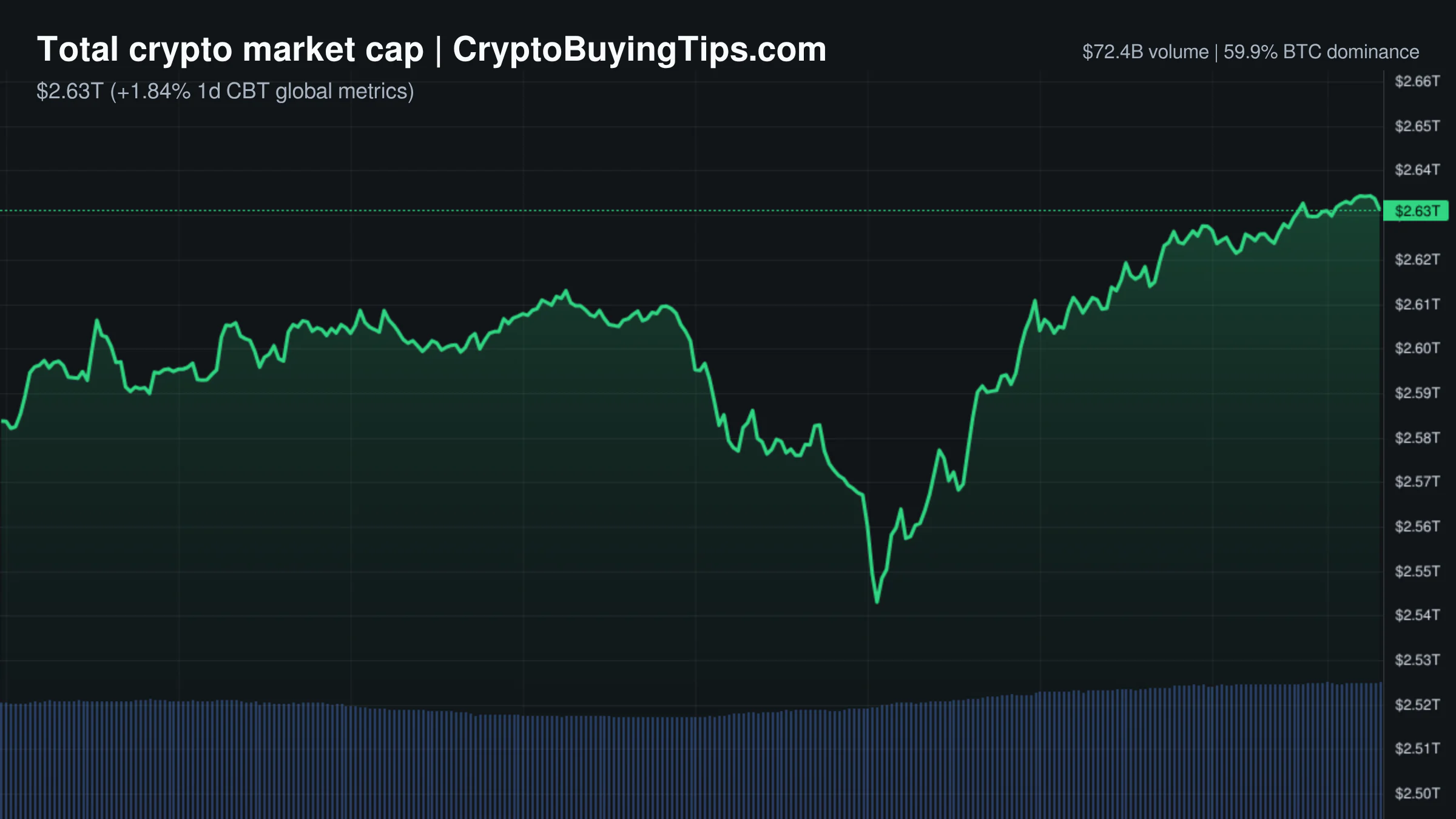
The market is currently experiencing a violent disconnect between price action and activity. While the total crypto market cap has fallen 7.17% to $2.55T, trading volume has surged. Spot volume is up nearly 29% and derivatives volume has spiked over 40% to $1.33T. This is not a slow drift lower. It is a high-velocity liquidation event. The Fear and Greed Index has dropped to 32, placing the market firmly in Fear territory.
This volatility is not happening in a vacuum. Traditional markets are also in a state of collapse, with the S&P 500 down 4.41% and the NASDAQ sliding 6.49%. We are seeing a classic risk-off rotation where investors flee volatile assets. The irony is that while prices are crashing, stablecoin volume has risen 27.85%. Capital is moving, but it is moving into the sidelines rather than into the dip.
Bitcoin dominance remains high at 59.84%, suggesting that while everything is falling, the appetite for altcoins is vanishing faster than the appetite for Bitcoin. The Altcoin Season Index sits at 41, which is neutral. In reality, it feels like a Bitcoin season where the only thing Bitcoin is winning is the race to the bottom, albeit more slowly than the rest of the market.
Bitcoin and Ethereum
Bitcoin has fallen 5.34% to $76,014. The price action is messy, but the underlying data shows a split in conviction. On one hand, spot Bitcoin ETFs saw $430 million in net outflows on November 5, led by Fidelity. This indicates institutional selling pressure. On the other hand, we have seen individual whales acting contrary to the trend. One whale recently withdrew nearly $100 million in BTC from Binance after a year of inactivity, effectively buying back the asset at a significantly lower price than their original deposit.
Ethereum is in a worse position, down 7.42% to $2,239. The implied volatility for ETH is 59.49, which is significantly higher than Bitcoin's 43.28. Traders are pricing in much larger swings for Ethereum. The most telling metric is the network state. ETH gas fees have hit a floor of 0.06 to 0.07 Gwei. The network is essentially a ghost town. When prices crash and gas fees vanish, it suggests that the current selloff is driven by centralized exchange liquidations rather than on-chain activity or DeFi migrations.
Top crypto prices
The broader market is bleeding across the board. BNB has dropped 2.78% to $696.14, showing some relative strength compared to the majors. XRP has been hit harder, falling 9.26% to $1.19. Solana is down 6.26% to $90.36. TRON is the outlier, remaining almost flat with a negligible 0.25% drop to $0.3177. Hyperliquid has fallen 4.61% to $78.54, though it continues to hold a top 10 market cap position despite the turmoil.
News driving today's market
The primary driver of today's panic is a series of security failures. The $6.3 billion Binance hack has sent shockwaves through the system. It is not just the loss of funds that matters, but the regulatory response. The Federal Reserve and the OCC are now contacting US banks to assess how they handle crypto-related security risks. This creates a systemic risk where banks may tighten their rails to the entire industry. We previously covered the Binance hack systemic danger and the latent liquidity risks involved.
The trust deficit is widening. Chainalysis disclosed that a breach exposed password hashes and live tokens, while Mercado Bitcoin's claims that its hack was contained were contradicted by blockchain data showing $48.6 million in stolen funds. When the analytics firms and the exchanges both fail, the market loses its sense of ground truth. This has accelerated the rotation toward on-chain infrastructure, a trend we noted in our analysis of Hyperliquid vs central exchanges.
There are a few counter-narratives providing a floor. In Paraguay, the resignation of President Santiago Peña following the collapse of Ueno Bank has revived the argument for Bitcoin self-custody. When 60% of a country is locked out of their bank accounts, the "Bitcoin fixes this" narrative moves from a meme to a macro reality. Additionally, Europe's Amundi has tokenized an equity index fund on Ethereum. This is a genuine institutional win for RWA, though it is currently being drowned out by the noise of the hacks. We have looked at this shift toward tokenized deposits concept in the past.
Social intelligence
The social mood is a mix of horror and absurdity. Reports are circulating that the Binance hackers paid only $15 in network fees to drain $2.5 billion in a single transaction. This was allegedly made possible by a feature in Ethereum's EIP-7702 upgrade. There is a certain bleak comedy in the fact that a multi-billion dollar heist cost less than a cheap lunch in London.
Institutional data from social feeds confirms the bearishness. Spot Ether ETFs saw nearly $100 million in net outflows, led by BlackRock's ETHA. This suggests that the "smart money" is not using this dip to accumulate Ethereum. Meanwhile, on-chain analysts are tracking whales who are shorting the market. One whale, 0xfC27, has reportedly made over $8 million shorting various assets, including BTC, on Aster DEX.
Trading ideas worth watching
The short-term outlook for Bitcoin is a battle between Fibonacci support and momentum. One technical read suggests that Bitcoin is currently testing the 0.5 to 0.618 Fibonacci retracement zone, having pumped from $58k to $87k previously. If this zone holds, the correction could be viewed as healthy, potentially leading to a new high. However, if the price drops below the 0.618 level, the correction has erased too much of the original impulse, and we may see a move toward the start of the original rally.
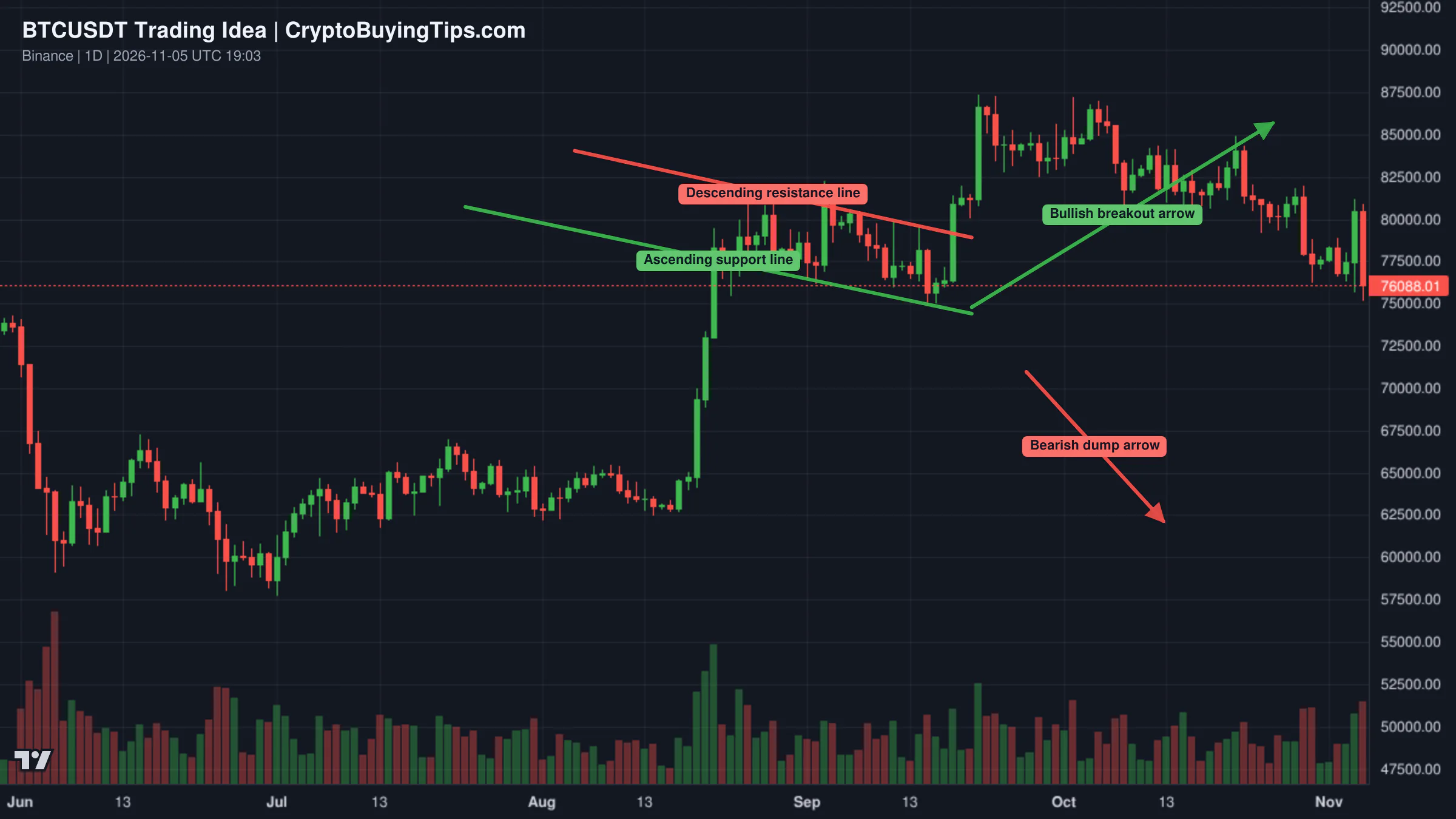
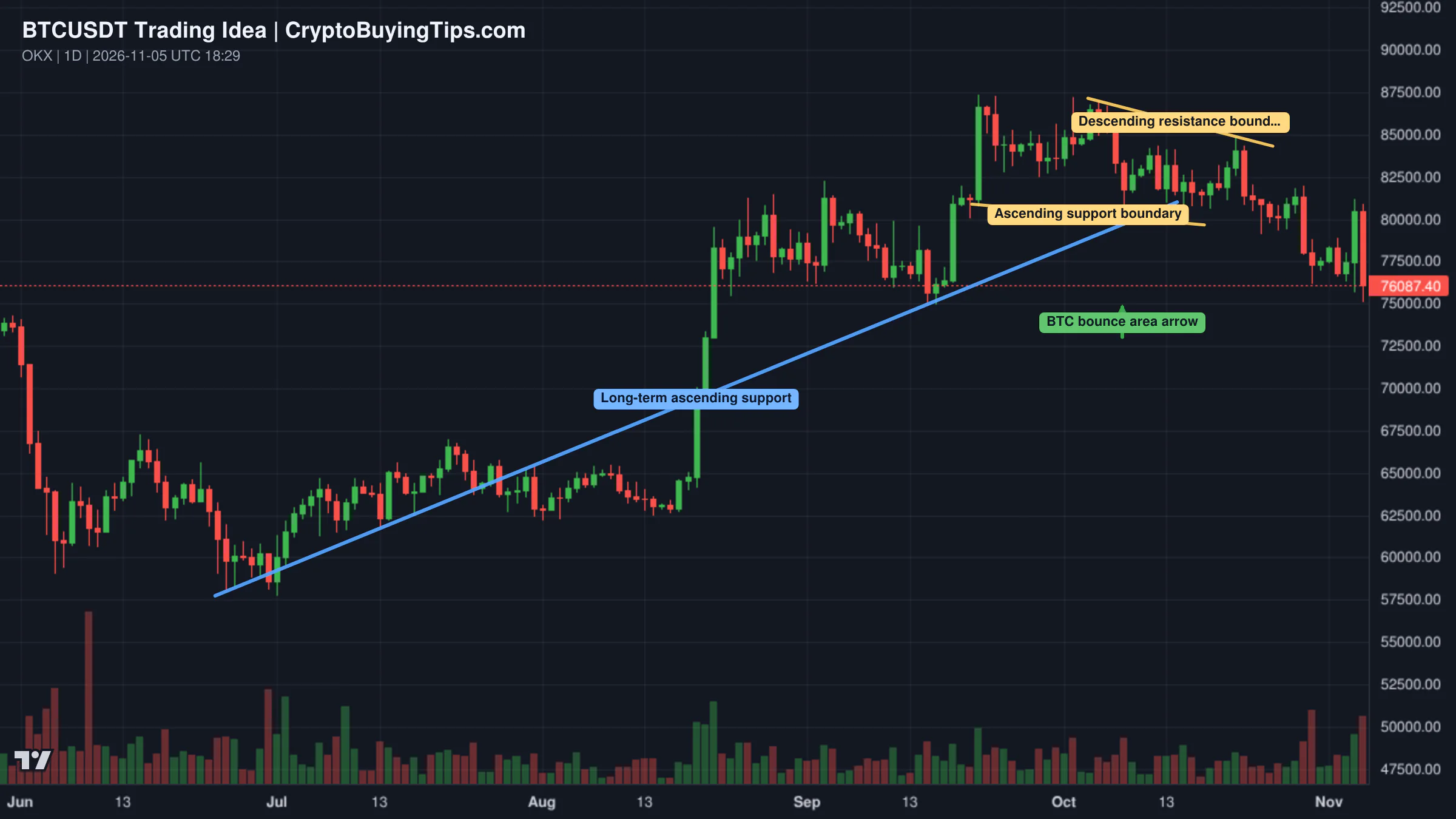
Another setup focuses on the daily moving averages. Bitcoin is currently juggling between the 50 EMA and the 200 EMA on the daily chart, which coincides with the .318 Fibonacci range. This choppy range makes shorting risky, but it may provide a "sweet spot" for building mid-term swing positions with low leverage. The key is to avoid over-leveraging in a market where volatility is this high.
For those looking at shorter timeframes, there is a bullish setup on the 1H chart. The strategy involves waiting for the current 1H candle to close and placing a buy stop at the high of that candle. The stop loss is set at $75,370. If activated, the first profit targets are $78,434 and $79,879. This is a momentum play that requires the market to stop its current descent and print a higher high on the hourly chart.
What to watch next
The market is currently trapped between a systemic disaster and a structural evolution. The Binance hack and the subsequent regulatory scrutiny from the Fed and OCC are the immediate pressures. If banks begin to restrict crypto-related services, we could see a further drain in liquidity.
However, the long-term signals are surprisingly resilient. The fact that Hyperliquid is seeking US futures registration and Democrats are pushing a broader Market Structure Bill suggests that the political and institutional framework is still moving forward. The market is essentially fighting a war between the failure of old-guard centralized exchanges and the rise of regulated, on-chain alternatives. We will be watching the $75,000 level for Bitcoin closely. If that breaks, the panic could accelerate. If it holds, the current volume spike may mark the local bottom of this risk-off event.
Some links in this article may be affiliate links. We may earn a commission at no extra cost to you — this never influences our analysis or coverage.

Sigrid Voss
Crypto analyst and writer covering market trends, trading strategies, and blockchain technology.
More Articles

Paraguay's banks just collapsed. Here is how self-custody actually works
When local banks collapse and your savings vanish into regulatory quicksand, it's a reminder that trusting any third…
Crypto Market Overview | leverage dominates as institutional inflows meet political uncertainty | November 5, 2026
Crypto market overview shows leverage driving activity as institutional inflows meet political uncertainty; see our read…

Washington is arguing about the midterms while Wall Street tokenizes the world
Washington debates midterms while global finance quietly moves assets onto the ledger. Security tokenization isn't…
Crypto Market Overview | Leveraged bets dominate volume amid fear and institutional regulatory shifts | November 4, 2026
Leveraged bets dominate volume amid fear and institutional regulatory shifts; see our market overview on BTC, ETH, and…