
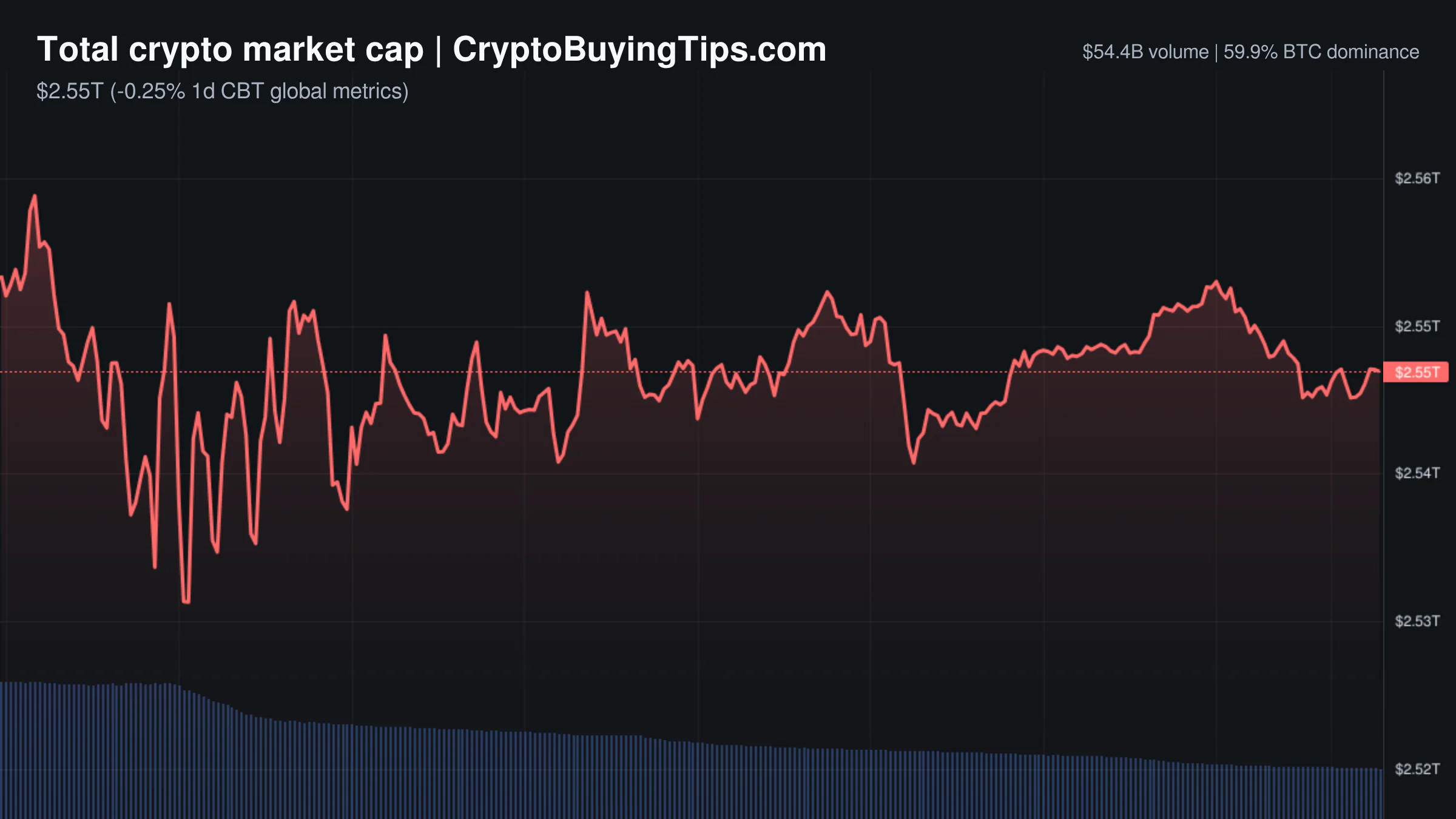
Crypto Market Overview | volume collapse amid regulatory crackdowns and whale accumulation | November 7, 2026
Crypto Market Overview | volume collapse amid regulatory crackdowns and whale accumulation | November 7, 2026
Market overview
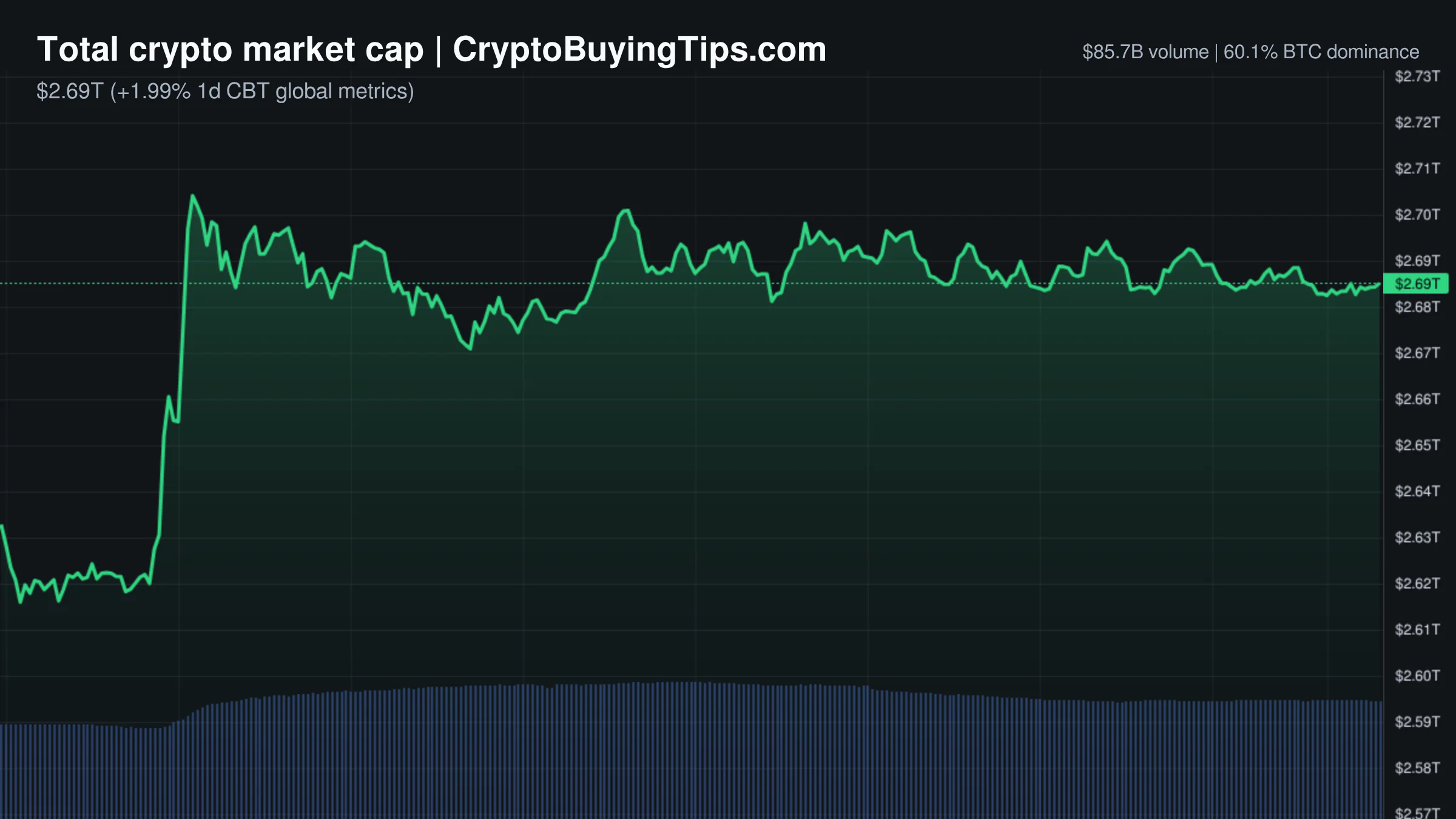
The market has entered a state of profound inertia. While the total market cap sits at $2.54T, the most striking data point is the systemic collapse in trading activity. Volume across spot, derivatives, and stablecoins has dropped by roughly 50% in a single day. It is a rare moment where the market is not so much crashing as it is simply forgetting to trade. This lack of conviction is reflected in a Fear & Greed Index of 32, placing sentiment firmly in Fear.
There is a clear divergence between crypto and traditional risk assets. The NASDAQ is up 1.40% and the S&P 500 has ticked up 0.31%, yet crypto remains flat or slightly bearish. This suggests that the current hesitation is internal to the digital asset space rather than a broader macro retreat. With Bitcoin dominance at 59.91%, capital is consolidating in the flagship asset, leaving altcoins to drift in a neutral state. The Altcoin Season Index of 35 confirms that we are still in a Bitcoin season, though the current mood is less about aggressive buying and more about a general liquidity pause.
Bitcoin and Ethereum
Bitcoin is holding steady at $75,889.9, down a negligible 0.17% over the last 24 hours. The price action is muted, and implied volatility sits at 41.19, which is significantly lower than that of Ethereum. This suggests that traders are not pricing in any immediate explosive moves for the largest asset. The lack of clear direction is likely a result of the volume crash, as there is simply not enough bid or ask pressure to move the needle.
Ethereum is trading at $2,242.26, managing a tiny gain of 0.06%. Despite the price stability, the network is practically dormant. Gas fees have plummeted to between 0.04 and 0.06 Gwei, which indicates a near-total absence of on-chain activity. Interestingly, Ethereum's implied volatility is much higher than Bitcoin's at 58.24. This gap suggests that while the network is quiet, the derivatives market expects a more violent move from ETH than from BTC.
Top crypto prices
The broader market is struggling to find a catalyst. BNB is down 0.34% at $693.74, while XRP has seen a sharper decline of 2.17% to $1.17. Solana is slightly lower at $89.93, down 0.48%. TRON is one of the few gainers among the majors, up 0.48% to $0.3192. Hyperliquid has dipped 0.47% to $78.17.
News driving today's market
The dominant narrative is a sharp regulatory crackdown on centralized exchanges. The US Treasury and FinCEN have ordered US financial institutions to stop processing transfers involving MEXC Global. The Treasury accuses the exchange of facilitating $16 billion in illicit transactions linked to sanctions evasion in Russia, Iran, and North Korea. This is a severe blow to market trust and liquidity. We previously covered US sanctions on crypto flows and the current action against MEXC is a direct extension of that trend.
There are some bullish offsets, though they feel like long-term promises in a short-term panic. The Trump administration is moving toward allowing crypto in 401(k) retirement plans, which would open the door for massive institutional inflows. Additionally, the Treasury has withdrawn a controversial proposal to expand the crypto surveillance travel rule. This reduces the immediate compliance burden for major assets, but it is not enough to counter the immediate fear surrounding exchange sanctions. We previously covered SEC safe harbor implications for more background.
Other negative headlines are adding to the noise. Nigeria has banned algorithmic stablecoins and introduced new licensing rules. In China, a Solana promotional event was halted over unauthorized promotion, according to a PBOC official. Security concerns are also surfacing, with Gnosis Pay reporting a breach that exposed customer card and wallet details. Finally, reports that Binance hackers swapped $124 million in stolen tokens for Bitcoin introduce a layer of counterparty risk that the market is not in the mood to absorb.
Social intelligence
On-chain data provides a contrast to the general fear. While retail traders seem to be standing still, whales are accumulating. One wallet spent nearly 20 million USDT to buy ETH at $2,245, and another fresh wallet withdrew over $22 million in ETH from Binance over the last five days. We also see a whale accumulating UNI, buying over 1.3 million tokens in the last 45 days.
The social mood is anxious. Keplr Wallet reported unauthorized transactions affecting accounts created via Google or Apple logins due to a Web3Auth security issue. This is the kind of news that fuels the current Fear index. Meanwhile, the focus on US politics continues, with Kalshi odds showing J.D. Vance leading the 2028 Republican nomination race at 33%. The market is clearly betting on the political climate as the primary driver of future regulation.
Trading ideas worth watching
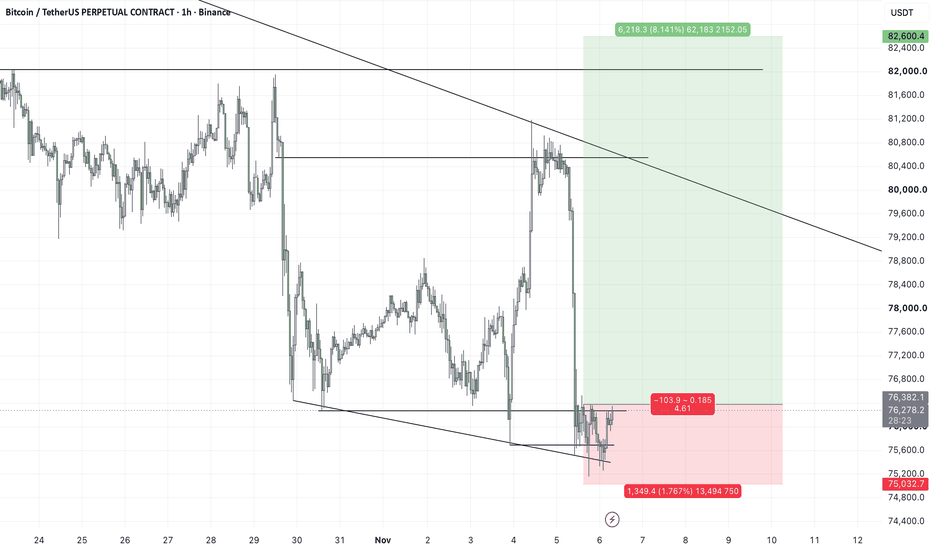
A high-risk setup for Bitcoin suggests a buy stop at $76,382.2 with a strict stop loss at $75,030. The setup is bullish but carries significant risk because of upcoming US economic releases, including Non-Farm Payrolls and the unemployment rate. These announcements often trigger volatility that can wipe out tight stops before a move actually happens. Traders are advised to keep risk per trade below 1%.
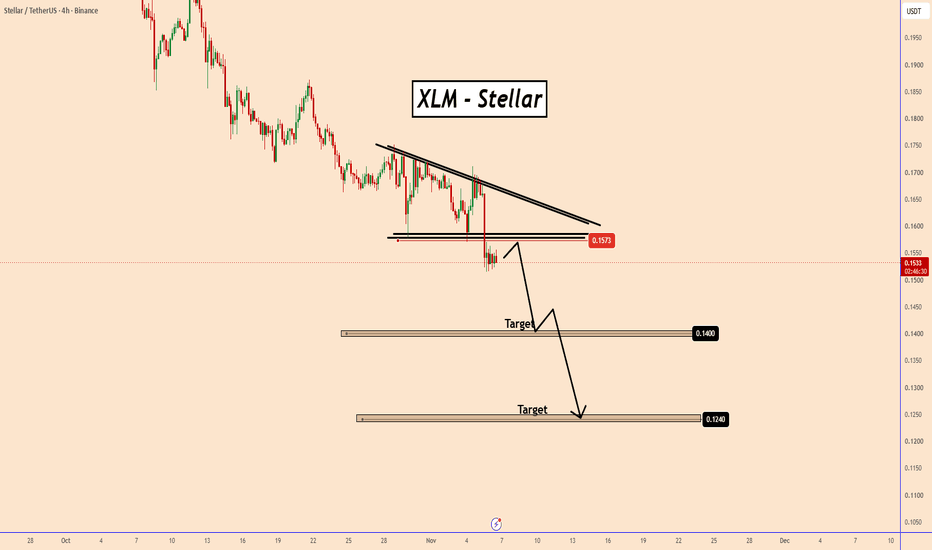
For XLM, the outlook is bearish. The asset has lost key support at 0.1573, which previously acted as a floor for buyers. This breakdown suggests sellers are in control. While a temporary pullback to retest the 0.1573 level is possible, the primary targets are now 0.1400 and 0.1240.
LTC is testing a critical support zone between $50 and $52. This area is meaningful because it was the launch point for a previous rally toward $75. For a new bullish impulse to develop, LTC needs to defend this zone and break above its current descending channel. If it succeeds, the $59 to $60 range becomes the next objective. A failure to hold $50 would likely derail any recovery hopes.
What to watch next
The immediate priority is seeing if the volume crash is a one-day anomaly or the start of a deeper liquidity drought. A market that doesn't trade cannot trend. We need to see if the 50% drop in activity persists, as this makes the market prone to "flash" moves and erratic price action.
The MEXC situation is the primary regulatory risk. If other exchanges are targeted under Operation Economic Outcast, we could see a broader exodus from centralized platforms. Conversely, any formal progress on the 401(k) integration would provide the institutional bid needed to break the current stalemate. For now, the market is in a waiting game, caught between long-term institutional hope and short-term regulatory fear.
Some links in this article may be affiliate links. We may earn a commission at no extra cost to you — this never influences our analysis or coverage.

Sigrid Voss
Crypto analyst and writer covering market trends, trading strategies, and blockchain technology.
More Articles

Whales are buying the ETH dip while the altcoin season index stays frozen
Whales treat market dips like clearance sales while retail sentiment suggests otherwise; professional capital appears…
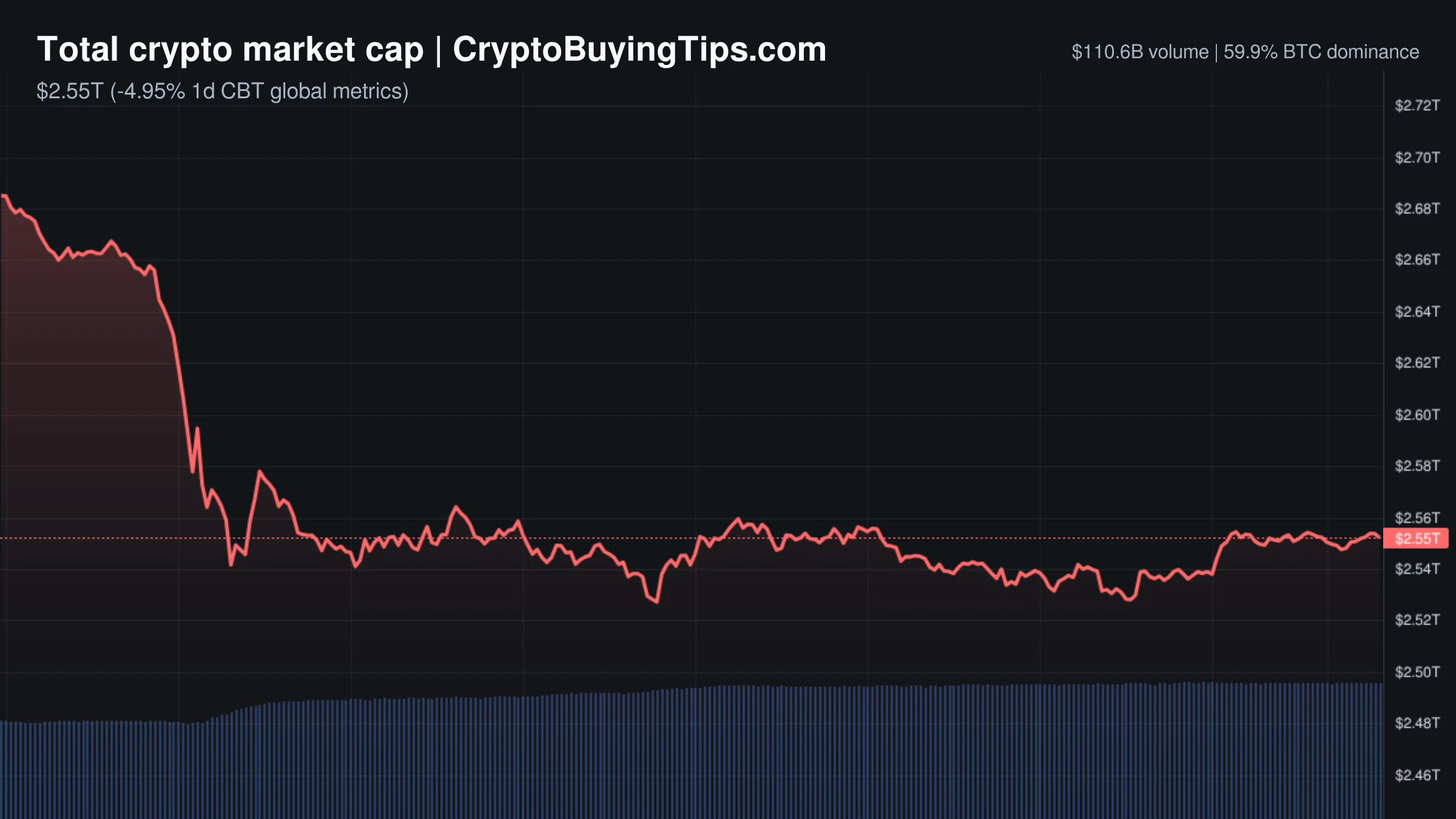
Crypto Market Overview | Systemic shocks and institutional selling drive broad selloff | November 6, 2026
Systemic shocks and institutional selling drive broad selloff as crypto market cap falls 7.17% amid high volatility.

Paraguay's banks just collapsed. Here is how self-custody actually works
When local banks collapse and your savings vanish into regulatory quicksand, it's a reminder that trusting any third…
Crypto Market Overview | leverage dominates as institutional inflows meet political uncertainty | November 5, 2026
Crypto market overview shows leverage driving activity as institutional inflows meet political uncertainty; see our read…