

The UK wants to tokenize everything, but Ethereum is barely breathing
The UK government has assembled a tokenization taskforce featuring the heavyweights: BlackRock, Goldman Sachs, JPMorgan, and Morgan Stanley. The narrative is clear. The world's financial assets are moving on-chain, and Ethereum is the presumed destination. But if you look at the actual plumbing of the network, the institutional party hasn't started. It hasn't even sent the invites. Our global market structure feed shows ETH gas at a staggering 0.09 Gwei, a figure that leads us to a confusing contradiction: why is ethereum gas so low?
The short answer
Gas prices are a direct reflection of network demand. When people fight for limited space in a block, prices rise. When the network is empty, prices collapse. A reading of 0.09 Gwei means there is almost no competition for block space, suggesting that despite the high-level talk of tokenization, very few people are actually using the main chain.
How it actually works
To understand the current stagnation, you have to understand that gas is the fuel that allows the Ethereum network to operate (ethereum.org). Every action on the blockchain, from sending ETH to interacting with a complex smart contract, requires a certain amount of computational effort. This effort is measured in gas.
Because the network can only process a limited number of transactions per block, gas turns computation into a market (ledger.com). If a thousand people want to move money at the same time, they bid against each other to get the validator's attention.
The cost is broken down into two main parts. First, there is the base fee, which is the minimum required to get into a block. This fee is burned, which reduces the total supply of ETH (crypto.news). Second, there is the priority fee, or a tip, that you pay to a validator to jump the queue.
These costs are quoted in Gwei, which is one-billionth of an ETH. In the height of a bull market, Gwei can spike into the hundreds. Right now, it is practically zero.
Why is ethereum gas so low right now?
The gap between the "institutional roadmap" and the current data is wide. We are told that the UK is preparing to tokenize everything, yet the network is in hibernation. There are a few reasons for this.
First, the "corporate makeover" we previously covered has largely shifted activity to Layer 2 solutions. While the main chain stays quiet, the actual utility is fragmenting across other networks. We've noted before how Ethereum market share vanishes as the narrative shifts from the main chain to these scaling layers.
Second, institutional "intent" is not the same as institutional "execution." A taskforce with BlackRock on it is a signal of interest, not a signal of current volume. Large firms spend months, if not years, in regulatory sandboxes before they ever push a single transaction to a public mainnet.
Our data puts the Fear & Greed Index at 29, which is deep in "Fear" territory. Retail traders are not using the network to mint NFTs or swap memes. They are either sitting in stables or watching from the sidelines. When you combine a terrified retail base with institutions that are still in the "planning" phase, you get a ghost town with a very expensive marketing budget.
Where people get tripped up
The biggest mistake traders make is confusing PR with protocol utility. It is easy to see a headline about the UK government and assume the network is about to explode with activity.
But the data doesn't lie. If tokenization were actually happening at scale on the main chain, we would see a sustained rise in the base fee. We would see the Gwei climb as these massive institutional portfolios began migrating. Instead, we see a network that is effectively idling.
Low fees are great for the user, but they are a warning sign for the asset's value proposition. If Ethereum is meant to be the "world computer," a computer that no one is using is just a very expensive piece of hardware. We've explored this before, noting that Ethereum gas costs explained often reveal a lack of demand rather than a victory in efficiency.
Putting it into practice
If you are trying to gauge whether the institutional tokenization narrative is actually working, stop reading the press releases and start watching the metrics.
Watch the base fee. If it begins to climb and stay high without a corresponding meme-coin craze, it suggests that something structural, like RWA (Real World Asset) tokenization, is actually hitting the chain.
Check the ETH dominance. It currently sits at 9.99%, while Bitcoin dominance has climbed to 58.24%. This suggests that capital is not rotating into the "utility" play of Ethereum, but is instead retreating to the safety of Bitcoin.
Until the Gwei moves, the UK's tokenization dreams are just a slide deck. We'll keep an eye on the feed, but for now, the network is barely breathing.
Related Tickers
Some links in this article may be affiliate links. We may earn a commission at no extra cost to you — this never influences our analysis or coverage.

Sigrid Voss
Crypto analyst and writer covering market trends, trading strategies, and blockchain technology.
More Articles
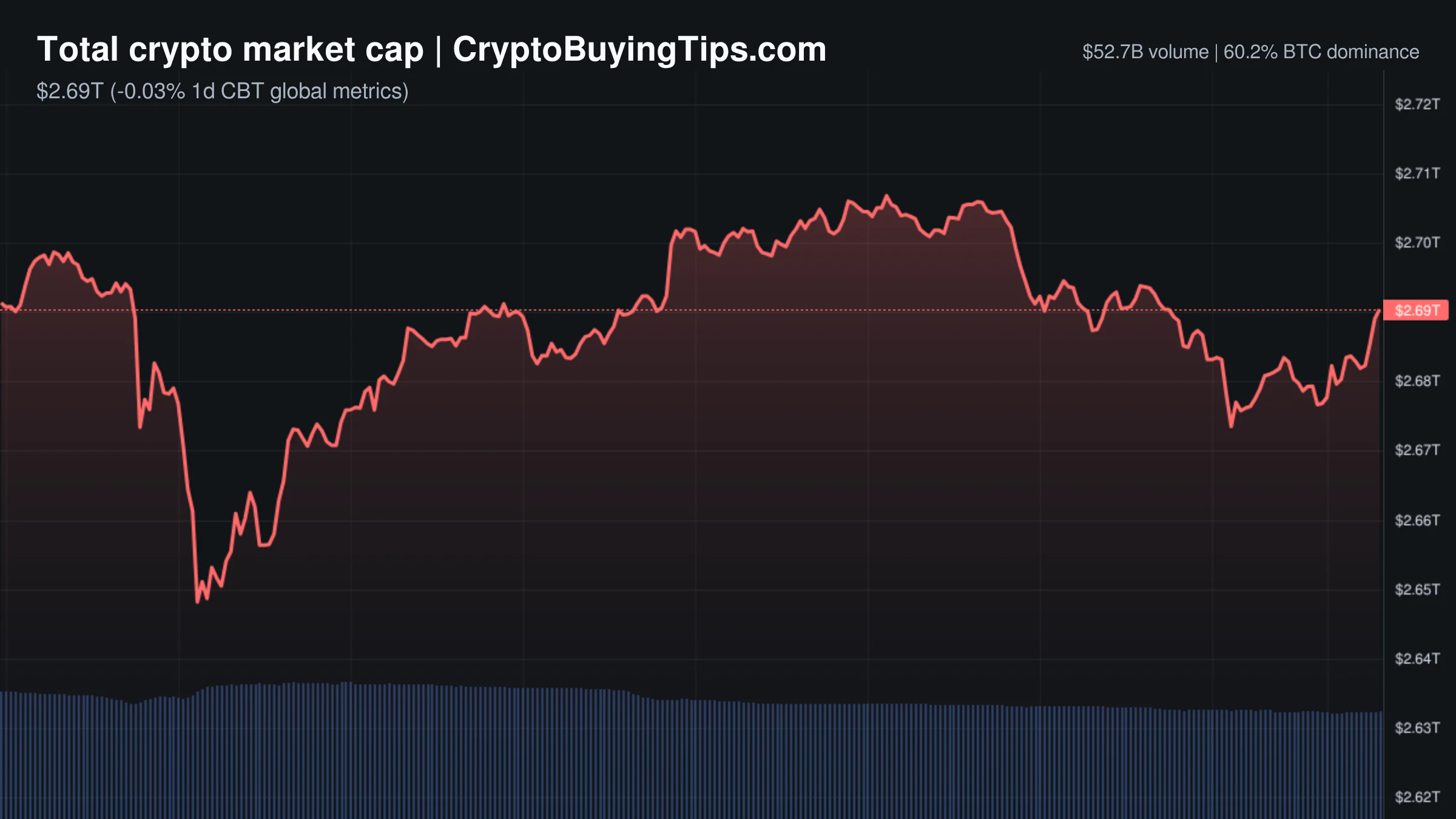
Crypto Market Overview | volume collapses as bitcoin holds $80k amid mixed institutional signals | October 25, 2026
Crypto market overview shows collapsing volume as bitcoin holds $80k amid mixed institutional signals and geopolitical…

Stablecoins are leaving the exchanges. HSBC just proved it
The market seems preoccupied with leverage ratios while real money moves elsewhere; a major bank issuing licensed…
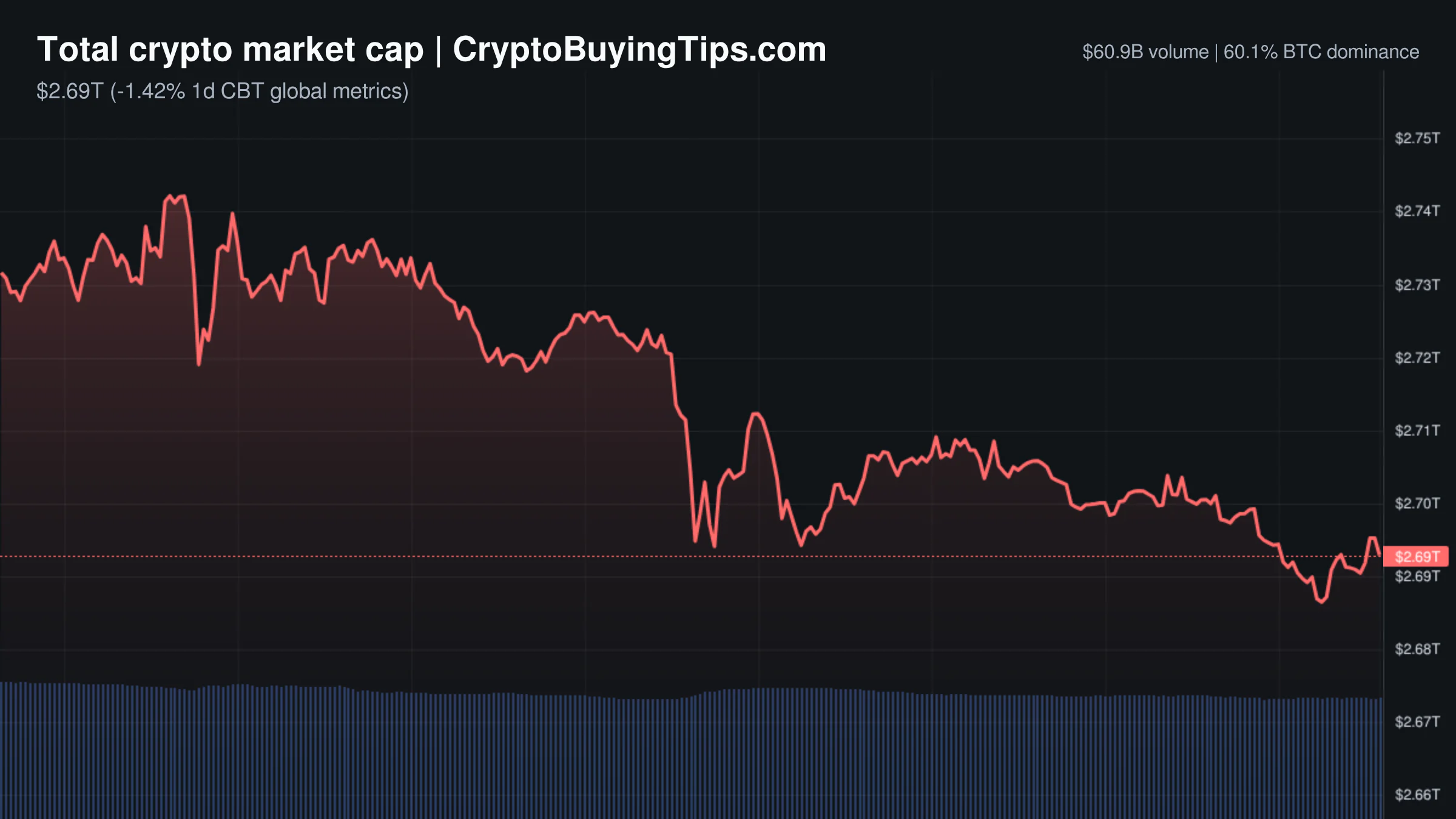
Crypto Market Overview | Derivatives volume dwarfs spot activity amid regulatory uncertainty and institutional outflows | October 24, 2026
Derivatives volume dwarfs spot activity amid regulatory uncertainty and institutional outflows, showing market…

Fidelity outflows and Ethereum OG dumps suggest a hidden exit
Another day of market data suggesting everything is fine until you look at the outflows and OG dumping. Institutional…