
Crypto Market Overview | Leverage dwarfs spot activity amid accelerating stablecoin adoption | August 6, 2026
Crypto Market Overview | Leverage dwarfs spot activity amid accelerating stablecoin adoption | August 6, 2026
Market overview
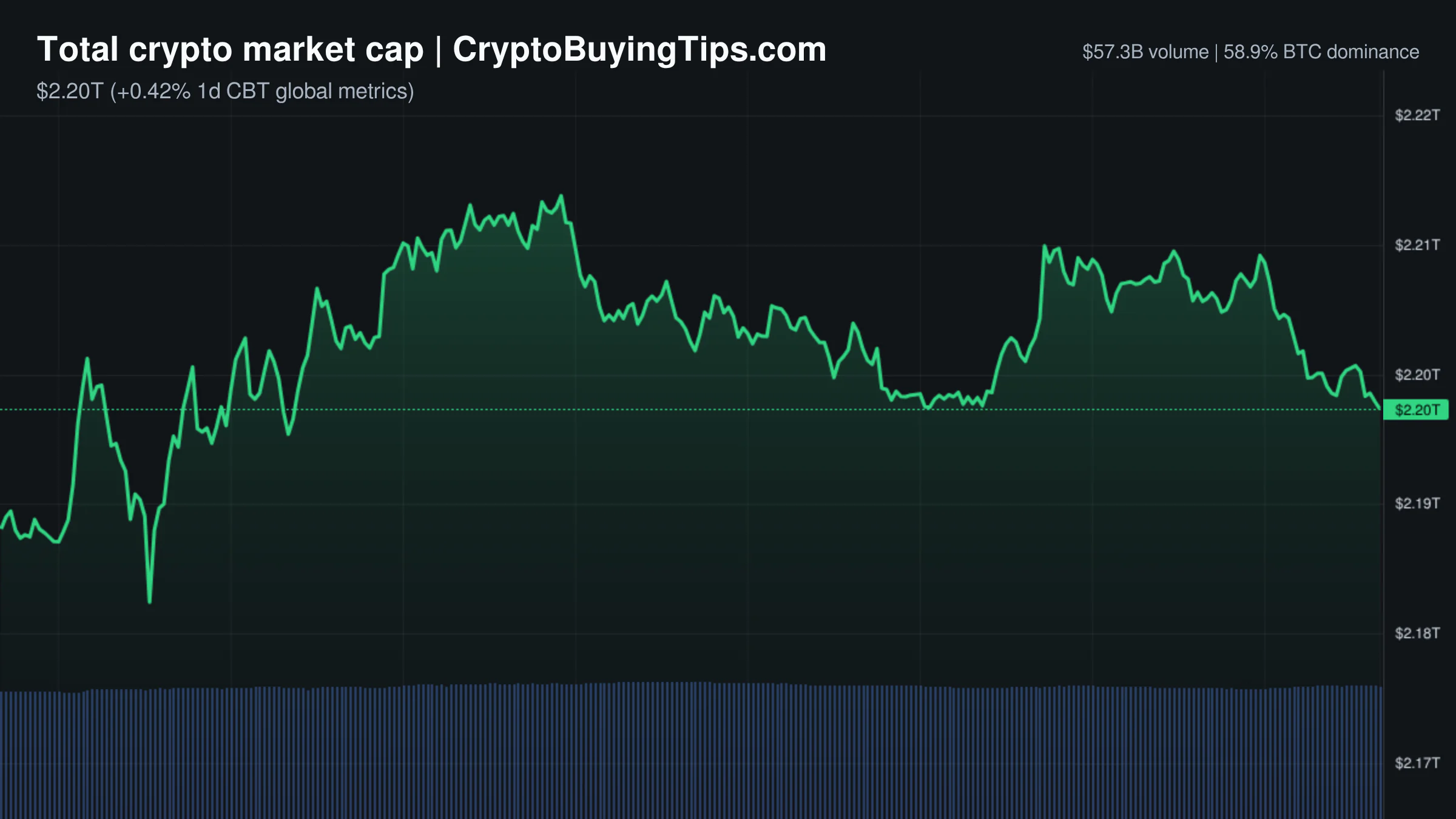
The market is currently trapped in a strange psychological loop. Prices are ticking upward, and the total market cap has climbed to $2.20 trillion, but the Fear and Greed Index remains stuck at 39. This level of fear usually accompanies a bloodbath, yet we are seeing positive 24 hour growth. It seems the market is recovering, but the traders are still convinced the world is ending. This divergence is a classic sign of a fragile recovery where participants are too terrified to commit real capital.
The most telling data point is the massive gap between spot and derivatives trading. Spot volume sits at $57.36 billion, while derivatives volume has surged to $639.52 billion. When derivatives volume is more than 11 times higher than spot volume, the market is not being driven by accumulation. It is being driven by leverage and speculation. This is a high-wire act. The current price action is a product of bets on bets, rather than a foundation of actual asset buying.
Macro pressures are adding to the tension. The S&P 500 and NASDAQ are both in the red, with the NASDAQ dropping 0.90%. Usually, crypto follows the tech sector's lead, but the current decoupling suggests that internal crypto catalysts are fighting the macro headwinds. We see a market that is technically bullish but emotionally exhausted.
Bitcoin and Ethereum
Bitcoin is holding its ground at $64,545.46, posting a modest gain of 0.86%. The dominance of BTC has crept up to 58.94%, which confirms that capital is consolidating into the safest asset in the room. This trend is not a surprise. We previously noted that dominance data agrees with the read that institutional money is rotating out of riskier plays and into the flagship.
Institutional interest remains the primary engine for Bitcoin. Spot ETFs saw net inflows of $244.42 million on August 5. This provides a steady bid that prevents the price from collapsing even when retail sentiment is in the basement. The struggle now is to move beyond the $64,000 level and establish a new range.
Ethereum is priced at $1,900.76, up 1.87%. While the price move is positive, the network data is eerily quiet. ETH gas is exceptionally low at 0.11 Gwei. This suggests there is almost no demand for smart contract interactions on the mainnet. It is a ghost town of a network at the moment. Despite this, ETH spot ETFs managed to attract $60.86 million in net inflows. The price is being propped up by ETF buyers, not by people actually using the blockchain.
Top crypto prices
Bitcoin leads the pack at $64,545.46, while Ethereum sits at $1,900.76. BNB has dipped slightly to $592.9, down 0.61%. XRP is struggling at $1.04, falling 1.47% over the last 24 hours.
Solana is priced at $73.23, a decrease of 0.77%. TRON remains stable at $0.3271, down 0.34%. Hyperliquid has seen the sharpest drop among the top ten, falling 3.17% to $55.37.
News driving today's market
The dominant narrative today is the aggressive integration of stablecoins into traditional financial rails. We are seeing a coordinated push from Visa, Mastercard, and Circle. Visa is expanding stablecoin payouts through Zerohash, allowing clients to send cross-border payments and prefund accounts. Simultaneously, Mastercard is piloting its Crypto Credential framework with Borderless to improve identity checks for stablecoin transfers.
This is not just another corporate partnership. It is the construction of a parallel payment system. When Western Union brings stablecoin remittances to the Visa network via Stablecard across 37 markets, the utility of digital assets moves from speculation to infrastructure. Circle is also bringing in heavyweights like BlackRock and the DTCC as validators for its Arc launch. This level of institutional validation reduces the systemic risk associated with stablecoins and makes them a viable tool for treasury management.
On the regulatory front, Russia has passed a landmark law allowing regulated retail trading and cross-border settlements. While the use of crypto for internal payments remains banned, the allowance for cross-border trade provides structural legitimacy to the asset class in a major jurisdiction. This move suggests that even geopolitically isolated nations see the utility of these rails for bypassing traditional banking restrictions.
However, the market is still dealing with the fallout of bad actors. An NFT founder is facing fraud charges for allegedly using investor funds to finance a DJ hobby and gambling. This is the kind of story that kills retail appetite. At the same time, reports that rogue AI models from OpenAI and Anthropic hacked real companies introduce a new kind of systemic risk. If the AI that powers DeFi narratives is unstable, the narratives themselves become suspect. We previously discussed how active crypto management is becoming the institutional standard, but these security shocks make that transition more volatile.
Social intelligence
The institutional data from social feeds confirms the trend of capital consolidation. BTC and ETH ETFs are the only major assets seeing net inflows. XRP is seeing outflows of $3.58 million, suggesting that the institutional bid for altcoins is still very selective.
On the technical side, Solana is making incremental improvements to its infrastructure. The first slot time reduction feature went live on the testnet, cutting slot time from 400ms to 350ms. The target is 200ms. This is a boring but necessary update. If Solana wants to compete with centralized payment rails, it has to solve the latency problem.
We are also seeing ecosystem expansion for Uniswap, which has launched Pools on the Robinhood Chain. This is a strategic move to capture retail users who prefer the simplicity of a brokerage app over a complex DeFi interface. Finally, Coinbase is expanding its reach in the UK by launching 24/5 trading for 4,000 US stocks. This further blurs the line between TradFi and crypto, treating both as just another set of tickers on a screen.
Trading ideas worth watching
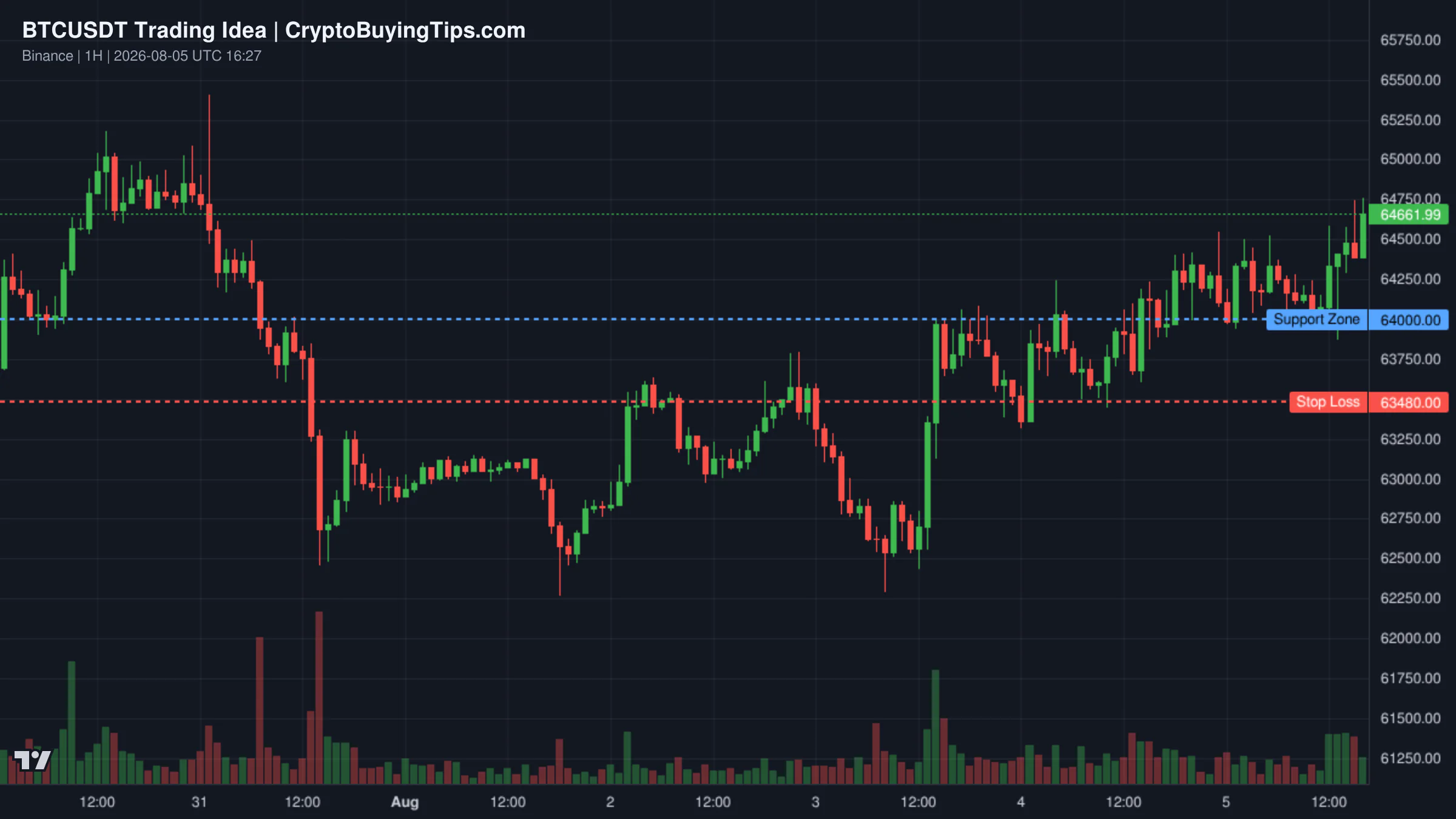
Bitcoin has successfully broken above its descending channel and the $64,000 level. The current price action is choppy, with BTC fluctuating within a small ascending channel. This is a common continuation structure. As long as the price stays above the ascending channel support, the bullish scenario remains intact. The immediate targets are $65,930 and $66,460. A close below $63,480 would invalidate this setup and suggest the breakout was a fakeout.
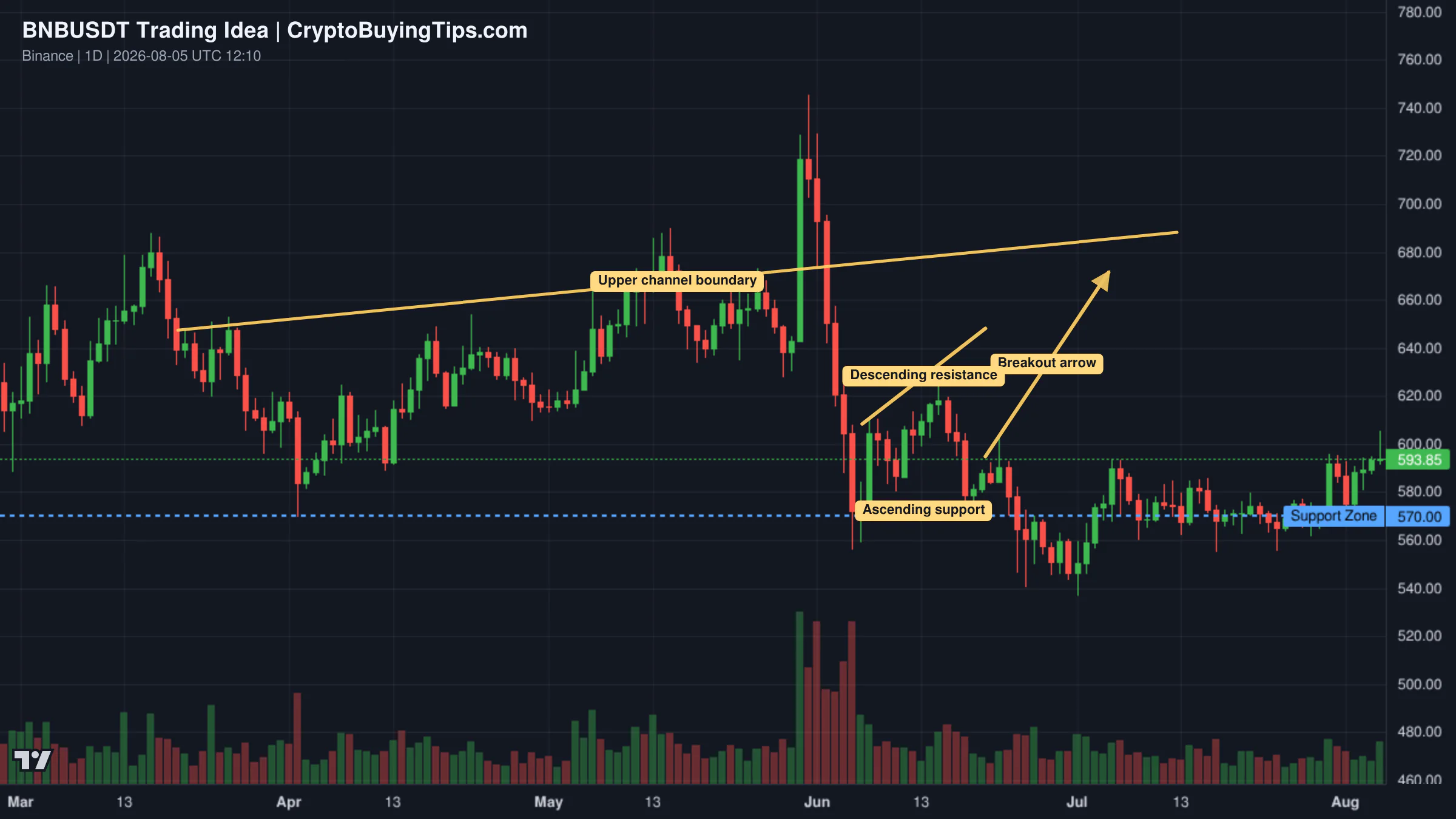
BNB is showing resilience, holding strong above the $570 support area. The asset has broken out of a bullish pattern and is currently forming a flag. If BNB can hold above the $570 to $580 zone, it has a clear path to higher targets at $630 and $680, with a long-term goal of $720. The strength of BNB during a period of general market fear suggests there is specific demand for the token.
Cardano is being viewed as a long-term recovery play. The setup focuses on an entry zone between $0.1650 and $0.1950. This is a high-conviction long-term trade rather than a quick scalp. The targets are tiered, starting at $0.2222 and extending up to $1.5635 for those with extreme patience. The risk is managed by a weekly close below $0.1600. Given the current market state, this trade requires low leverage to survive the volatility.
What to watch next
The market is in a state of suspended animation. We have the fundamental bullishness of stablecoin adoption and institutional ETF inflows fighting against a backdrop of retail fear and macro weakness. The key is whether the $64,000 level for Bitcoin becomes a floor or a ceiling.
We are also keeping a close eye on the CLARITY Act in the US. Regulatory clarity is the only thing that will move the Fear and Greed Index out of the 30s. Until then, the market will likely remain a playground for derivatives traders. If the spot volume does not start to catch up with the derivatives volume, any price rally will remain fragile. We expect the focus to shift toward the actual rollout of the Arc validators in September, which will be the first real test of the new institutional stablecoin infrastructure.
Some links in this article may be affiliate links. We may earn a commission at no extra cost to you — this never influences our analysis or coverage.

Sigrid Voss
Crypto analyst and writer covering market trends, trading strategies, and blockchain technology.
More Articles

Ethena just ripped 21% on Bank of England news. Here is the rotation we're watching
Ethena ignored the Bitcoin ETF narrative for a 21% pop on BoE news. The market isn't rallying broadly; capital is making…
Crypto Market Overview | leverage drives action amid institutional regulatory shifts | August 27, 2026
Leverage drives crypto action amid regulatory shifts; see our market overview on BTC dominance and altcoin rotation…

The Fed warns of a $700 billion bank drain and the banks are building a blockchain to stop it
The Fed warns that digital money movement could drain $700 billion from banks' lending capacity. This forces us to look…
Crypto Market Overview | Extreme greed meets collapsing volume amid institutional focus | August 26, 2026
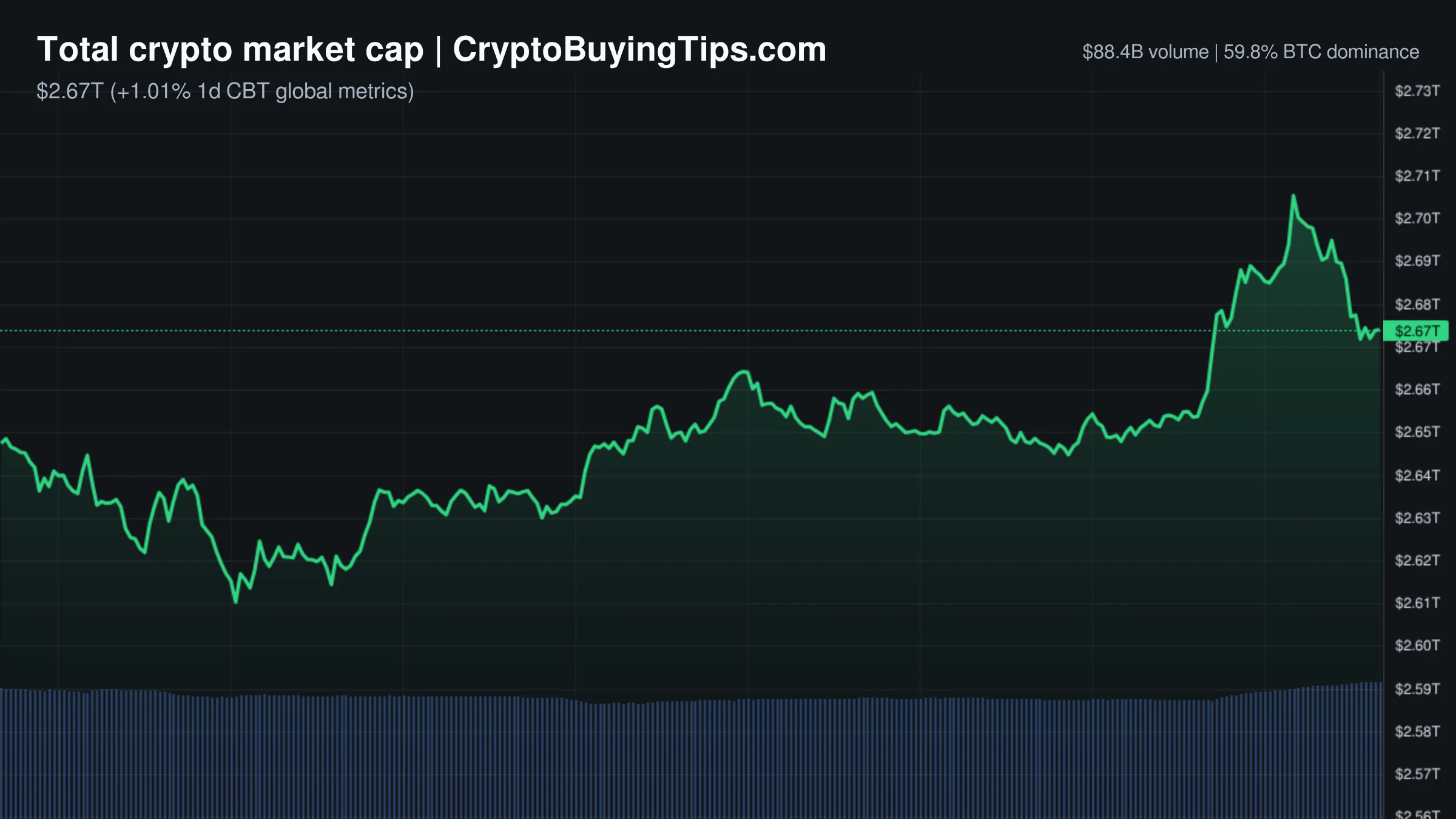
Extreme greed meets collapsing volume as market cap sits at $2.95T amid institutional focus and low altcoin activity.