
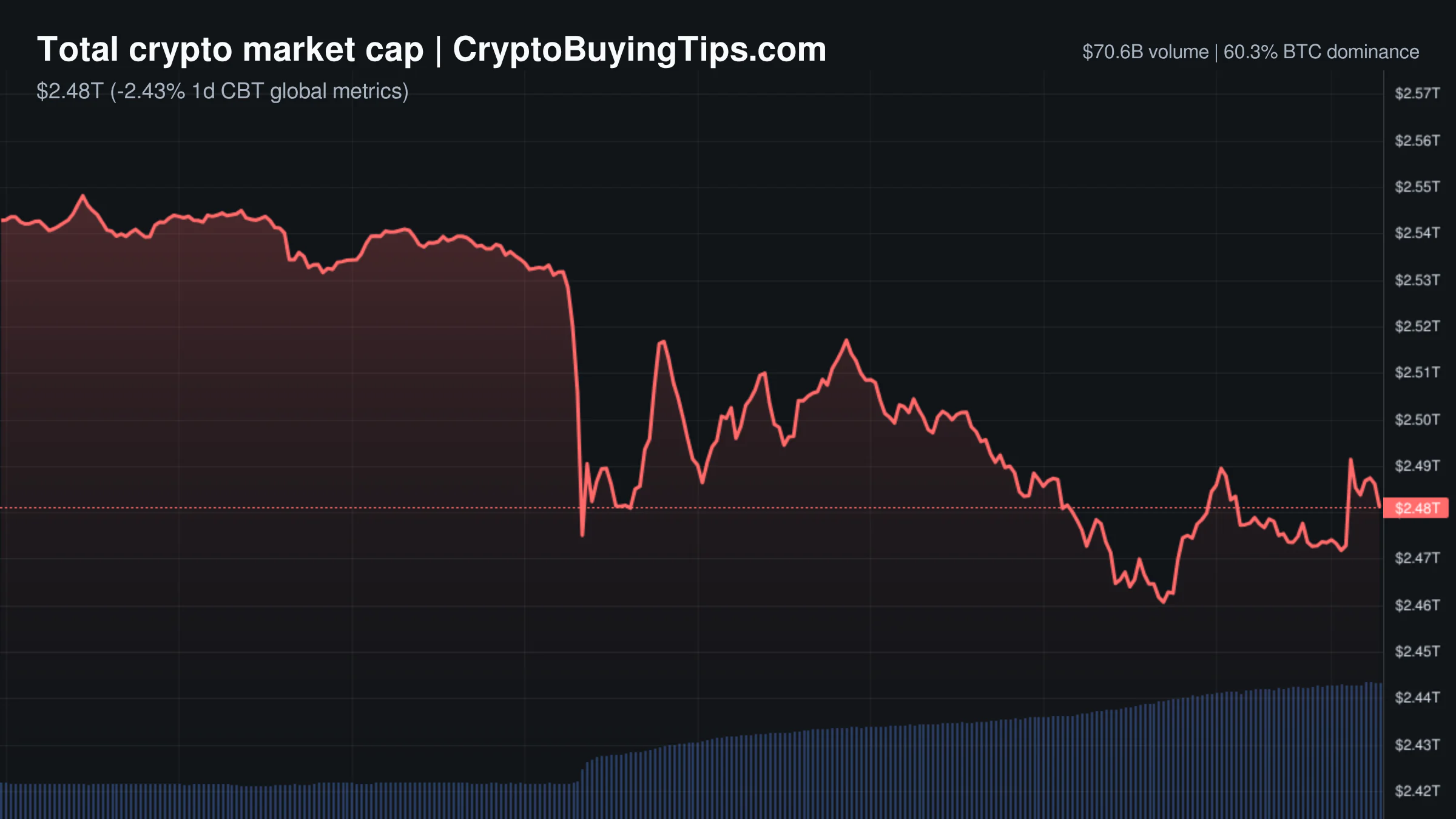
Crypto Market Overview | volume surges amid geopolitical risk and institutional outflows | November 9, 2026
Crypto Market Overview | volume surges amid geopolitical risk and institutional outflows | November 9, 2026
Market overview
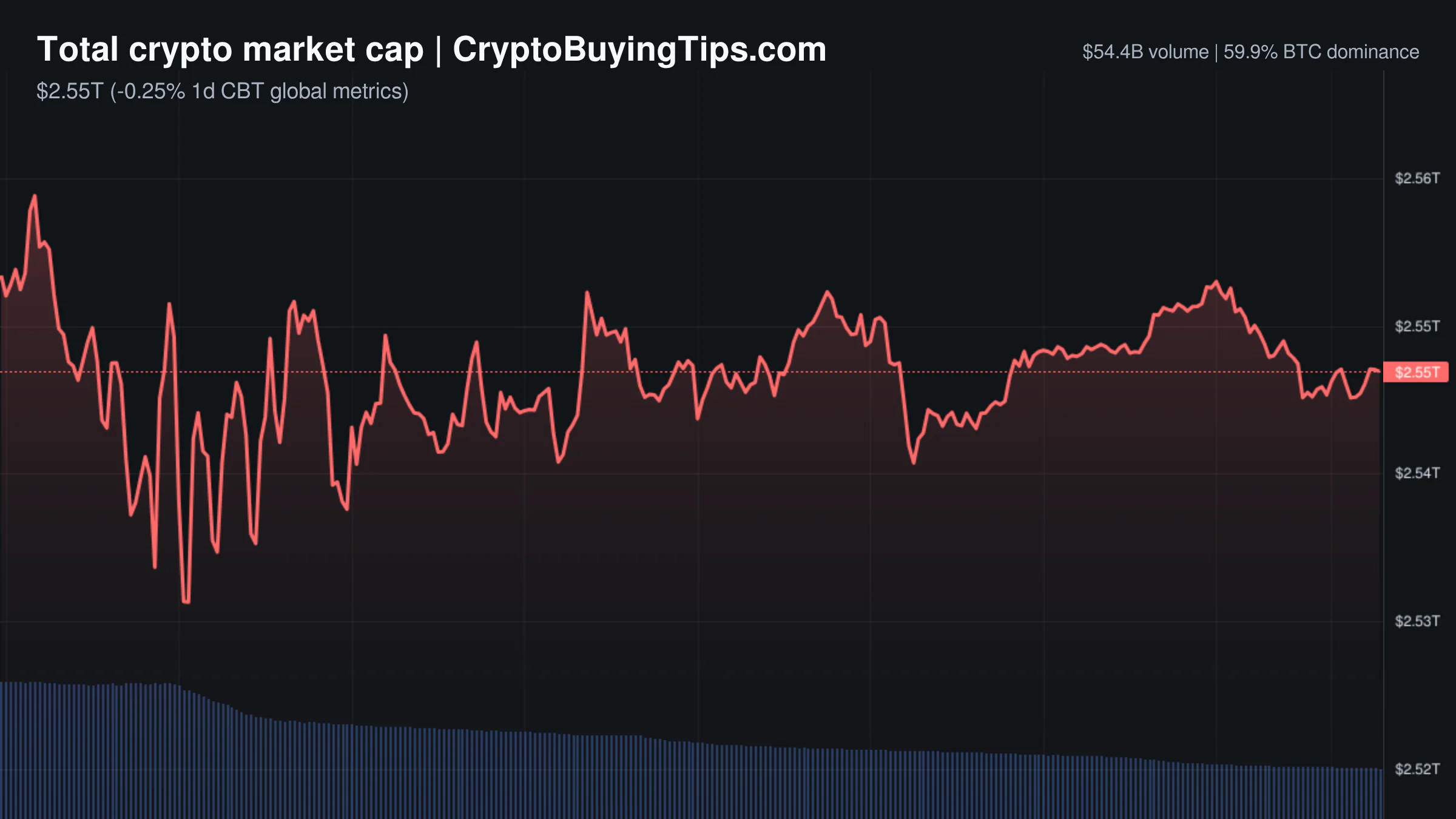
The market is currently experiencing a violent contradiction. Prices are sliding, yet trading volume is exploding. Spot volume is up 143 percent and derivatives volume has surged by 211 percent. This is not the quiet drift of a tired market; it is a high-conviction flush. The Fear and Greed Index has dropped to 27, placing the market firmly in Fear territory. Usually, such a gap between price action and volume suggests a liquidation event where leveraged positions are being wiped out in haste.
This correction is happening in a vacuum relative to traditional equities. The S&P 500 and NASDAQ are both trading in the green, with the NASDAQ up 1.40 percent. Crypto is decoupling from the broader risk-on trade, suggesting the current pain is specific to the digital asset sector rather than a macro collapse. Bitcoin dominance has climbed to 60.26 percent. This indicates that while Bitcoin is falling, altcoins are falling faster. We are in a clear Bitcoin season, though it is a season where the lead asset is merely the safest place to hide during a storm.
Liquidity is shifting toward the sidelines. Stablecoin dominance sits at 9.94 percent, and stablecoin volume has risen 144 percent. Traders are not just selling; they are moving into USDT and USDC to wait for a floor. The Altcoin Season Index is at 41, which is neutral, but the price action for everything outside the top two is decidedly bearish.
Bitcoin and Ethereum
Bitcoin is trading at $74,345.57, down 2 percent over the last 24 hours. The primary drag is institutional. Bitcoin ETFs saw a net outflow of $1.3 billion over the last week, the largest since June. When the regulated pipes start leaking this much capital, the price rarely finds a quick bottom. The market is reacting to a combination of political uncertainty in the US and a broader tech sell-off that has finally reached the ETF holders.
Ethereum is having a significantly worse day, down 5.56 percent to $2,112.46. The network is effectively a ghost town. Gas fees have plummeted to between 0.11 and 0.14 Gwei, suggesting that on-chain activity has evaporated. Vitalik Buterin has suggested that Ethereum should be viewed as a store of value rather than a fee-burning token, but the market is currently treating it as a high-beta risk asset. The disconnect between the founder's vision and the current price action is stark.
Top crypto prices
Bitcoin leads the market at $74,345.57. Ethereum follows at $2,112.46. BNB is trading at $683.53, down 2.07 percent. XRP has taken a harder hit, dropping 7.06 percent to $1.08. Solana is at $86.11, down 3.81 percent. TRON is one of the few assets showing relative strength, down only 0.82 percent to $0.3174. Hyperliquid has fallen 5.51 percent to $73.09.
News driving today's market
The dominant narrative today is a strange mix of geopolitical scandal and regulatory progress. The most immediate shock is the news that Nvidia's board is investigating CEO Jensen Huang over allegations involving a Chinese spy. Because Nvidia provides the compute infrastructure that powers much of the AI and crypto world, this has triggered a ripple effect. Nvidia perpetuals on Binance dropped 4.2 percent, and the uncertainty has bled into Bitcoin sentiment. We previously covered XRP institutional winner analysis for more background.
Simultaneously, Coinbase has received a full US national trust bank charter from the OCC. This is a massive win for institutional legitimacy, as it allows the exchange to hold digital assets as a fiduciary. In any other market, this would be a major bullish catalyst. Today, however, the market is largely ignoring the bank charter in favor of the Nvidia drama and political headwinds.
The US election results have also weighed heavily. The strong performance of the Democrats has been interpreted as a signal for tighter cryptocurrency regulations and potential investigations into the Trump family's crypto interests. This political shift is creating a risk premium that traders are unwilling to pay right now. We previously covered how dominance data agrees with the trend of capital consolidating into Bitcoin during periods of risk aversion.
Further pressure comes from the US Senate. Senator Richard Blumenthal has set a November 30 deadline for Binance and Tether to produce records. The threat of further action if they miss the January deadline adds another layer of regulatory risk to the two largest players in the ecosystem. This coincides with news that Binance France is closing user accounts on December 31, adding to the feeling that the regulatory walls are closing in on centralized exchanges.
Social intelligence
On-chain data shows some signs of hidden accumulation. A dormant wallet that had been inactive for two years suddenly withdrew 34,601 ETH from Binance, worth roughly $73.75 million. While the rest of the market is panicking, some whales are moving assets into private custody.
Technical analysts are divided on the Bitcoin floor. Alex Thorn of Galaxy noted that Bitcoin has slipped below its 50-week average. He pointed out that historically, after a bear market bottom, this specific dip has not led to new lows. It is a comforting thought, though perhaps cold comfort for those currently staring at a red portfolio.
The institutional picture remains grim. Social data confirms the ETF outflows, with Bitcoin seeing a $1.28 billion exit and Ethereum losing $365 million. CZ has attempted to shift the conversation toward tokenized stocks, arguing that 24/7 trading gives investors an edge on news. This is a structural argument for the future, but it does little to stop the current bleed.
Trading ideas worth watching
The outlook for Bitcoin is a battle between short-term political fear and long-term technical support. One analysis suggests that the Democratic victory in the midterms has triggered an aggressive sell-off that could persist for weeks. This view sees Bitcoin breaking the 76,500 support zone, with targets now sitting at 73,500 and 71,600. This is a bearish read based on the assumption that regulatory pressure will intensify.
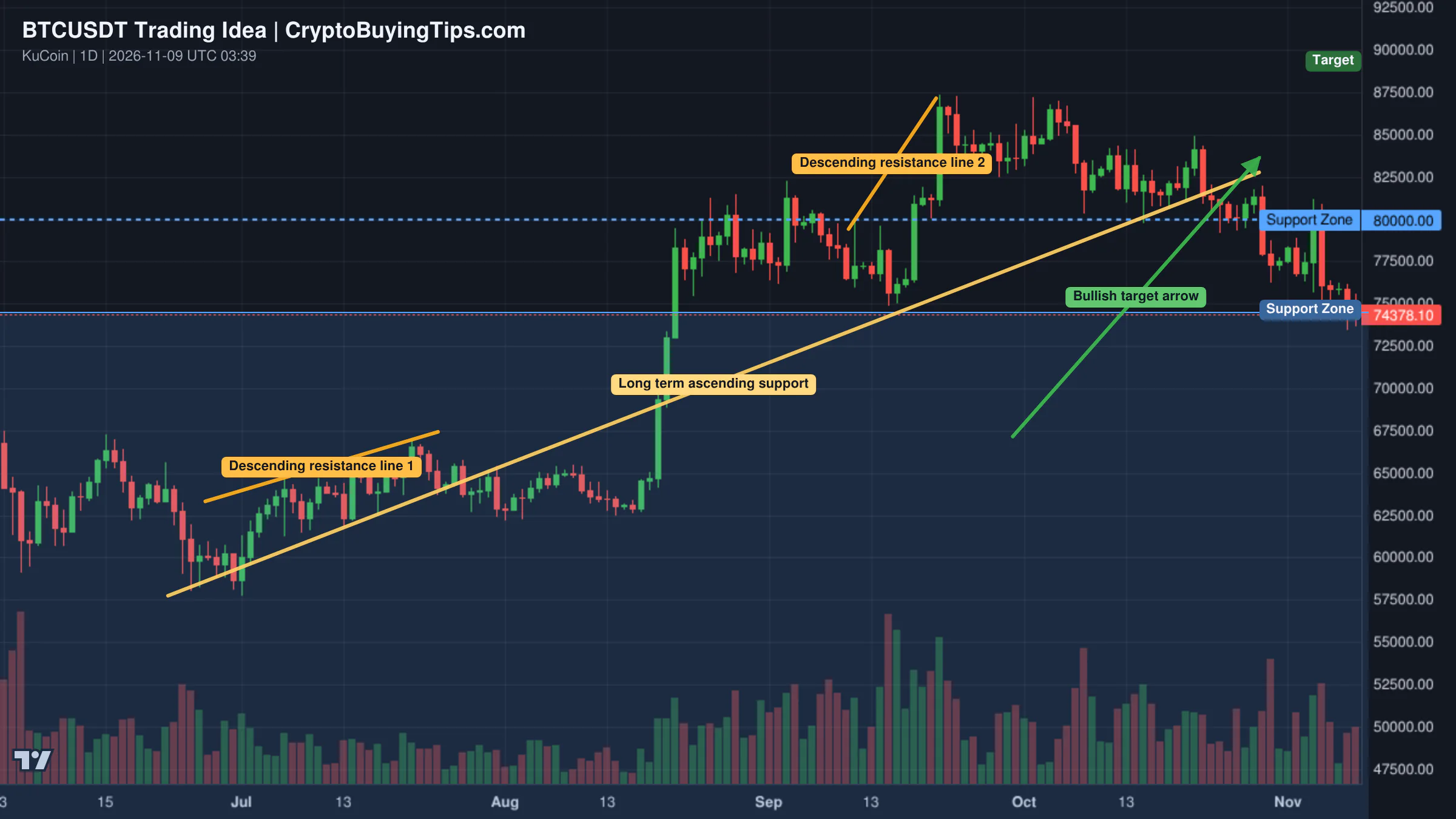
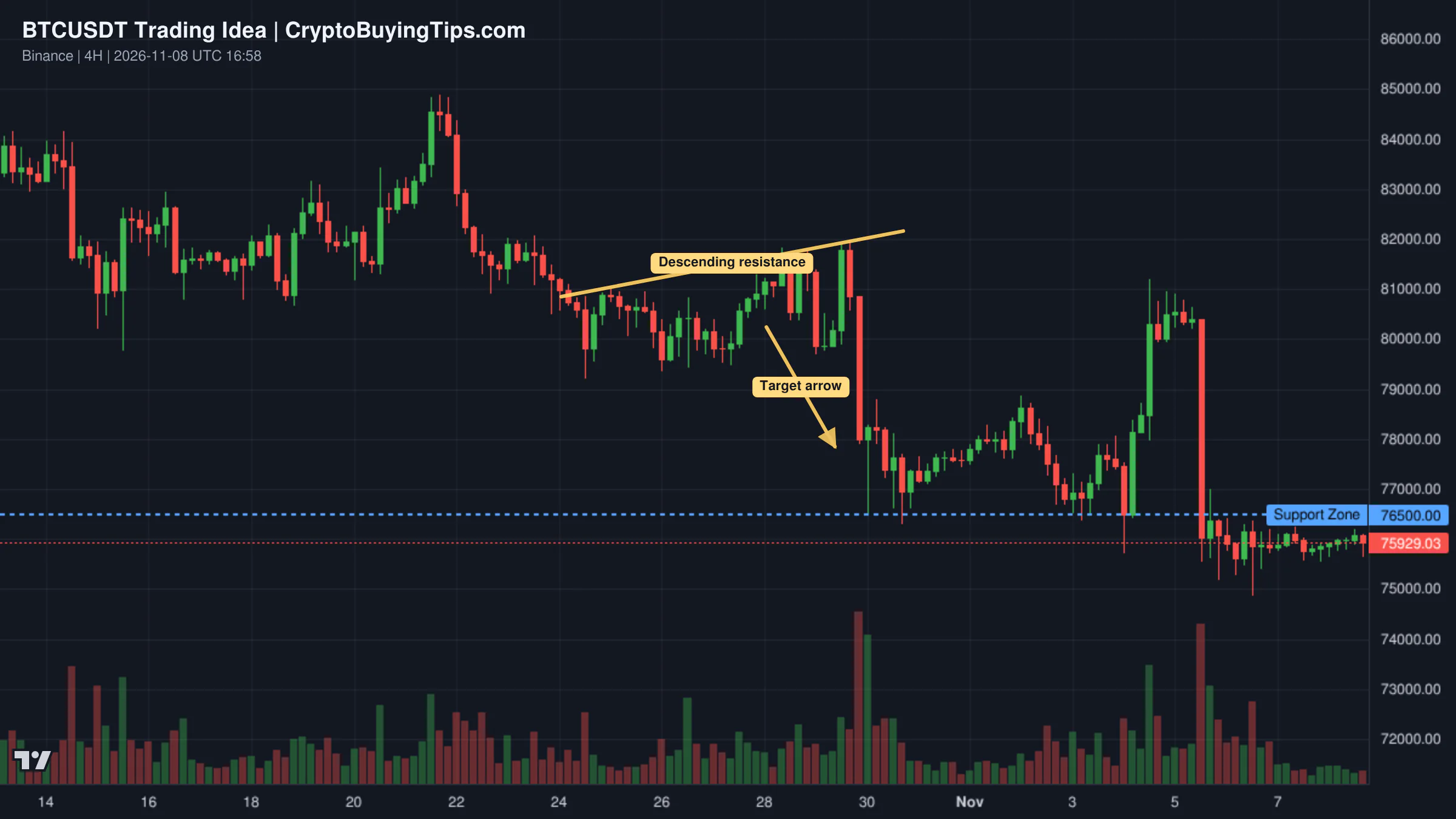
Conversely, some analysts argue that the current drop is a continuation of a retrace that started in September. This perspective holds that the low of $73,500 is a hard floor. The argument is that the lack of volume on the drop suggests a shakeout rather than a trend reversal. This view anticipates a bullish advance starting around mid-November, with a potential major high in January 2027. The contradiction here is clear: one side sees a political death spiral, the other sees a healthy flush before a rally.
For Ethereum, the focus is on the $2,000 psychological level. Analysis suggests that the 0.5 Fibonacci retracement has been lost, making the area just below $2,000 the next major support zone. There is a strong bullish bias for those looking to buy the dip, with the expectation that a recovery will begin in the second half of November. However, the current lack of network activity makes this a risky bet.
What to watch next
The immediate focus is on the Nvidia investigation. If the scandal involving Jensen Huang deepens, the contagion could spread from AI stocks into the broader tech-crypto overlap. The market is currently treating Nvidia as a proxy for the AI-crypto narrative; any instability there is a direct hit to sentiment.
The next hard date is November 30, the Senate records deadline for Binance and Tether. Any news of non-compliance or aggressive legal escalation from Senator Blumenthal will likely trigger another round of selling in centralized exchange-linked assets.
Finally, we are watching the mid-November window. Several technical setups suggest this is the period where the current correction either finds a definitive floor or accelerates toward the $71,000 level for Bitcoin. The gap between the bullish long-term maps and the bearish political reality is where the volatility will live for the next two weeks.
Some links in this article may be affiliate links. We may earn a commission at no extra cost to you — this never influences our analysis or coverage.

Sigrid Voss
Crypto analyst and writer covering market trends, trading strategies, and blockchain technology.
More Articles

Vitalik wants Ethereum to be a store of value because the gas data says he has to
The narrative shift from transaction utility to store of value seems rather convenient given current gas fees. With…
Crypto Market Overview | volume collapse amid regulatory heat hitting centralized exchanges | November 8, 2026
Crypto market overview shows volume collapse amid regulatory heat hitting centralized exchanges; see why liquidity is…

The $1.28B ETF exodus is real but the signal scanner sees a different story
The $1.28B ETF exodus sounds dramatic enough to warrant an emergency meeting; our signal scanner suggests that headline…
Crypto Market Overview | volume collapse amid regulatory crackdowns and whale accumulation | November 7, 2026
Crypto market overview shows volume collapse amid regulatory crackdowns and whale accumulation data points to internal…