
Crypto Market Overview | DeFi security fears mount | May 27, 2026
Crypto Market Overview | DeFi security fears mount | May 27, 2026
Market overview
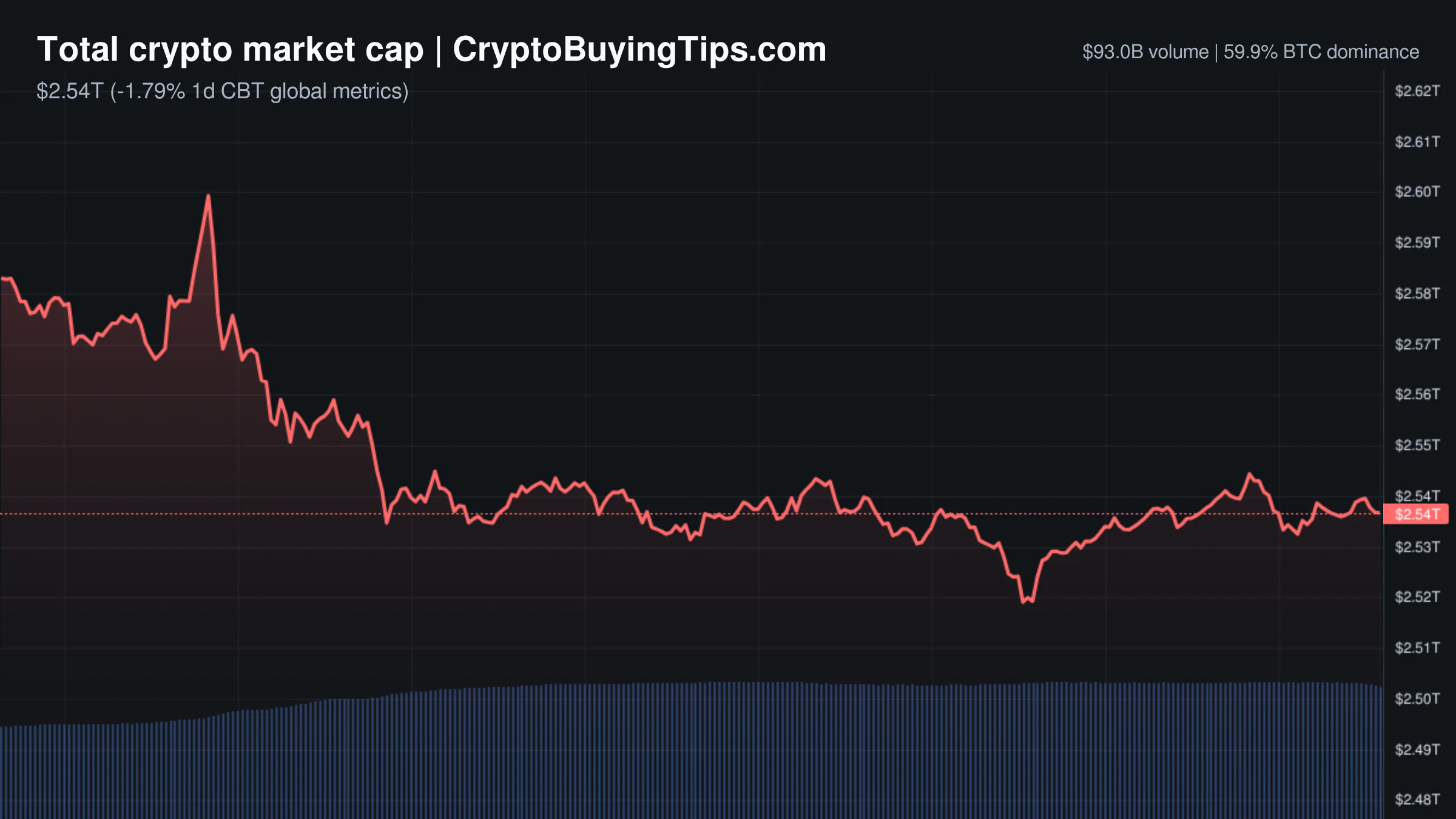
The crypto market is currently in a short-term bearish trend, with the total market cap falling 1.89% to $2.54T. While prices are sliding, trading activity is surging. The 24h spot volume rose 32.61% to $93.09B, but this is dwarfed by the derivatives market, where volume climbed 33.63% to $716.67B. When derivatives activity outweighs spot trading by such a wide margin, it usually indicates that the current price action is being driven by high leverage and speculative bets rather than organic buying or selling.
Sentiment has shifted firmly into the fear zone, with the Fear & Greed Index sitting at 37/100. This anxiety is reflected in the heavy rotation into stablecoins, as stablecoin volume jumped 34.46% to $98.78B. Traders are moving to the sidelines or preparing for further volatility. Bitcoin dominance remains high at 59.87%, which continues to limit the upside for most altcoins. With the Altcoin Season Index at 35/100, the market remains in a Bitcoin season, meaning any modest recovery in the broader market is likely to be led by the primary asset rather than a diversified altcoin rally.
Bitcoin and Ethereum
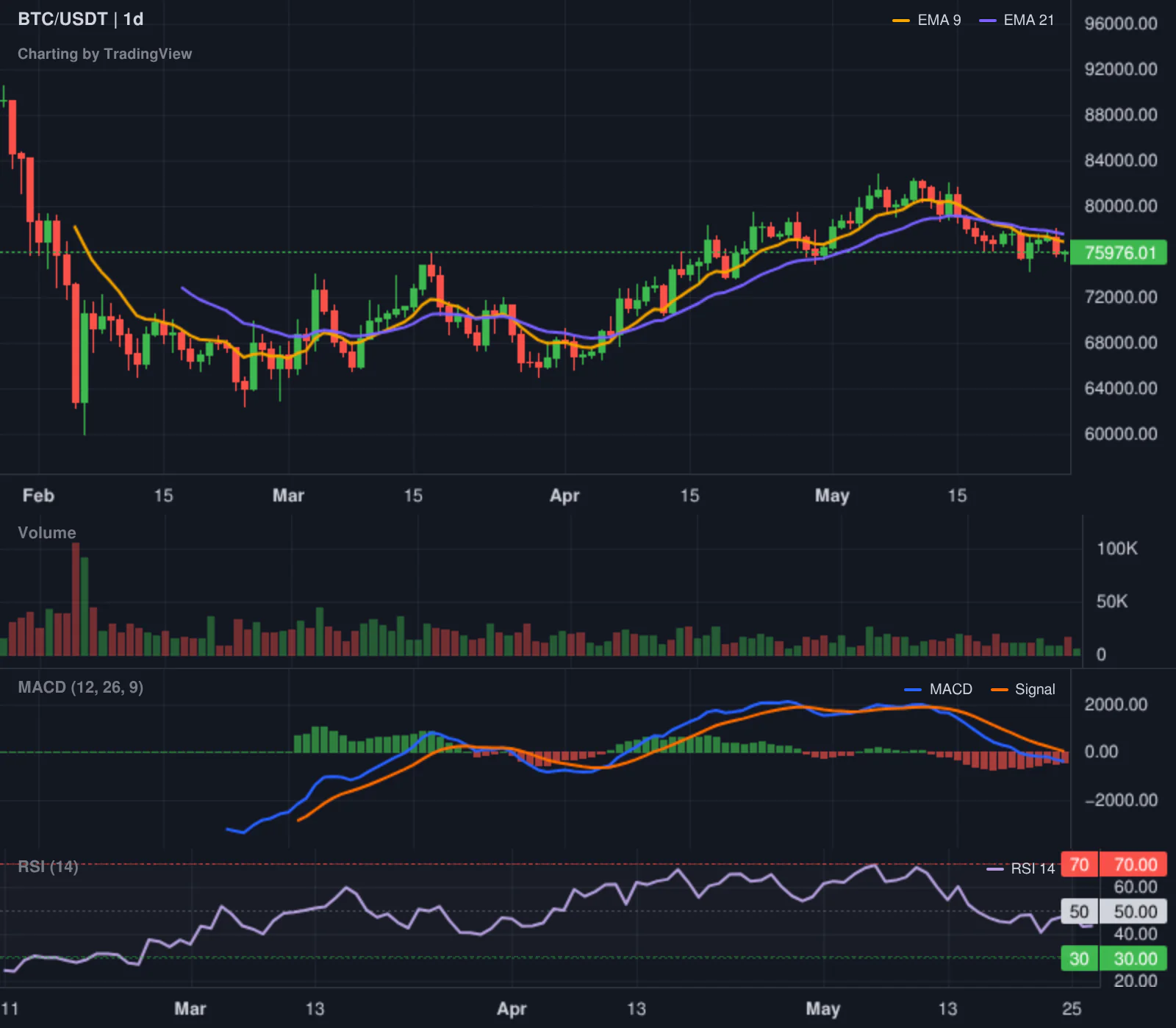
Bitcoin is trading at $75,804.67, down 2.05% over the last 24 hours. The price pressure is largely institutional. A single investor dumped $1.29 billion of BlackRock's IBIT ETF in a dark pool trade, a move that signals a significant scaling back of exposure by a major player. This isn't an isolated event, as U.S.-listed spot ETFs have seen net outflows for seven straight days, losing a total of $1.88 billion. The combination of institutional selling and stalled hopes for interest rate cuts is keeping a lid on any meaningful recovery.
Ethereum is under similar pressure, priced at $2,076.99 and down 2.32%. The network state is surprisingly quiet, with gas fees at an extremely low 0.17 Gwei. This suggests a lack of on-chain activity and a general absence of the "hype" that usually drives ETH price action. However, on-chain data shows some divergence in sentiment. A known smart trader recently bought 7,000 ETH, valued at $14.52M, and deposited the assets into Aave. This suggests that while the broader market is fearful, some high-conviction traders are using this dip to accumulate.
Top crypto prices
The broader market is seeing a synchronized decline. BNB is down 1.36% at $653.87, while XRP fell 2.07% to $1.32. Solana also dropped 2.09%, trading at $83.76.
A few assets are bucking the trend. TRON remained flat with a slight gain of 0.07%, sitting at $0.3725. More notably, Hyperliquid rose 2.10% to $62.8, showing strength even as the major caps bleed.
News driving today's market
Security concerns are currently the primary driver of market anxiety. Manuel Aráoz, the CEO of OpenZeppelin, has warned that all of DeFi is now unsafe. He argues that AI coding agents have become superhuman at finding vulnerabilities in smart contracts, making them nearly impossible to defend at human speed. This warning comes as DeFi's total value locked has dropped by over $20 billion this year. When a leading security expert advises friends and family to exit all DeFi positions, it creates a psychological ripple effect that pushes investors toward safer, more liquid assets. We previously covered Tokenized Stocks Explained for more background.
This fear is compounded by a fresh exploit at StablR. The issuer had to freeze USDR and EURR tokens after an attacker minted $13.5 million in unbacked tokens. The breach was linked to a weakness in a 1-of-3 multisig wallet. This event highlights the persistent risks in stablecoin architecture. We previously covered Stablecoin Security Risks and the dangers of centralized control, and the StablR incident is another example of how a single point of failure can jeopardize millions in user funds.
On the regulatory front, the United Kingdom has taken an aggressive stance by issuing sanctions against Justin Sun's HTX and other firms over alleged ties to Russia. This is the first time a major economy has applied banking-style sanctions to crypto exchanges. British financial institutions are now barred from doing business with these entities, which increases the regulatory risk for any exchange operating internationally.
In contrast, there is a sliver of optimism from the U.S., where President Trump is backing CFTC Chair Michael Selig's push to expand authority over prediction markets. This could potentially open new avenues for regulated crypto-linked financial products.
Social intelligence
On-chain activity is providing a mixed signal. While the macro trend is bearish, the debut of spot HYPE ETFs has been remarkably strong. According to data from Kairos Research, these ETFs absorbed 1.04% of the total market cap of Hyperliquid in just ten trading days. This is a faster absorption rate than the initial debuts of Bitcoin (0.59%), Ethereum (0.41%), and Solana (0.31%), suggesting strong institutional appetite for this specific asset.
Regulatory enforcement is also making headlines in Asia. South Korean prosecutors have made their first arrest in a DEX rug pull case involving the Solana-based meme coin CATFI. The suspect, who operated under the handle "Eth Father," allegedly manipulated the price and stole roughly $260,000 from investors. This marks a shift toward more active criminal prosecution for decentralized exchange scams, which may eventually improve investor confidence in the DEX space.
Altcoin Spotlight
Hyperliquid is the standout performer of the day. While most of the top 10 assets are in the red, HYPE has climbed 2.10% to $62.8. The strength appears to be driven by the successful launch of its spot ETFs. The fact that it is absorbing market cap at a rate higher than BTC or SOL during its first ten days of ETF trading suggests a high level of concentrated demand. In a market where most altcoins are being crowded out by Bitcoin dominance, HYPE is finding a unique catalyst to decouple from the general downturn.
What to watch next
The immediate focus for traders is the $75,000 level for Bitcoin. If the institutional exodus from spot ETFs continues, this psychological support will be tested. The massive $1.29 billion dark pool trade suggests that some of the largest players are hedging or exiting, which often precedes a larger move.
The DeFi sector is also at a crossroads. If more protocols suffer from AI-driven exploits, we could see a broader flight from on-chain finance into centralized exchanges. Keep an eye on Ethereum gas fees; if they remain this low, it indicates a lack of utility and demand that could keep ETH suppressed. Finally, the UK's sanctions on HTX may be a bellwether for other Western nations, potentially leading to a more fragmented global liquidity pool.
Some links in this article may be affiliate links. We may earn a commission at no extra cost to you — this never influences our analysis or coverage.

Sigrid Voss
Crypto analyst and writer covering market trends, trading strategies, and blockchain technology.
More Articles
Crypto Market Overview | leverage driving bitcoin's move amid institutional adoption and geopolitical risk | August 25, 2026
The market shows contradiction as leverage drives bitcoin's move amid institutional adoption and geopolitical risk…

Coinbase is putting stocks on Base, but the money is still in Bitcoin
Coinbase has launched tokenized stocks on Base, which sounds rather sophisticated for mere digital shares. However, our…
Crypto Market Overview | Leverage-driven rally amid strong ETF inflows as BTC targets 80k | August 24, 2026
Leverage-driven rally sees BTC near 80k amid strong ETF inflows; see our market overview on current crypto dynamics.

Derivatives volume is 8x higher than spot. Here is why that is a warning
The market's current price action seems to be driven by bets rather than cash; with derivatives volume eight times…