
Crypto Market Overview | Derivatives volume spikes while spot assets decline amid institutional friction | October 29, 2026
Crypto Market Overview | Derivatives volume spikes while spot assets decline amid institutional friction | October 29, 2026
Market overview
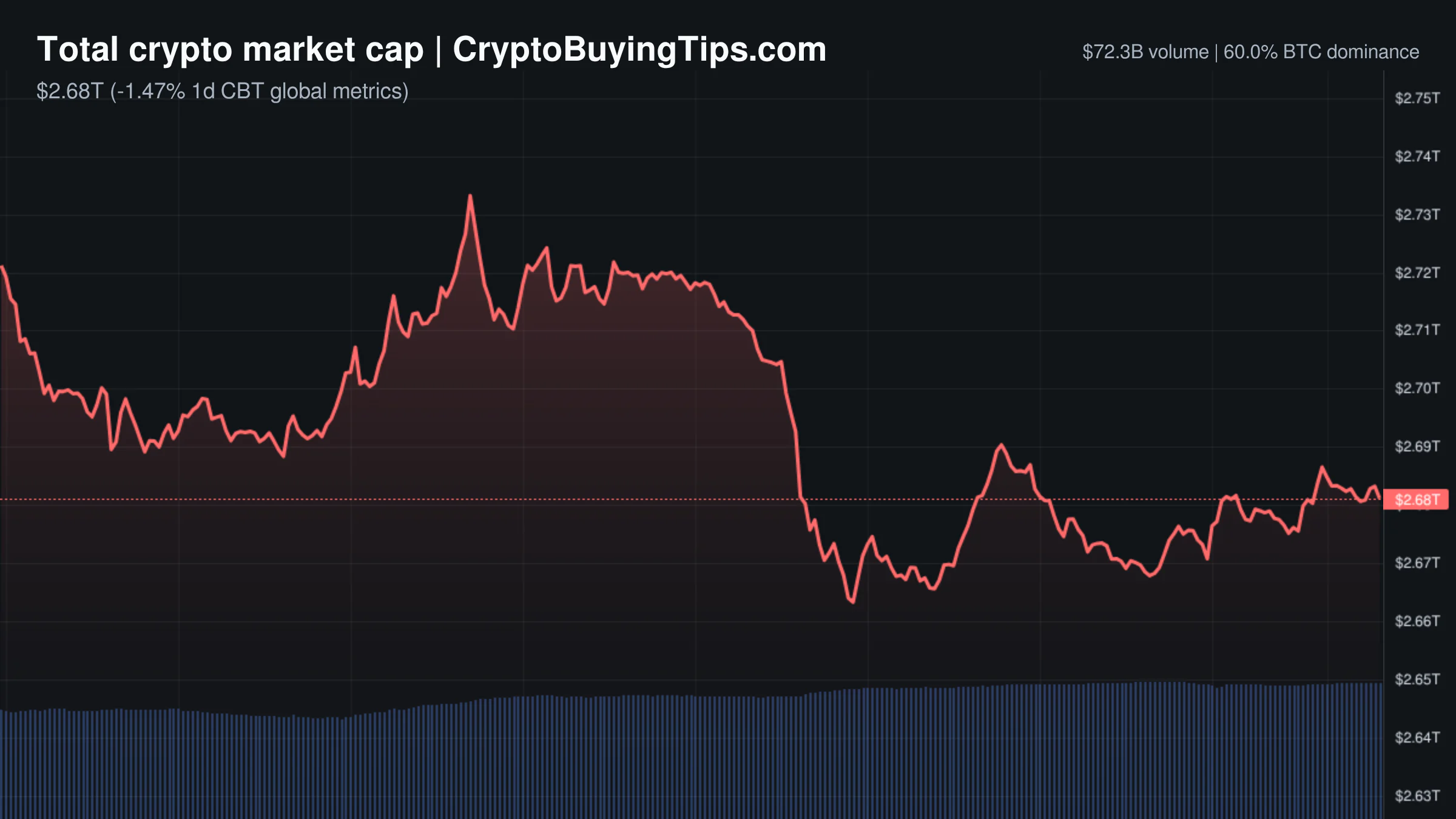
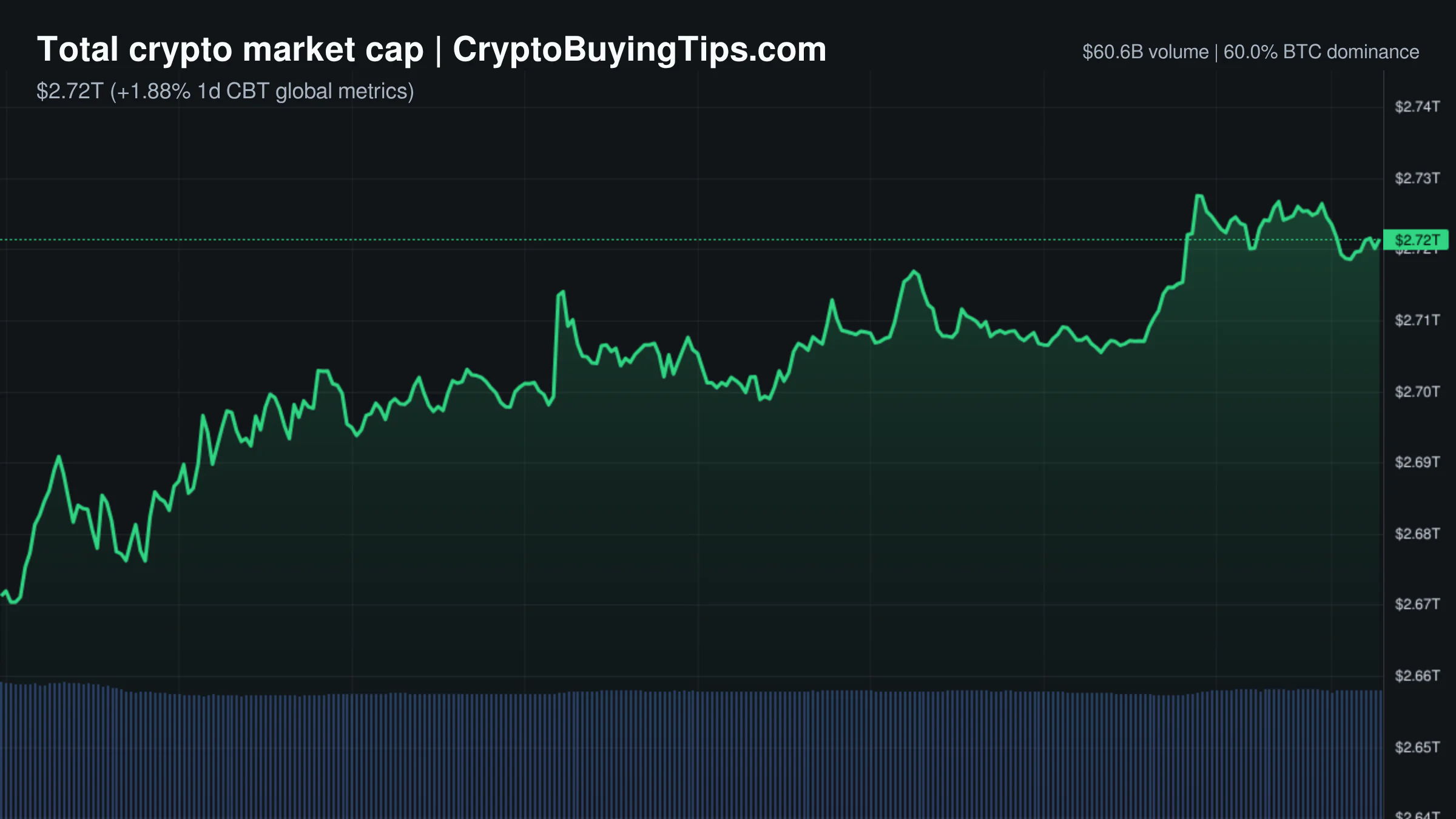
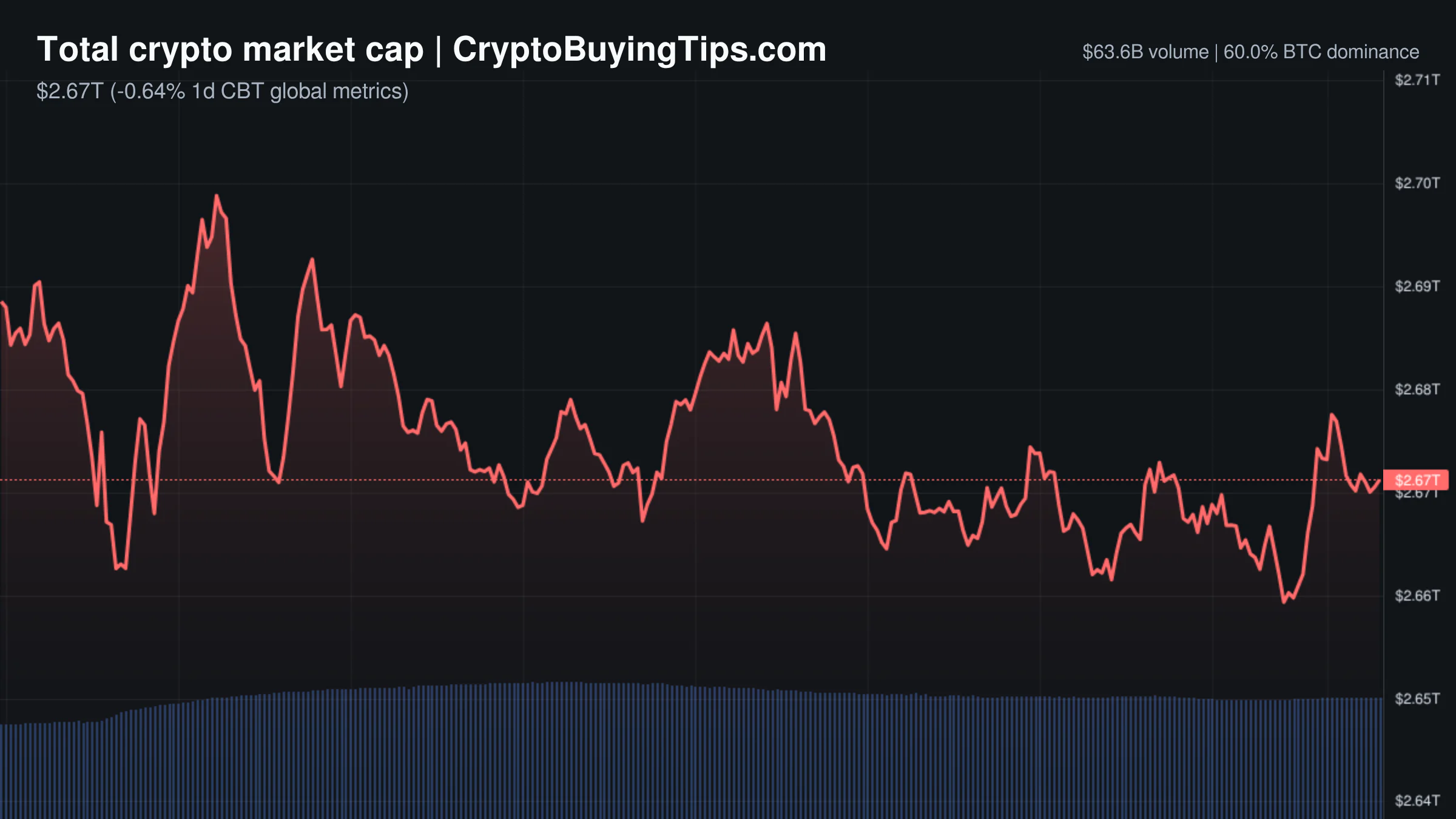
The crypto market is currently experiencing a strange sort of disconnect. While the S&P 500 and NASDAQ both posted modest gains, the total crypto market cap fell by 5.01% to $2.68T. This divergence suggests that the current dip is not a macro-driven risk-off event but something more internal to the digital asset space. The most telling data point is the volume. Spot trading volume grew by 19.40%, but derivatives volume exploded by 46.21% to $875.51B.
When derivatives volume outpaces spot growth by such a wide margin, it usually means the price action is being driven by leveraged bets and hedging rather than organic accumulation. Traders are not buying the dip with cash; they are gambling on the direction of the slide. Bitcoin dominance remains flat at 59.99%, which indicates that capital is not rotating into the flagship asset for safety. Instead, the entire market is sliding in unison, though Bitcoin is holding its value slightly better than the altcoin market.
Sentiment is currently neutral, with the Fear and Greed Index sitting at 44. This is a remarkably calm reading for a day where the market cap dropped by billions. It suggests a level of trader apathy or perhaps a collective agreement that this volatility is simply a Tuesday in crypto. The Altcoin Season Index at 38 confirms that we are far from an alt-season, as the majority of the market continues to struggle against the weight of Bitcoin's dominance.
Bitcoin and Ethereum
Bitcoin is trading at $80,067.6, down 1.44% over the last 24 hours. The price action is currently trapped in a tug-of-war between institutional adoption and technical vulnerabilities. On one side, the DTCC is bringing $30 trillion in securities closer to the blockchain, and Canada is introducing Bitcoin-backed mortgages. On the other side, a public exploit discovered by AI can now crash Bitcoin nodes on Windows and Macs. It is a classic crypto paradox: the plumbing is being adopted by Wall Street while the pipes themselves are being found to leak.
Ethereum is slightly worse off, trading at $2,323.38, a 1.60% decline. The network is currently a ghost town in terms of activity, with gas fees sitting at an exceptionally low 0.04 Gwei. This lack of on-chain demand is a concern, even as the CFTC chair suggests that AI-powered fridges might one day stake Ether. The gap between the regulatory fantasy of "autonomous AI agents" and the reality of a dormant network is wide.
The relationship between the two remains stable, but the lack of ETH momentum continues to feed the dominance of Bitcoin. We have previously noted that the dominance data agrees with a trend of capital consolidation. Until Ethereum can generate genuine on-chain utility that exceeds the current "fridge-staking" memes, it will likely continue to lag.
Top crypto prices
The broader market is mostly red. BNB fell 2.79% to $739.32, and XRP dropped 2.52% to $1.29. Solana is down 2.30% at $100.39. TRON is one of the few assets showing resilience, slipping only 0.15% to $0.3312.
The standout performer is Hyperliquid, which climbed 7.68% to $87.71. This move is likely a reaction to news that the owner of the NYSE is taking steps to bring Hyperliquid perpetual futures to the U.S. market. In a sea of red, a direct link to the NYSE is a powerful enough catalyst to ignore the general market trend.
News driving today's market
The primary narrative today is the corporate civil war over tokenization. We are seeing a split between the infrastructure providers and the asset owners. The DTCC's move to bring major banks into tokenization is a bullish signal for the technology. However, this is being countered by a growing list of objections. JPMorgan, Coca-Cola, and Dell are among 33 companies that have explicitly said no to having their shares traded on the OKX-ICE tokenized venue.
This friction shows that while the "rails" are ready, the corporations are not yet comfortable with their equity becoming a liquid token. This regulatory and corporate resistance creates a ceiling for the RWA narrative. It is a reminder that institutional adoption is not a monolith; the banks who build the systems often disagree with the companies whose assets are being tokenized.
On the fundamental side, Ripple is projecting a $900 million annualized product revenue run rate. This is one of the few examples of a project providing tangible business growth figures rather than vague roadmap promises. This supports our previous XRP institutional winner analysis, as Ripple continues to integrate into institutional payment flows while other assets rely on speculative fervor.
The most concerning news is the AI-discovered exploit for Bitcoin nodes. The fact that a language model could find flaws that can crash nodes on common operating systems is a reminder that the "secure" nature of the blockchain is only as strong as the software used to run it. This is a structural risk that the market has not yet fully priced in.
Social intelligence
The social sphere is currently focused on the tokenization of physical commodities. Reports that the London Metal Exchange plans to tokenize metals stored in Hong Kong for financing is a significant development. This is a more practical application of RWA than tokenized stocks, as it solves a real-world financing problem for physical assets.
Stellar is also gaining attention after introducing Project Thruput. Early benchmarks showing 7.02 million payments per second are impressive, but the market has a history of ignoring high throughput numbers if there is no actual traffic to fill the pipes.
There is also a lingering sense of distrust following testimony from the former FTX COO, who claimed she only learned of the liquidity crisis hours before the public. This serves as a reminder that in the crypto industry, "liquidity" is often a polite word for "we hope the money is still there."
Trading ideas worth watching
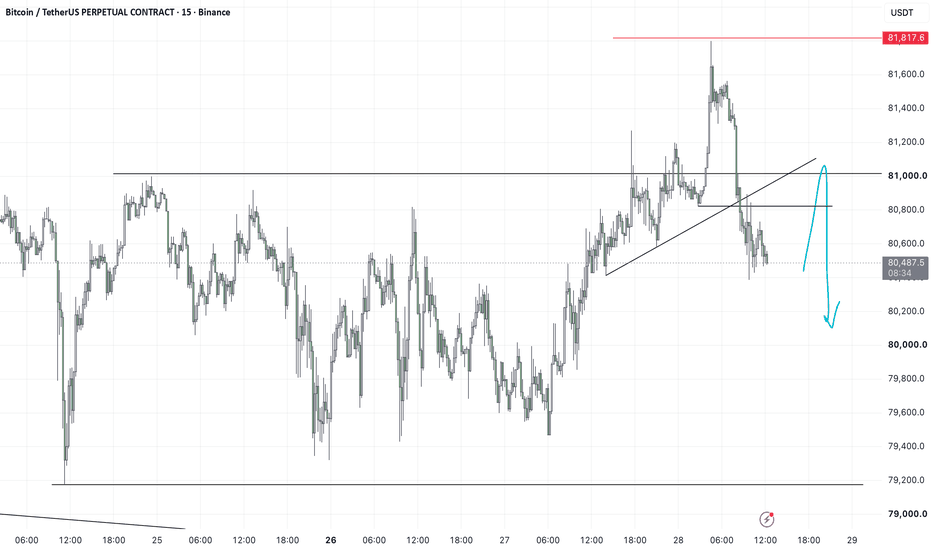
The short-term outlook for Bitcoin is contested. One analysis suggests that the recent move above $81,000 was a fake breakout. The price pumped to $81,800 before dumping back to the $80,500 range. For those looking for a short entry, a pullback to $80,822 with bearish confirmation could be a trigger. The primary targets for this move are $79,500 and $78,000. If the $79,500 level breaks, the move could accelerate toward $74,817.
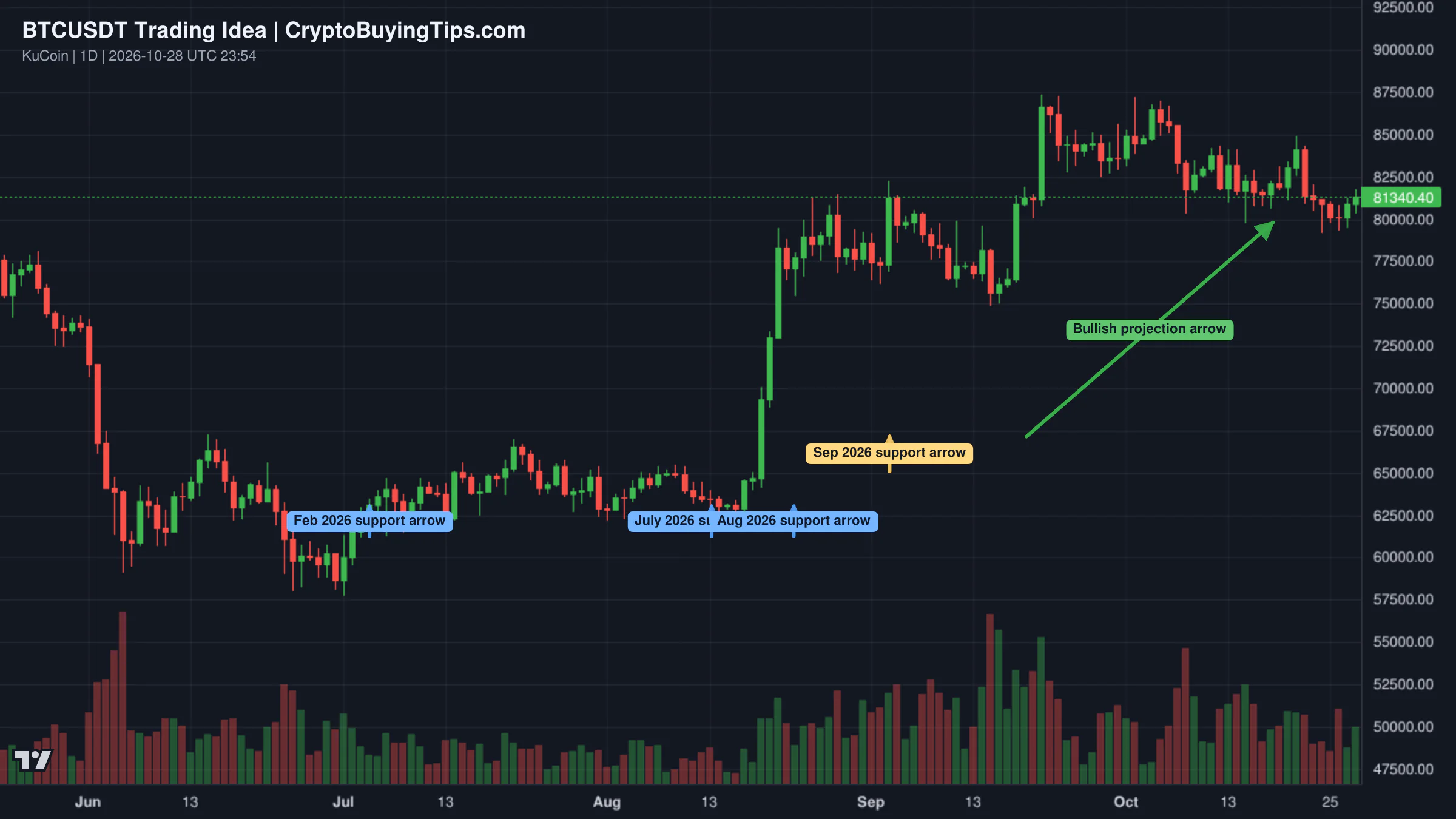
In contrast, the long-term view remains bullish. Some analysts argue that Bitcoin is currently in a healthy recovery phase after the bear market of 2025. They point to the fact that Bitcoin has maintained most of its gains after its recent surge, suggesting a strong base. The target for this camp is a move toward $100,000, arguing that there is no sign of uptrend exhaustion.
A third, more cynical perspective views the current rally as underwhelming. This view suggests that a 42% move in a bull market is merely background noise. While influencers call for $200,000, this analysis targets a more modest rally to the $115,000 to $118,000 range. The caution here is that the market is over-reliant on four-year cycle narratives that may no longer apply in a world of institutional ETFs and AI-driven exploits.
Altcoin Spotlight
Hyperliquid is the only major asset moving against the grain today. Its 7.68% gain is directly tied to the institutional validation from the NYSE's owner. The planned ICE venue would offer 24/7 perpetual futures on stocks and crypto, pending CFTC approval.
This is more than just a price pump. It is a structural shift. If a major U.S. financial entity integrates a decentralized perpetuals platform, it removes a massive layer of regulatory risk for the protocol. While the rest of the market is worrying about node crashes and corporate objections, Hyperliquid is building a bridge to the most liquid financial markets in the world.
What to watch next
The immediate focus is on the FOMC press conference and the Federal Funds Rate. As noted in the trading setups, this event could trigger a volatile move for Bitcoin, potentially confirming the fake breakout or providing the fuel for a move toward $82,000.
Beyond macro, the market needs to see a resolution to the Bitcoin node exploit. If the community cannot patch these flaws quickly, the bearish narrative will shift from "price correction" to "infrastructure failure."
Finally, the battle over tokenized stocks will be a key indicator for the RWA sector. If more companies follow JPMorgan and Coca-Cola in objecting to the OKX-ICE plan, the narrative of "seamless" institutional integration will be exposed as a fantasy. We will be watching the stablecoin dominance closely; any rise in USDT and USDC dominance would suggest that traders are moving to the sidelines to wait for the dust to settle.
Some links in this article may be affiliate links. We may earn a commission at no extra cost to you — this never influences our analysis or coverage.

Sigrid Voss
Crypto analyst and writer covering market trends, trading strategies, and blockchain technology.
More Articles

AI can now crash Bitcoin nodes. The institutional narrative just hit a wall
The grand narrative of institutional adoption seems slightly less robust when viewed through a machine's lens;…
Crypto Market Overview | derivatives volume dwarfs spot activity amid institutional rails expansion | October 28, 2026
Derivatives volume dwarfs spot activity in today's crypto market overview; see BTC and ETH action amid institutional…

Bitcoin dominance is hitting 60%. Here is what that means for your alts
Bitcoin's share of the market hits 60%, which means less money for everything else. Our read suggests that rising…
Crypto Market Overview | Volume surges as regulatory wins clash with institutional friction | October 27, 2026
Market volume surges amid regulatory wins and institutional friction; see our overview on crypto's mixed signals for…