
Crypto Market Overview | leverage surge meets deep sentiment fear | July 7, 2026
Crypto Market Overview | leverage surge meets deep sentiment fear | July 7, 2026
Market overview
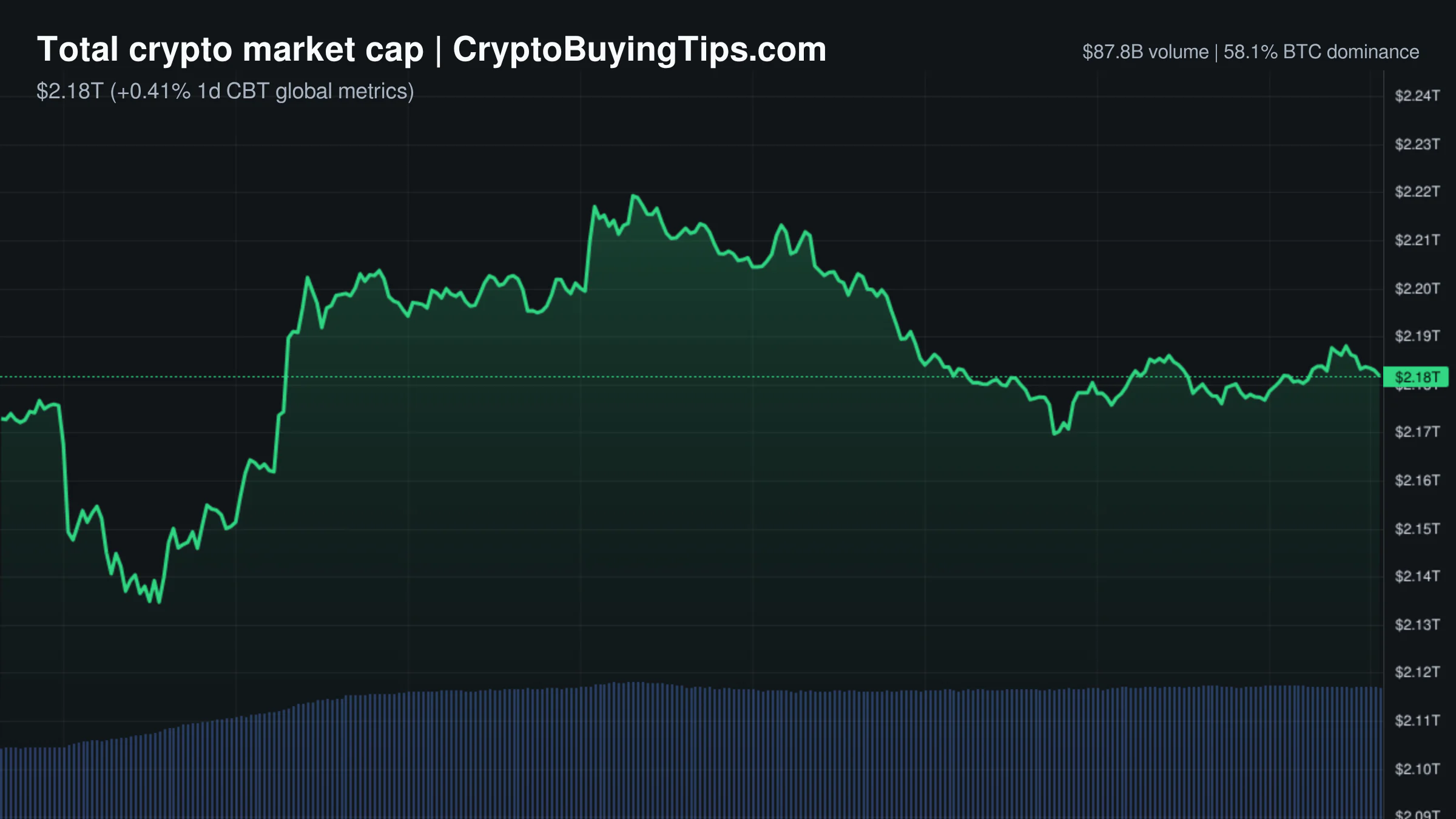
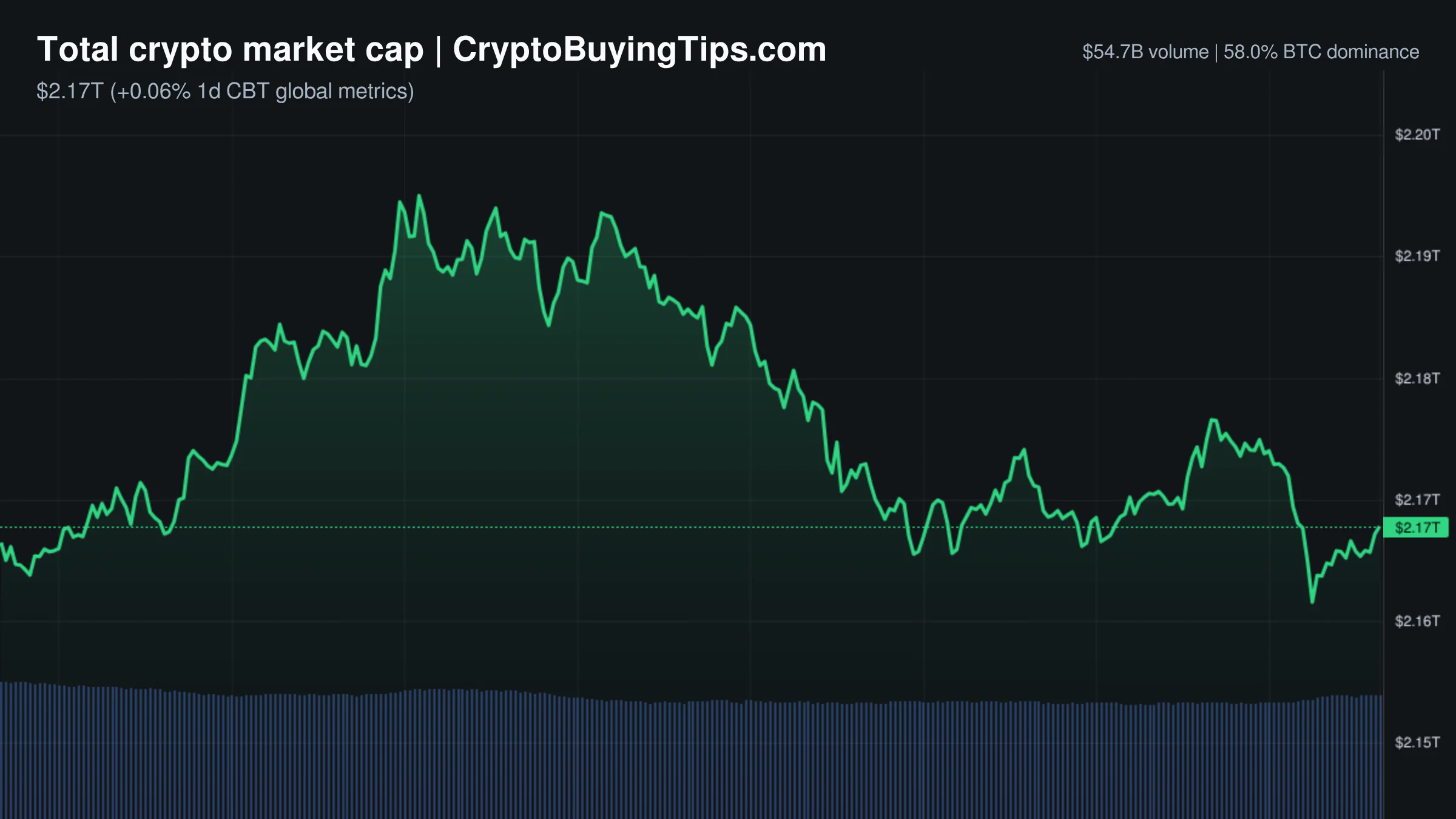
The current market state is a study in contradiction. While the total crypto market cap sits around $2.27T with a slight 24h gain of 0.39%, the sentiment data suggests a room full of people waiting for the floor to drop. The Fear and Greed Index is at 28, placing the market firmly in "Fear" territory. Usually, this level of pessimism accompanies a bloodbath. Instead, we are seeing a massive surge in activity. Spot volume has jumped nearly 59% to $88.06B, but that is a rounding error compared to the derivatives market.
Derivatives volume has exploded to $800.18B, a nearly 60% increase. When derivatives volume is ten times larger than spot volume, the market is not being driven by people buying assets to hold them. It is being driven by gamblers. This skew suggests that the recent price stability is built on a foundation of high-leverage bets rather than organic demand. Stablecoin volume has also spiked by 62% to $90.72B, indicating that capital is moving rapidly, though it remains unclear if this is a rotation into assets or a frantic move into the safety of the sidelines.
Bitcoin dominance remains high at 58.08%, while Ethereum dominance lingers at 9.81%. The Altcoin Season Index is at 46, which is neutral. Money is not flowing into the broader altcoin market in any meaningful way. Instead, the market is trapped in a Bitcoin-centric regime where the big cap assets dictate the mood and everything else just tries to keep up.
Bitcoin and Ethereum
Bitcoin is currently trading at $63,205.19, up 0.71% over the last 24 hours. The price action is sideways, but the underlying plumbing is volatile. Open interest in perpetuals has climbed to $413.74B, meaning the market is heavily positioned. The implied volatility for Bitcoin is 40.33%, which is relatively high for a period of stagnant price action. This suggests traders are bracing for a move, even if they cannot agree on the direction.
Ethereum is at $1,773, showing a marginal gain of 0.25%. The network state is oddly quiet, with gas fees at an extremely low 0.16 Gwei. This lack of on-chain activity contrasts with the high implied volatility of 55.51% seen in the options and futures markets. Vitalik Buterin has announced a massive protocol overhaul that will take three to four years to complete, focusing on quantum safety and privacy. While this is a positive long-term signal, the market is currently ignoring it in favor of short-term price struggles. We previously covered how Ethereum market share vanishes as institutional PR fails to spark a real capital rotation.
Top crypto prices
Bitcoin holds the top spot at $63,205.19. Ethereum follows at $1,773. BNB has dipped slightly to $578.02, down 0.26%. XRP is seeing more significant selling pressure, falling 1.57% to $1.12.
Solana is trading at $81.04, up 0.66%. TRON has gained 1.08% to reach $0.3303. Hyperliquid is showing strength among the top ten, rising 1.48% to $71.46.
News driving today's market
Institutional adoption is taking a strange turn in Russia. Sberbank, the country's largest bank, plans to launch a crypto wallet and digital depository by December. This move depends on the "On Digital Currency and Digital Rights" bill taking effect in September. It is a stark shift from previous central bank opposition. We previously noted how the safe haven narrative shifting was linked to economic survival, and Sberbank's entry into the market is the next logical step in that process.
In the US, the Strategic Bitcoin Reserve is facing internal friction. While the reserve was established by executive order in March 2025 to treat Bitcoin like gold, the Treasury and Commerce departments are now fighting over who actually gets to run it. This bureaucratic infighting is a reminder that government adoption is rarely a clean process.
Regulatory news from Europe is mixed. Ripple has secured a full MiCA license, allowing it to provide regulated services across the European Economic Area. This is a major de-risking event for XRP. However, the Belgian regulator has already flagged six unauthorized providers for missing the MiCA deadline. The era of "move fast and break things" in Europe is officially over.
On the AI front, China is cracking down. ByteDance and Alibaba are pulling "humanlike" agent features from their AI products to comply with new rules banning simulated human personalities. This regulatory risk is spilling over into AI-related tokens, as the market realizes that the "AI agent" narrative can be erased by a single government memo.
Social intelligence
The on-chain data is messy. Over $498M was liquidated in the last 24 hours. This level of liquidation usually suggests a "long squeeze" or "short squeeze" that has cleared out the over-leveraged traders. Given the high derivatives volume we mentioned earlier, this is likely just the first wave of a larger shakeout.
Whale movements are also creating noise. James Fickel has transferred 20,000 ETH into a new wallet after reportedly losing 25,000 ETH on long ETH/BTC trades. When whales move tens of millions of dollars in assets, it often signals a change in strategy or an attempt to hide positions before a move.
Meanwhile, Richard Heathcote, the former CIO of Tether, is reportedly looking to sell part of his 1.26% stake in the stablecoin issuer. While this is a personal financial move, any insider selling from a key figure at the world's largest stablecoin issuer tends to make the market nervous.
Trading ideas worth watching
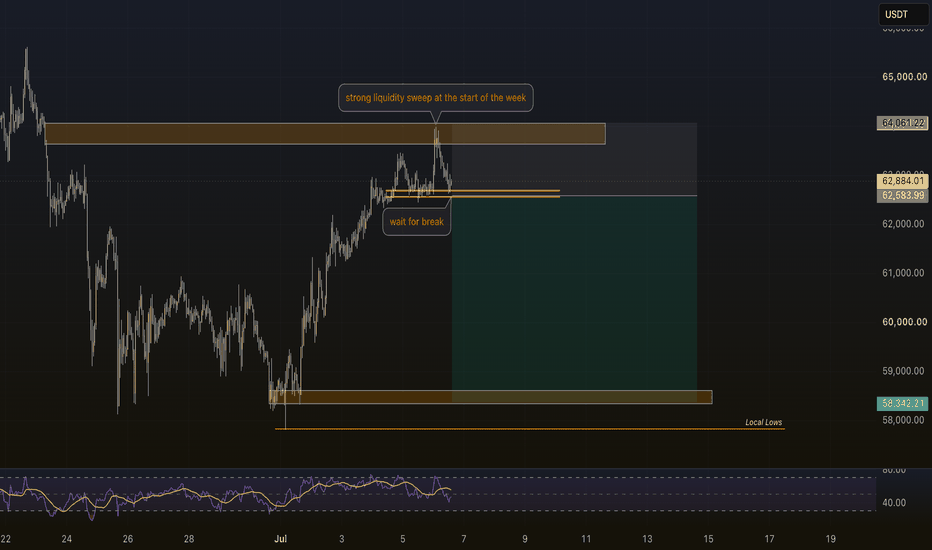
Bitcoin is currently in a precarious position. Analysis from SwallowAcademy suggests a bearish liquidity sweep at $64,000 has already occurred. The critical level is now the $62,583 neckline. If Bitcoin closes below this level, it confirms that sellers have taken control. The primary target in this scenario is the $58,342 zone, where local lows are waiting to be swept. Until that neckline breaks, the market is essentially in a waiting room.
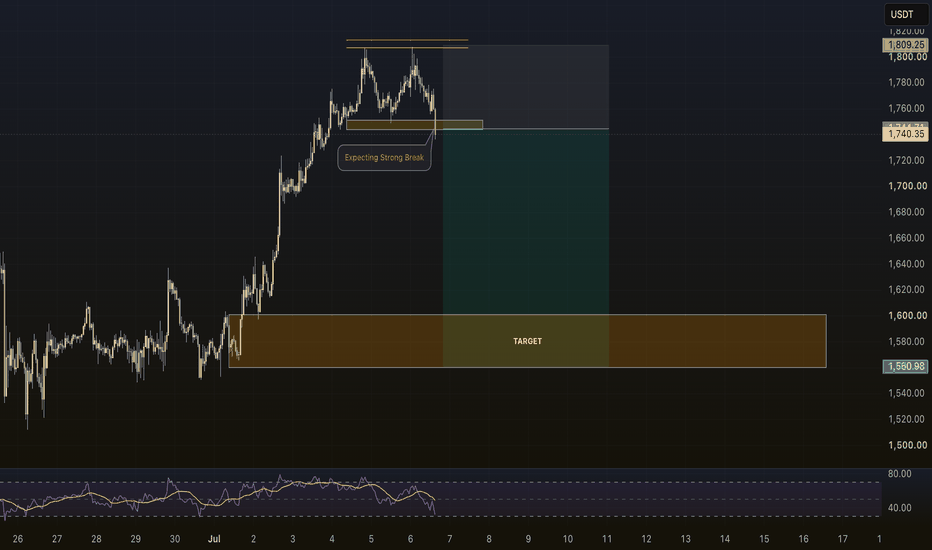
Ethereum looks even more fragile. Two separate analyses point to a bearish breakdown. One setup identifies a double-top near $1,809 and a critical neckline at $1,744. A confirmed break below $1,744 could trigger a sharp move down toward the $1,580 to $1,600 demand zone.
Another perspective from melikatrader94 highlights a head-and-shoulders pattern on the 30-minute chart. The neckline around $1,735 has already been broken, which turns previous support into resistance. While a short-term bounce is possible from the $1,724 support area, the overall bias remains bearish. The immediate downside target is $1,705 to $1,710. If Ethereum cannot reclaim $1,735, the path of least resistance is lower.
What to watch next
The most important thing to watch is the gap between sentiment and volume. A Fear and Greed score of 28 combined with $800B in derivatives volume is a recipe for a volatility spike. The market is essentially a powder keg of leverage and anxiety.
Keep an eye on the US Treasury and Commerce departments. If they resolve their dispute over the Strategic Bitcoin Reserve, it could provide the fundamental catalyst needed to break the current sideways trend. On the technical side, the $1,744 level for Ethereum is the line in the sand. If that fails, we could see a rapid descent toward $1,600, which would likely drag the rest of the altcoin market down with it.
Some links in this article may be affiliate links. We may earn a commission at no extra cost to you — this never influences our analysis or coverage.

Sigrid Voss
Crypto analyst and writer covering market trends, trading strategies, and blockchain technology.
More Articles

Bitcoin ETFs are buying again but the chart says wait
Another day of ETF buying arrives just in time to keep things interesting on paper. Our signal scanner flags that…
Crypto Market Overview | Leveraged derivatives volume masks underlying market fear despite institutional stablecoin adoption | July 6, 2026
Leveraged derivatives volume masks underlying market fear despite institutional stablecoin adoption; see our crypto…

Ethereum gas is practically free. Here is why that is not necessarily good news.
Ethereum's low gas fees feel like a bargain compared to past crazes. However, our read suggests this quiet period might…
Crypto Market Overview | price stability amid volume collapse and high fear index readings | July 5, 2026
Crypto market overview shows price stability amid volume collapse; fear index at 26 suggests exhaustion rather than…