
Crypto Market Overview | price stability amid volume collapse and high fear index readings | July 5, 2026
Crypto Market Overview | price stability amid volume collapse and high fear index readings | July 5, 2026
Market overview
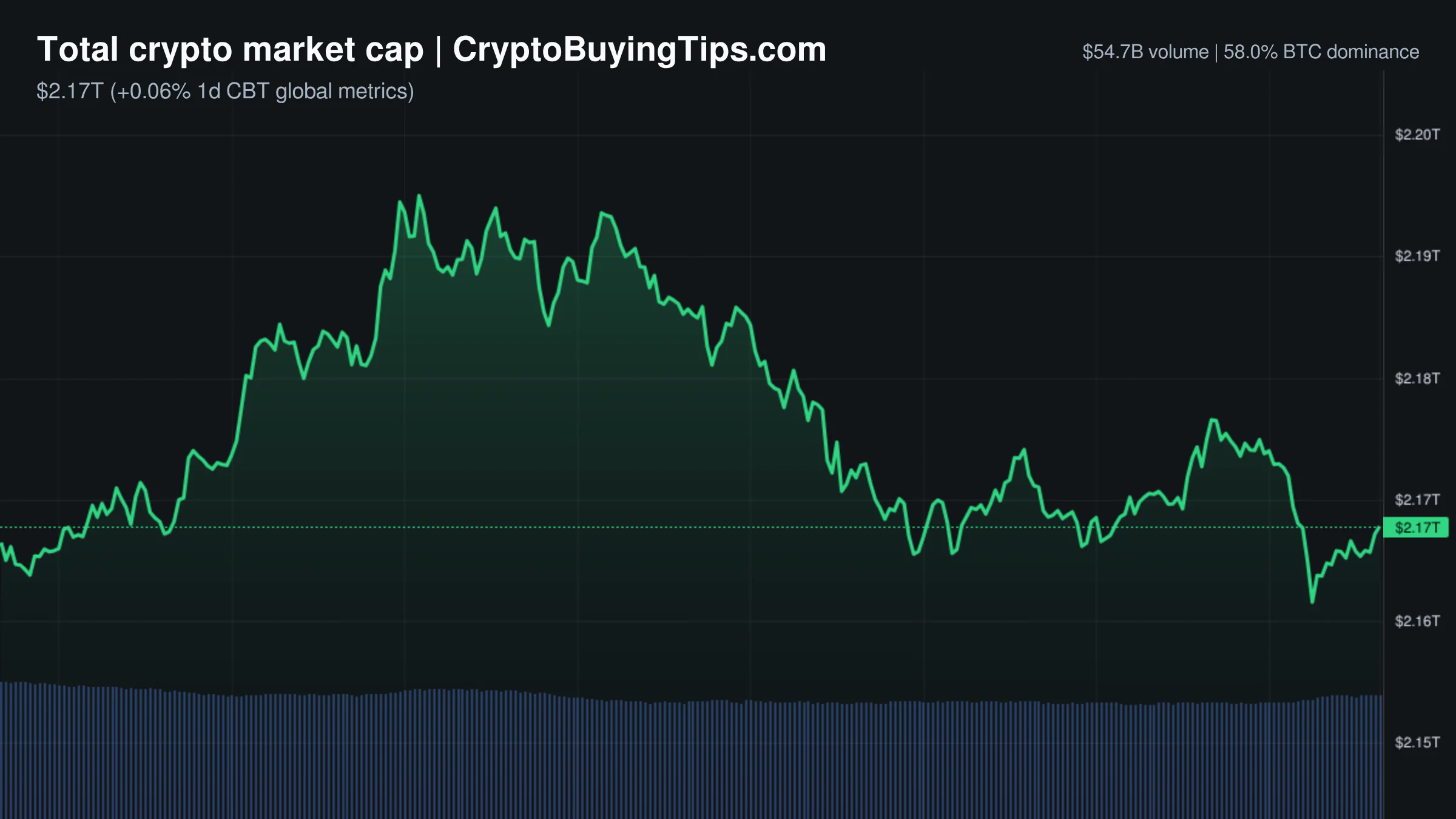
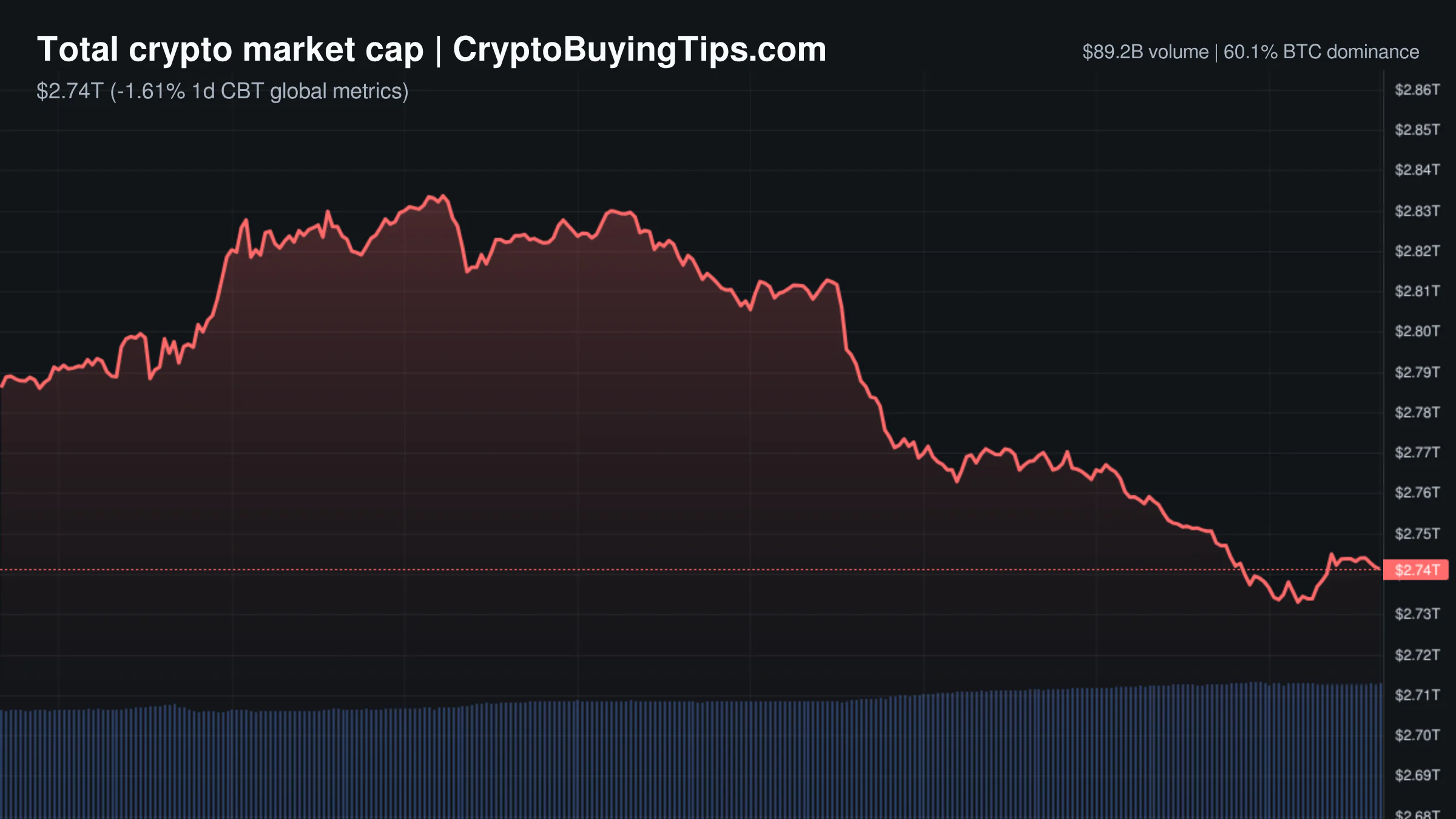
The market is currently presenting a confusing set of contradictions. On the surface, prices are holding steady or ticking slightly higher, but the plumbing suggests a different story. Total market capitalization sits at $2.17 trillion, a marginal increase of 0.07 percent. However, this price stability is happening on a backdrop of a significant volume collapse. Spot volume has dropped by 8.57 percent, derivatives volume is down nearly 10 percent, and stablecoin activity has fallen by almost 11 percent. We are seeing a market that is not so much bullish as it is exhausted.
The sentiment gap is the most striking feature of the day. The Fear and Greed Index has plummeted to 26, placing the market firmly in the Fear zone. Usually, this level of fear accompanies a violent price crash. Instead, we have a sideways market where the indices are slightly positive. This divergence suggests that while the crowd is anxious, there is no aggressive selling pressure to actually drive prices down. It is the kind of atmosphere where traders wait for a catalyst that never arrives, resulting in a deadening of liquidity.
The leverage picture remains skewed. Derivatives volume at $459.33 billion is roughly 8.3 times higher than spot volume. This concentration of leverage means that any sudden move in either direction could trigger a cascade of liquidations, regardless of the current lack of momentum. With the S&P 500 and NASDAQ both closing in the red, the macro environment is offering little support for a risk-on rally. The market is essentially holding its breath.
Bitcoin and Ethereum
Bitcoin is trading at $62,693.53, up a modest 0.34 percent. The price action is unremarkable, but the on-chain data is more interesting. Social intelligence indicates that the realized profit and loss ratio has hit a 43-month low. Historically, this metric has often flagged major market bottoms. If that pattern holds, the current stagnation might be the final stage of a long consolidation before a new leg up. Bitcoin dominance remains high at 57.99 percent, which confirms that capital is staying in the safest asset while the rest of the market struggles to find a narrative.
Ethereum is far less convincing, hovering at $1,759.47. While the price is technically up 0.06 percent, the network is seeing a strange mix of signals. Gas fees are exceptionally low, between 0.09 and 0.15 Gwei, which suggests a lack of on-chain congestion and a general absence of retail activity. At the same time, we are seeing a massive surge in ETH withdrawals from Binance, which have hit a three-year high.
This exodus from centralized exchanges often suggests that whales are moving assets into cold storage or preparing for a specific protocol event. Vitalik Buterin has shared a roadmap for a Lean Ethereum, which targets native STARKs and quantum resistance over the next few years. While these technical ambitions are high, they do not provide immediate price support. We previously covered how Ethereum market share vanishes as it attempts to pivot toward institutional needs, and today's price action suggests that the corporate makeover is not yet translating into buying pressure.
Top crypto prices
Beyond the two giants, the performance across the top assets is mixed. BNB is one of the few bright spots, trading at $575.53 and gaining 0.75 percent. It seems to be benefiting from a specific accumulation phase that is decoupled from the broader market fear. TRX is essentially flat at $0.3252.
The losses are concentrated in the high-beta assets. Solana has slipped 1.53 percent to $80.34, while Hyperliquid has fallen 2.46 percent to $68.98. XRP is also in the red, down 1 percent to $1.12. This trend is typical for a Fear-dominated environment; when the crowd gets nervous, they sell the assets that rose the fastest first.
News driving today's market
Regulatory friction is the primary theme of the week. Revolut has notified users that it will delist USDT in August, citing regulatory and risk concerns. This is a blow to the ease of on-ramping for many retail users and adds to the general uncertainty surrounding stablecoin compliance. We have seen this pattern before, and we previously explained how Mica crypto regulation explained is forcing a cull of non-compliant assets across Europe.
Systemic risk is also back in the conversation. Ethical hackers discovered a flaw in the Aptos blockchain that could have put $70 billion at risk. Although the vulnerability was patched, the fact that a $3,000 server was enough to simulate a successful attack on a major layer-1 is a sobering reminder of the fragility of these systems. This news tends to push traders toward more established protocols and away from the newer, more experimental chains.
In the EU, regulators are moving to block retail investors from prediction markets, arguing that the actual function of a product as a derivative matters more than its label. This is a direct hit to a growing sector of DeFi and signals that the era of regulatory forbearance is over. Conversely, the UK is attempting to unlock global trading with a new framework, though the compliance hurdles remain daunting. The market is currently weighing the UK's openness against the EU's tightening grip.
Social intelligence
The on-chain data is providing some contrast to the general fear. Hyperliquid has seen $116 million in net bridged inflows in just 24 hours. This suggests that while the broader market is hesitant, sophisticated traders are moving capital into high-performance DeFi platforms to seek yield or better trading tools.
There is also a significant shift in stablecoin distribution. Ethereum now controls 87 percent of the stablecoin supply. This is a massive structural advantage for ETH as it ensures that the vast majority of liquidity remains within its ecosystem. If the market decides to rotate back into alts, the path of least resistance will likely be through the Ethereum-based assets.
Finally, the Bitcoin realized profit and loss ratio hitting a 43-month low is the most bullish signal on the board. It suggests that a large number of holders are currently underwater, which often happens right before a trend reversal. It is a cold, mathematical indicator that contradicts the emotional fear currently seen in the index.
Trading ideas worth watching
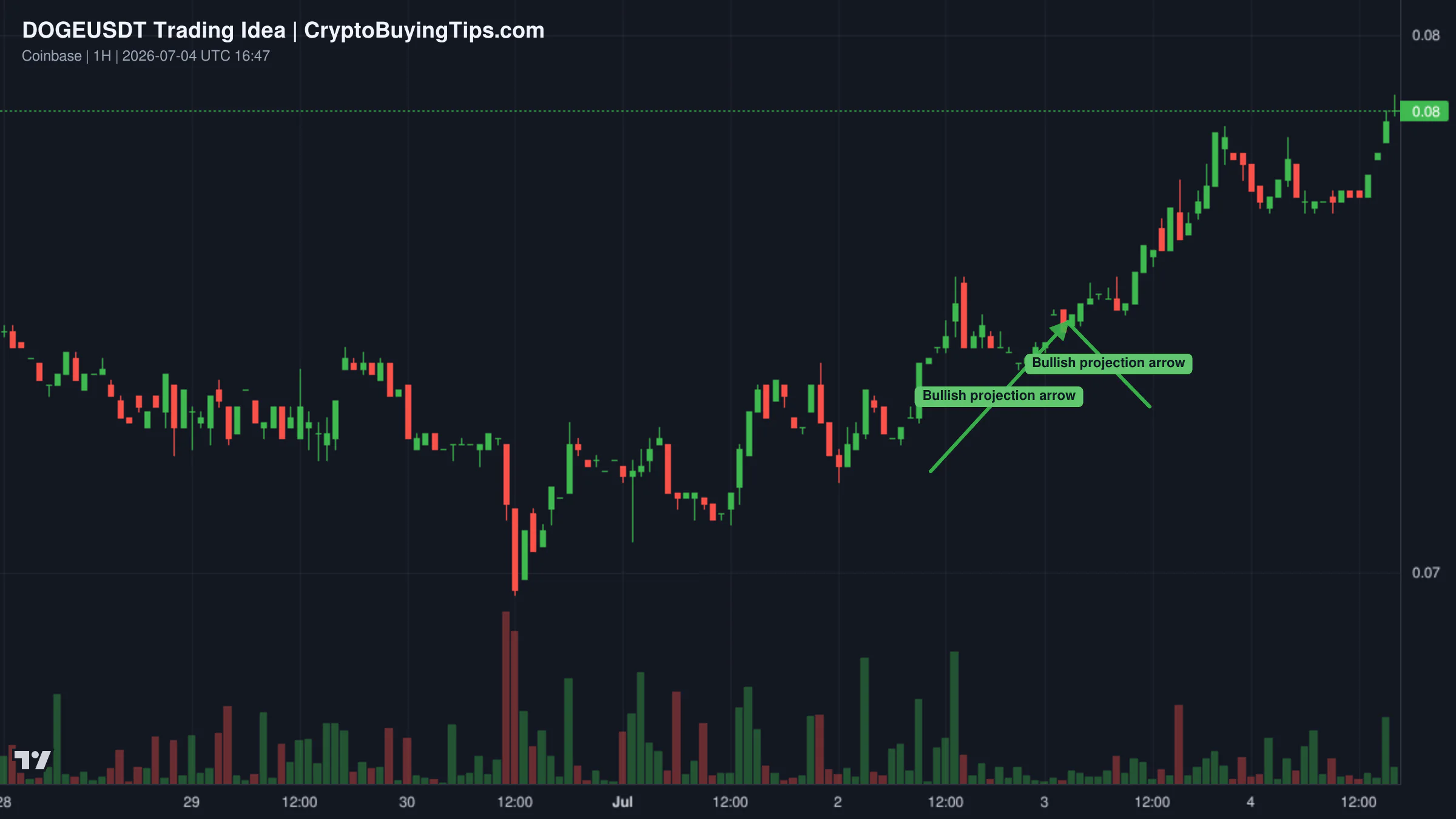
Dogecoin is presenting a high-risk setup for those with a high appetite for volatility. The asset recently pierced below long-term support and is now attempting a recovery. A long position with an entry zone between $0.0730 and $0.0800 targets a move up to $0.0969 and potentially as high as $0.4482 in a full bullish extension. The invalidation point is a weekly close below $0.0720. This is essentially a bet that the bearish cycle has exhausted itself, though the lack of volume in the recent drop makes this a speculative play.
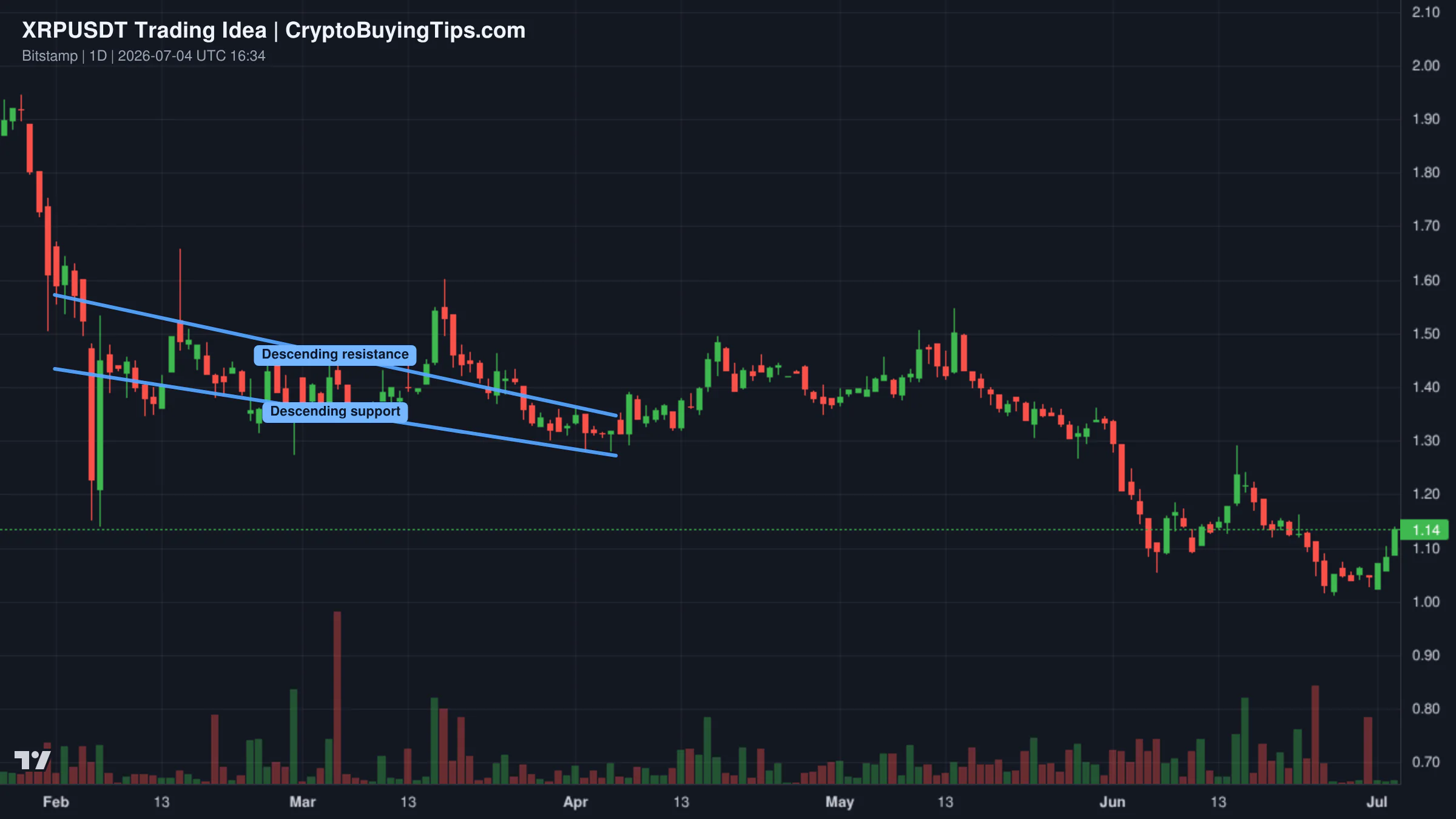
XRP has re-entered what looks like a five-month accumulation range. After a stop-loss hunt in February, the asset has spent months moving sideways. Bullish momentum has been visible for four consecutive days, and the setup suggests a long-term growth phase starting from the June-July lows. The goal here is a move toward new all-time highs, provided the asset can maintain its current floor.
BNB is showing a more technical setup. It has broken out of a falling wedge pattern, and there is a clear RSI divergence suggesting strength. The asset recently printed a selling climax followed by high-volume accumulation, which is often a sign that smart money is positioning ahead of a move. Resistance is currently at 664, with a further target of 729 if the momentum sustains.
What to watch next
The immediate future depends on whether the volume collapse is a temporary lull or the start of a deeper liquidity drain. Price stability in the face of extreme fear is often a sign of a bottom, but without a surge in volume, it is just a stalemate. We are watching the $62,000 level for Bitcoin and the $1,750 level for Ethereum as the critical lines in the sand.
If the Revolut delisting of USDT triggers a wider move away from centralized stablecoin gateways, we could see an increase in volatility as traders scramble for alternative liquidity. The tension between the UK's optimistic framework and the EU's restrictive approach will likely define the institutional flow for the rest of the month. For now, the market is in a state of professional paranoia, where the data suggests a bottom but the mood suggests a crash.
Some links in this article may be affiliate links. We may earn a commission at no extra cost to you — this never influences our analysis or coverage.

Sigrid Voss
Crypto analyst and writer covering market trends, trading strategies, and blockchain technology.
More Articles
Crypto Market Overview | Derivatives volume dwarfs spot activity amid regulatory uncertainty and institutional outflows | October 24, 2026
Derivatives volume dwarfs spot activity amid regulatory uncertainty and institutional outflows, showing market…

Fidelity outflows and Ethereum OG dumps suggest a hidden exit
Another day of market data suggesting everything is fine until you look at the outflows and OG dumping. Institutional…
Crypto Market Overview | Leveraged bets surge amid regulatory clarity and institutional inflows | October 22, 2026
The market shows divergence between spot interest and leveraged bets amid regulatory clarity; see our overview here.

Volume is surging but prices are flat. Here is where the trigger is
Volume spikes while prices remain stubbornly flat; this divergence suggests an underlying battle between leveraged…