
Crypto Market Overview | Extreme fear meets a flat tape as derivatives volume towers over spot | November 19, 2026
Crypto Market Overview | Extreme fear meets a flat tape as derivatives volume towers over spot | November 19, 2026
Market overview
The Fear & Greed Index reads 12, which is extreme fear, and the five largest coins are all trading within a point of where they started the day. That is an unusual pairing. Panic ordinarily comes with price action to match, but the screens today look more like a waiting room than a trading floor.
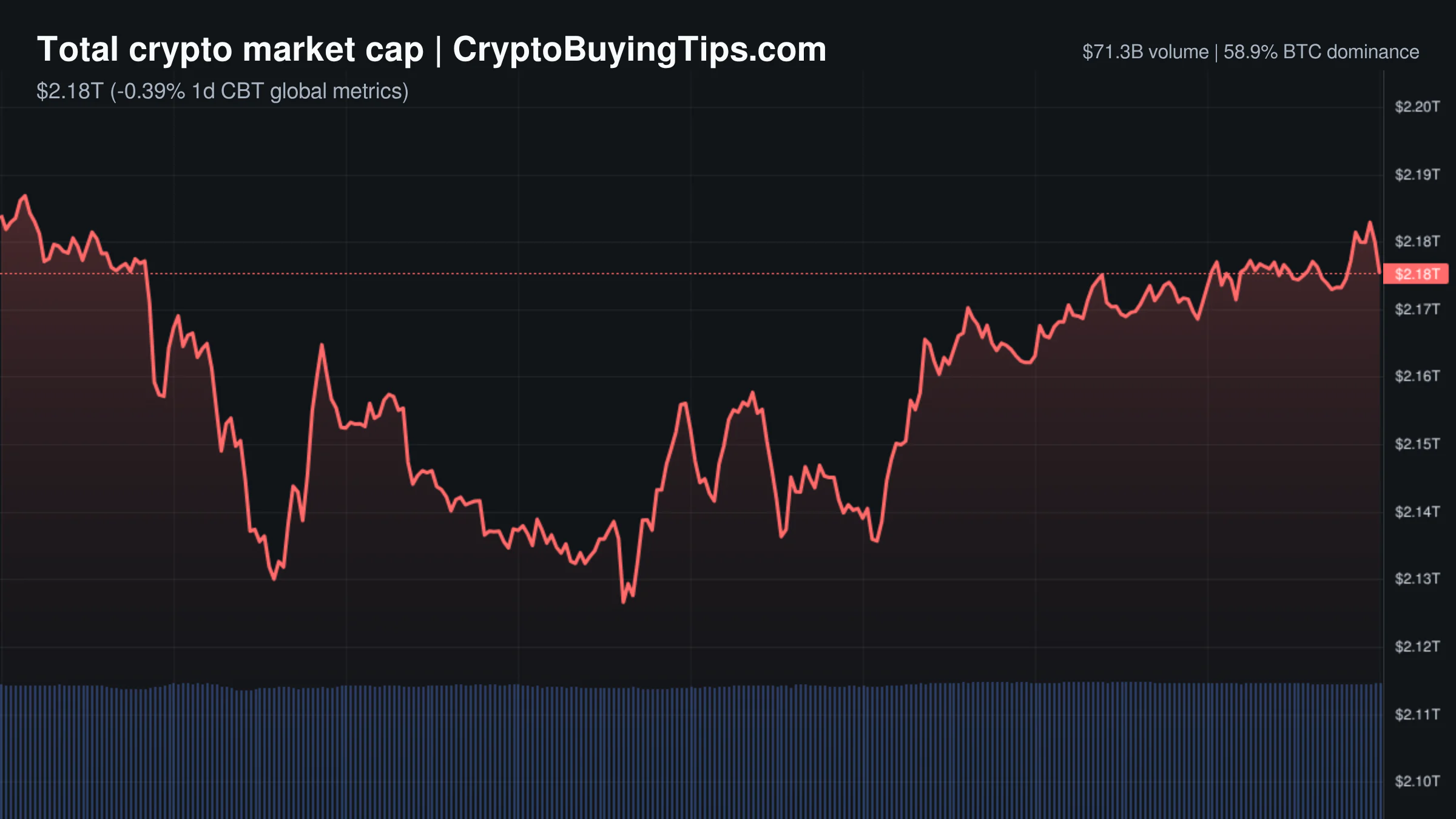
The headline market cap is $2.18T, and the two main feeds disagree on how it moved. CoinGecko shows a 24h change of -2.98%, while CoinMarketCap shows -0.15%. Neither page explains the gap, and the likeliest explanation is different snapshot windows, though that is an inference. The CMC reading fits the coin-level data better, since BTC, ETH, BNB, SOL and XRP are all green in the briefing snapshot. If the -2.98% figure is closer to the truth, the weakness sits in the long tail of smaller tokens rather than the majors.
Volume is the more telling number. Spot volume is $73.1B on CoinGecko and $70.92B on CMC (up 0.48%), while derivatives volume is $782.68B, down 3.22%. That makes derivatives roughly 11x spot, or 91.7% of combined activity (782.68 / 853.60). Perpetual open interest is $330.51B, about 4.7x 24h spot volume (330.51 / 70.92), and perpetuals are 99.7% of the combined open interest shown. Price discovery is happening on leveraged venues, and the spot market is mostly watching. Funding rates and liquidation figures did not load, so there is no way to say which side of that leverage is crowded.
Dominance and liquidity add a wrinkle. BTC dominance is 58.90% on CoinGecko (58.95% on CMC) and ETH is 10.12%. Total2, the market ex-Bitcoin, is $894.7B, and Total3, which also strips out Ethereum, is $674.4B. USDT and USDC together hold 11.14% of the market, about $243B (2,180 × 0.1114). Higher stablecoin share usually signals capital on the sidelines, but without a historical comparison the direction of that number is unknown.
The Altcoin Season Index reads 57 in one feed and 53 on CMC, which uses a 90-day window. Both land in neutral territory, between Bitcoin Season at 25 or below and Altcoin Season at 75 or above. A neutral reading beside a fear score of 12 is a mismatch. Altcoins have held up against Bitcoin over the window even as sentiment sits at the floor, so they are being miserable in an orderly fashion.
The data has gaps. ETF flows, funding rates, liquidations, market cycle indicators and every historical comparison failed to load, so no cycle-phase call is made here.
Bitcoin and Ethereum
Bitcoin trades at $63,908.08 in the briefing snapshot (+0.37%) and $63,929.73 on the CMC front page at 12:00 UTC (-0.43%). The sign flips between snapshots, which is the best summary of the session: nothing is moving. Market cap is $1.28T. Dominance fell 0.15% on a day when Bitcoin rose, so the Others bucket gained share even though the majors were green. That is consistent with the CMC20 index, which sits at 130.33 (-0.21%) against CMC100 at 124.81 (-0.05%). The largest names are lagging the broader top 100 slightly.
On the sentiment side, The Block's newsletter cites CryptoQuant saying Bitcoin is back in a bearish phase but has entered a "value zone." That is a hedge in the way analysts like best, bearish and attractive at the same time. Volmex implied volatility for Bitcoin is 49.22, which does not describe a market bracing for a collapse. ETF flow data is unavailable, so the institutional bid or lack of one cannot be assessed today.
Ethereum is at $1,806.39 (+0.45%), or $1,806.89 (+0.37%) on the front page, with a market cap of $220.89B and roughly 10.13% dominance. Implied volatility is 62.25, which is 13.03 points above Bitcoin's. Traders are paying more for protection on Ethereum even though it has barely moved. Network activity is thin, with gas at 0.11 Gwei slow and 0.12 Gwei fast and confirmation around 45 seconds. Cheap blockspace is great for users and less encouraging as a demand signal. DeFi tells the same story: market cap is $65.01B, about 3.0% of the total, and DeFi 24h volume is $9.27B, down 13.23%, the sharpest decline in the dataset.
Top crypto prices
Beyond the two leaders, the front-page snapshot (timestamped 12:00 UTC) shows BNB at $592.53 (+0.57%) with a market cap of $77.92B. XRP is $0.9898 (+0.21%) at $62.87B, and Solana is $74.83 (+0.59%) at $44.28B. TRON leads the group with a 1.03% gain to $0.3126 and a market cap of $29.71B. Hyperliquid is $68.69 (+0.15%) with a market cap of $17.34B, ranked ninth.
The spread between best and worst performer among these seven is under 1.5 percentage points. The market is moving as one slow block, which suits the thin-volume, high-leverage picture above. Nothing here is a breakout, and nothing is a breakdown.
News driving today's market
The heaviest story is security. A court filing detailing the Binance hack says the thieves took 192 tokens across 11 networks, with total theft of $6.3B, of which at least $3.46B was stablecoins. Separately, The Block reports Binance obtained a $6.5B freezing order from an Abu Dhabi court. For market structure, the question is what happens to the funds that have not yet moved, a risk we previously covered in Binance hack risk, our piece on the $3 billion still sitting dormant. A freezing order narrows the exits for stolen assets, and any stablecoin issuer that can freeze balances becomes part of the story.
That ties into the second theme. CoinDesk reports that a blockchain investigation traced $518M of illicit-linked activity, including funds from the 2025 Bybit hack, through a reserve backing Sky's DAI and USDS. The reputational problem for a protocol selling itself to institutions is plain. Meanwhile, S&P Global kept Tether's USDT at 5 (weak), the lowest on its five-point scale, and Tether publicly rejected the framework. For traders, the relevance is that stablecoins are the settlement layer for the leveraged venues described above. Any doubt about them reaches the whole market, though nothing in today's price data shows that doubt arriving yet. We previously covered GSR dumping ETH for Bitcoin for more background.
Regulation offers a counterweight. Senators including Cynthia Lummis are pressing Treasury Secretary Bessent to extend a proposed GENIUS Act safe harbor to state-regulated stablecoin issuers. If it lands, it lowers the barrier for smaller issuers and reduces the regulatory split between state and federal applicants.
Tokenization is the optimistic corner. Singapore settled a $77.5M tokenized bill sale in wholesale central bank digital currency, with MAS planning to rename its test network SG Digital Ledger and test wider collateral use in 2027. Ondo's ANTon token will track Anthropic shares from the day the company lists on Nasdaq, and CZ says Anthropic-linked tokens from bStocks, Ondo and xStocks will arrive on BNB Chain on day one, following a $500M pre-IPO rush that comes with fine print. Backpack has also secured NFA approval, adding to its CFTC approval as a designated contract market and clearing organization ahead of a US derivatives launch. None of these items moves today's price, but they show where institutional plumbing is being built while spot volume idles.
Social intelligence
On-chain trackers add some supply-side detail. Lookonchain flags that an Ethereum Foundation-linked wallet (0x5CBC) sold another 1,200 ETH ($2.14M). That is under 0.001% of Ethereum's $220.89B market cap, so the price impact is negligible, but in a fearful tape the optics of a foundation-linked seller carry more weight than the size. Lookonchain also reports that Pump.fun sold another 33,390 SOL ($2.44M) roughly two hours before its post, bringing total sales to 5,651,889 SOL ($890M) at an average price of $157.47. SOL trades at $74.83, about 52% below that average (74.83 / 157.47 = 0.475). A persistent seller of a top-ten asset is a headwind for any recovery thesis.
WuBlockchain's post on the S&P assessment adds detail the headlines skipped: higher-risk assets, including gold, Bitcoin, equities and loans, equal 28% of USDT in circulation as of September 30, up from 24% a year earlier. S&P also cited limited disclosure of audited statements, reserve segregation and custodians. Cointelegraph's post on the GENIUS Act letter confirms the senators want state issuers given the same protection as federal applicants.
Trading ideas worth watching
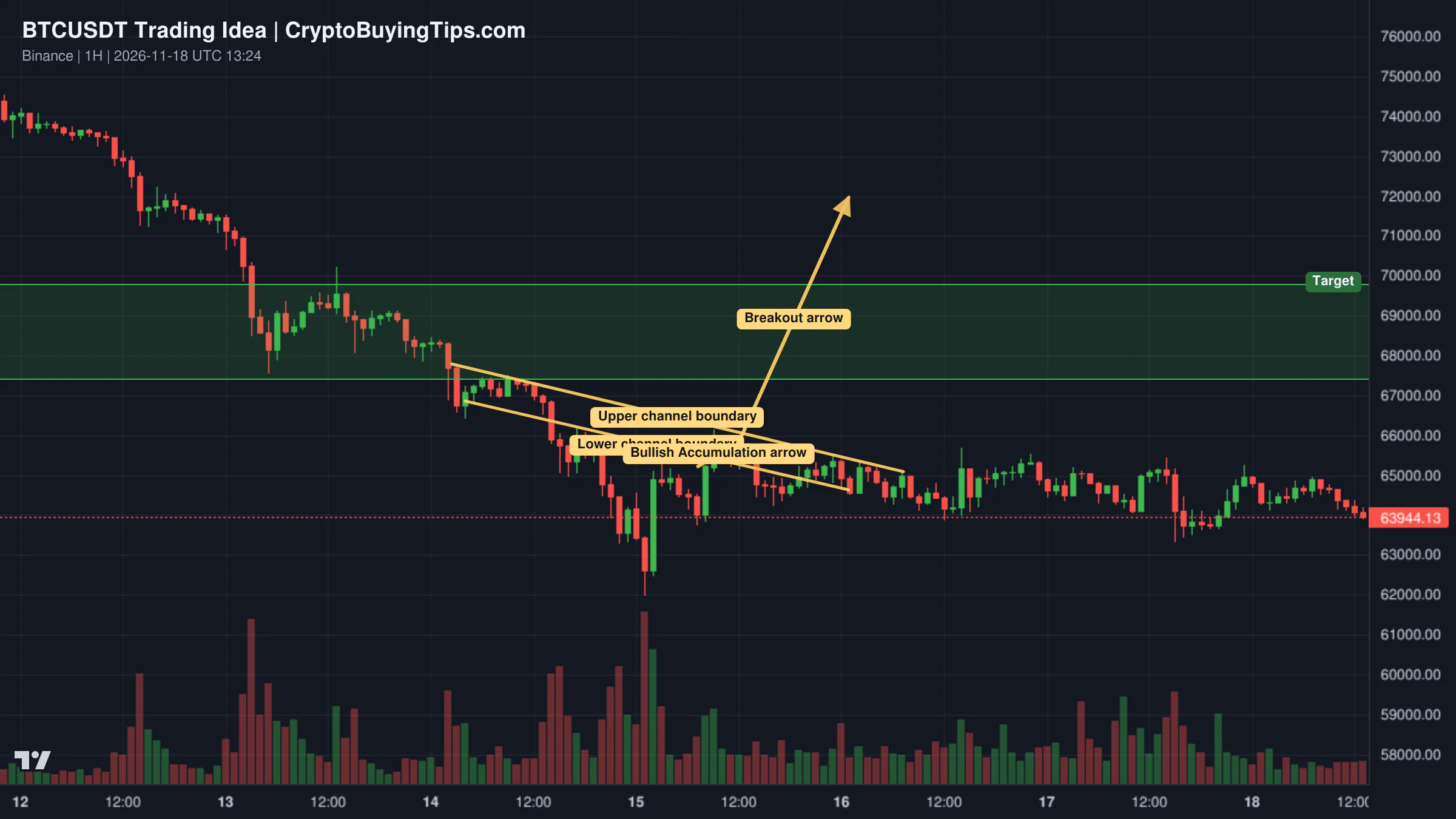
The first idea is a bullish flag on BTCUSDT (1h chart, Binance) from author KlejdiCuni, built on the observation that Bitcoin has been rallying for a week. The author names upside targets near 67,400 and 69,800 and says to wait for confirmation of the pattern before acting. From $63,908.08, those levels are about 5.5% and 9.2% higher (67,400 / 63,908 and 69,800 / 63,908). The idea also leans on the FOMC minutes as a catalyst, with a hope that the market is surprised in a risk-friendly direction. A flag is a continuation pattern and only means something if it resolves upward; with 24h Bitcoin moves swinging between -0.43% and +0.37% depending on the snapshot, that confirmation has not arrived. Invalidation is not specified in the idea, so a break of the flag's lower boundary is the natural point to abandon the thesis. Against extreme fear and a market that has gone nowhere, patience is the sensible reading.
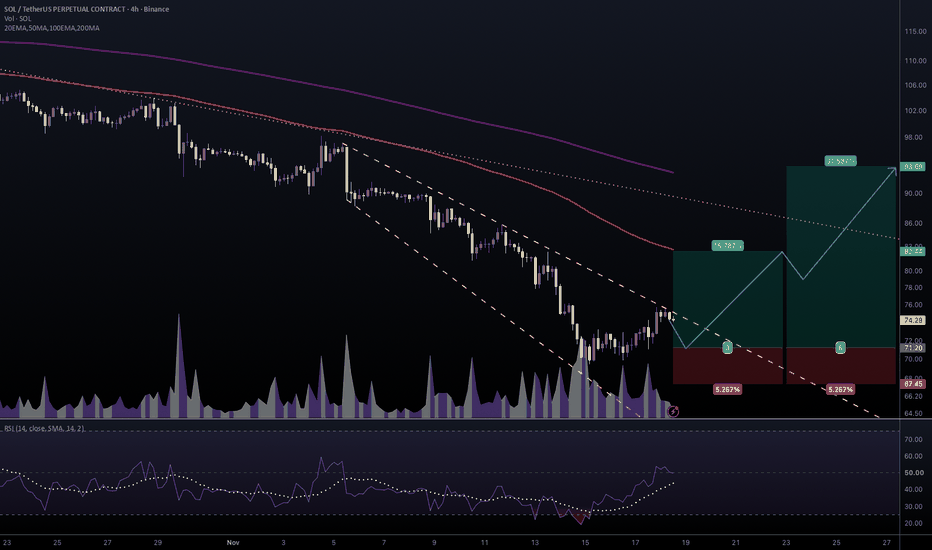
The second is a broadening wedge on SOLUSDT perpetuals (4h chart) from TradingOn, which expects one last dip before a recovery toward the 100 EMA. The signal gives an entry at 71.20, take-profit levels at 82.44 and 93.69, and a stop at 67.45, with isolated 7x leverage. With Solana at $74.83, the entry sits about 5% below the current price (71.20 / 74.83), so the plan needs a dip to trigger. The stop is about 5.3% beneath entry, and the quoted +110.5% and +221.1% profit figures are leveraged outcomes, not price moves. The Pump.fun selling described above is the obvious reason for caution, since a consistent seller can cap a bounce well before 82.44.
The third is a descending wedge break and retest on GRAMUSDT perpetuals (2h chart), also from TradingOn. GRAM, formerly Toncoin, is described as pulling back to a demand zone with a bounce toward 200MA resistance. The entry is 1.018, targets are 1.105 and 1.192, and the stop is 0.989, using 14x isolated leverage. GRAM is not in the price data for today, so its position relative to those levels cannot be verified. The stop sits only about 2.8% below entry (0.989 / 1.018), which at 14x leaves very little room. This is the most aggressive of the three, and a wide spread of outcomes should be assumed.
What to watch next
The first test is the FOMC minutes, which the Bitcoin flag idea names as its catalyst. Reaction at 67,400 and 69,800 matters only if price first confirms the pattern, and Ethereum's higher implied volatility (62.25 against Bitcoin's 49.22) hints that options traders expect it to move more than Bitcoin does.
The second is whether the data holes get filled. ETF flows, funding rates, liquidations and historical comparisons were all unavailable today, and without them it is impossible to say whether a Fear & Greed reading of 12 is capitulation or just boredom with a bad PR department. A tape this calm with $330.51B of perpetual open interest underneath is the setup where a modest move turns into a forced one.
The third is stablecoin plumbing. The USDT assessment, the Sky investigation and the Binance freezing order all land on the settlement assets the leveraged market runs on, and the safe harbor request in Washington will show how regulators intend to treat them. Finally, Anthropic's Nasdaq debut is the date for tokenized-equity activity on BNB Chain, and it is worth noting whether the volume shows up in spot or, as usual, on the perpetual venues.
Some links in this article may be affiliate links. We may earn a commission at no extra cost to you — this never influences our analysis or coverage.

Sigrid Voss
Crypto analyst and writer covering market trends, trading strategies, and blockchain technology.
More Articles

XRP is calm at $0.9771 in extreme fear. These are the levels that decide whether it lasts
XRP is currently shrugging off a market in extreme fear. We see $0.94 as the critical support level that determines if…
Crypto Market Overview | Extreme fear and heavy derivatives leverage as spot volume declines and Bitcoin tracks risk assets | November 18, 2026
Bitcoin trades near $64,190 amid extreme fear as spot volume declines. Derivatives volume is up 9.03%, showing heavy…

Are crypto perpetual futures legal in the US? The CFTC just licensed two venues to find out
The CFTC has finally decided that crypto perpetual futures are legal in the US, provided you use a licensed venue. It is…

What is implied volatility in crypto? ETH's reads 13.8 points hotter than Bitcoin's
Price charts are just yesterday's weather reports. Implied volatility offers a look at what traders are actually betting…