
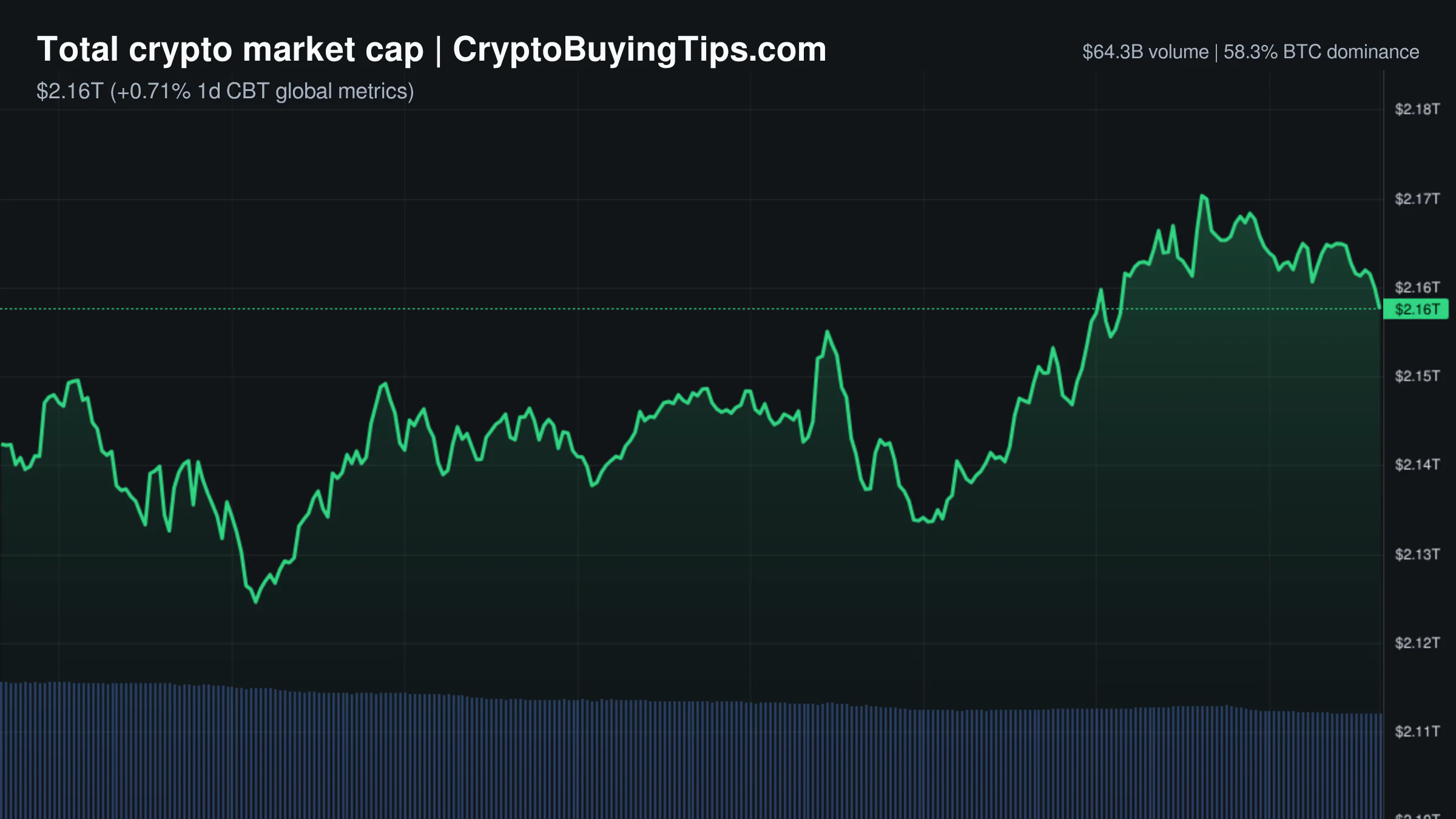
Crypto Market Overview | low volume divergence amid institutional adoption | July 9, 2026
Crypto Market Overview | low volume divergence amid institutional adoption | July 9, 2026
Market overview
The market is currently presenting a contradiction that would make a seasoned trader blink. We are seeing a sentiment score of 27 on the Fear and Greed Index, placing the mood firmly in Fear, yet the major indices are posting modest gains. The CMC20 and CMC100 indices have climbed between 0.73% and 0.97% over the last 24 hours. This is the kind of divergence that usually suggests the crowd is either terrified of a ghost or simply ignoring the price action.
The real story is the collapse in activity. Trading volume has fallen off a cliff across the board. Spot volume is down roughly 18%, derivatives volume has plummeted by about 21%, and stablecoin activity has dropped by 18%. We are operating in a liquidity vacuum. When prices rise on such thin volume, the move lacks conviction. It is a fragile recovery.
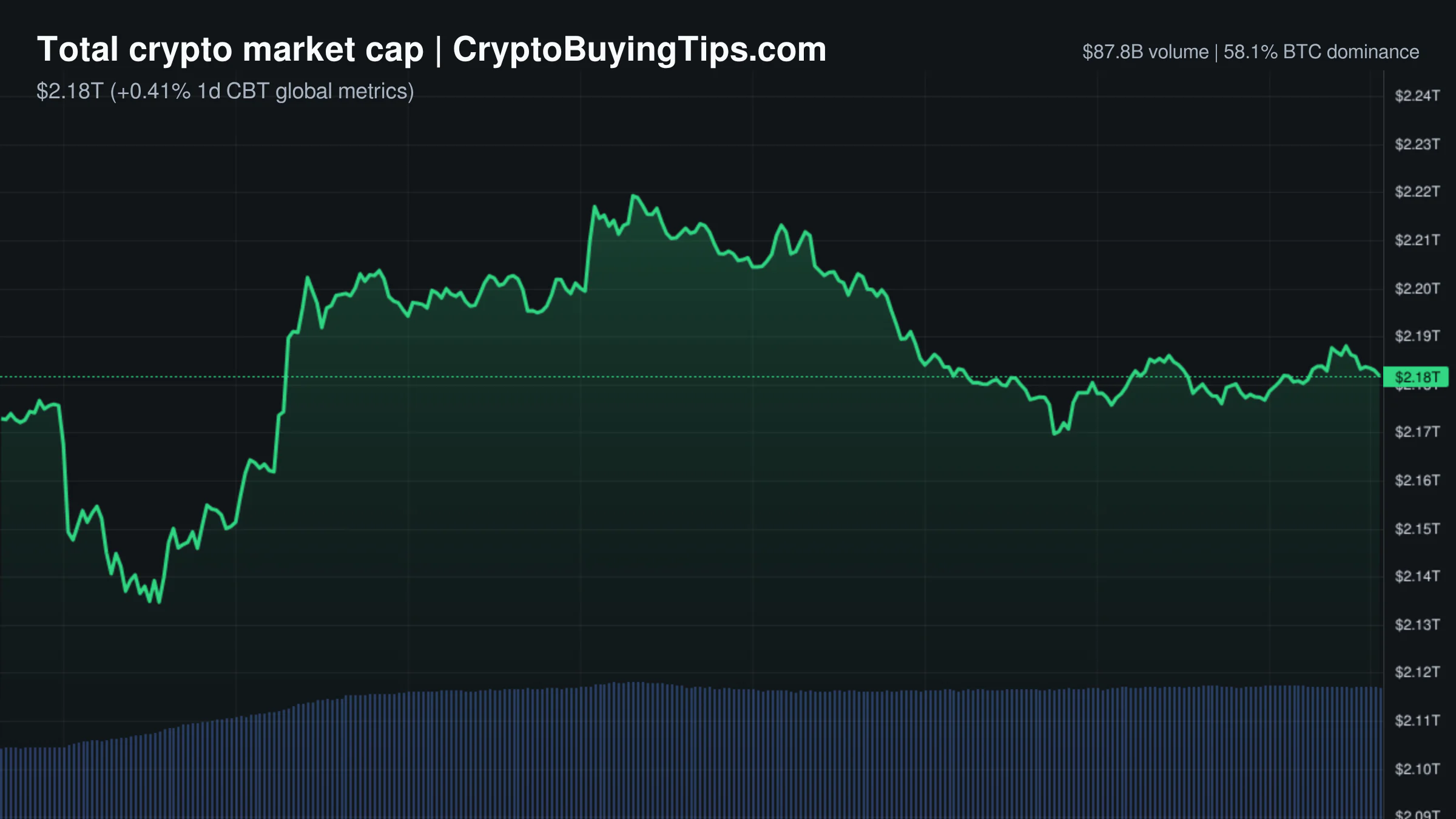
Bitcoin dominance remains high at 58.3%, which continues to squeeze the available capital for smaller assets. With a total market cap sitting around $2.16T and an Altcoin Season Index of 47, we are in a neutral zone. Neither the flagship asset nor the alts are leading the charge. This is a waiting game. We previously covered how BTC dominance data analysis suggests capital is consolidating during a general liquidity pause, and today's data confirms that the ghost town is still very much open for business.
Bitcoin and Ethereum
Bitcoin is trading at $62,684.45, up 0.91% on the day. The price action is stagnant, but the institutional narrative is attempting to shift. Recent reports suggest Bitcoin ETFs are turning a corner after a record $8 billion bleed since mid-May. However, the immediate flow data is mixed. Social intelligence indicates that BTC spot ETFs saw net outflows of $84.86M on July 8. The market is absorbing the selling, but there is no aggressive bid to push the price higher.
Ethereum is priced at $1,743.87, a slight increase of 0.30%. While the price is flat, the flow data is surprisingly positive. ETH spot ETFs recorded net inflows of $70.48M on July 8, contrasting sharply with the outflows seen in Bitcoin and Solana. This suggests a tactical rotation into the second largest asset, perhaps as a hedge or a bet on upcoming network utility.
Network activity on Ethereum is exceptionally quiet. Gas fees are sitting between 0.07 and 0.08 Gwei. This indicates almost zero on-chain congestion, which is a double-edged sword. Low fees are great for users, but they signal a lack of demand for block space. We have noted before that Ethereum market share vanishes even as the corporate narrative improves. The current price action reflects this tension.
Top crypto prices
The top of the market is showing modest green across most names. BNB is one of the stronger performers, trading at $569.55 and up 1.28%. TRON follows closely at $0.3312, rising 1.12%. XRP is holding at $1.09, up 0.94%, while Solana is slightly higher at $77.7, a 0.58% gain.
Not every asset is participating in this low-volume drift. Hyperliquid is trading at $67.34, down 1.19%. This suggests a slight cooling off for the perp-dex narrative as traders rotate back into the majors.
News driving today's market
The institutional side of the market is producing the only genuine catalysts. SWIFT has launched a blockchain ledger to host a tokenized bank deposit pilot with 17 major banks. This is a significant move. It moves blockchain from the realm of speculative assets into the plumbing of global cross-border payments. When the world's primary banking messaging system adopts a ledger, the utility argument for the technology wins a major victory.
Similarly, Sony Bank has received conditional OCC approval to set up a U.S. stablecoin trust bank. This subsidiary, Connectia Trust, will be capitalized with $40 million. The entry of a global giant like Sony into the stablecoin space adds a layer of legitimacy that the industry desperately needs to move past the "wild west" phase.
On the regulatory front, the European Commission is looking to expand the MiCA framework to cover non-EU stablecoin issuers and tokenization. This is a move toward a more regulated and structured environment. We previously explained how Mica crypto regulation explained creates operational hurdles for platforms, and this expansion will likely increase compliance costs for any issuer wanting to touch the European market.
Law enforcement is also active. INTERPOL led a global crackdown that resulted in over 5,800 arrests and the discovery of a laundering network tied to a $122.5 million wallet. This serves as a reminder that the perceived anonymity of cross-chain swaps is often an illusion. These actions increase the operational risk for DeFi protocols that lack robust KYC or AML filters.
Social intelligence
The political atmosphere is adding a layer of volatility to the sentiment. Donald Trump has been vocal about the need for the U.S. to develop cryptocurrency to prevent other countries from taking dominance. He argues that the Biden administration's initial crackdown was a political miscalculation. This rhetoric keeps the "political hedge" trade alive, as traders bet on a more permissive regulatory environment if the political wind shifts.
On the on-chain side, tokenized stock transfers are surging. Data shows a 105% increase in a single month, reaching $8.4B in volume. This trend suggests that the real innovation is happening in the tokenization of traditional assets rather than the creation of new, speculative tokens.
The ETF flow data remains the most actionable social signal. The divergence between ETH inflows and BTC outflows is a clear indicator of a short-term sentiment shift. Traders are rotating. They are not leaving the market, but they are changing their bets.
Trading ideas worth watching
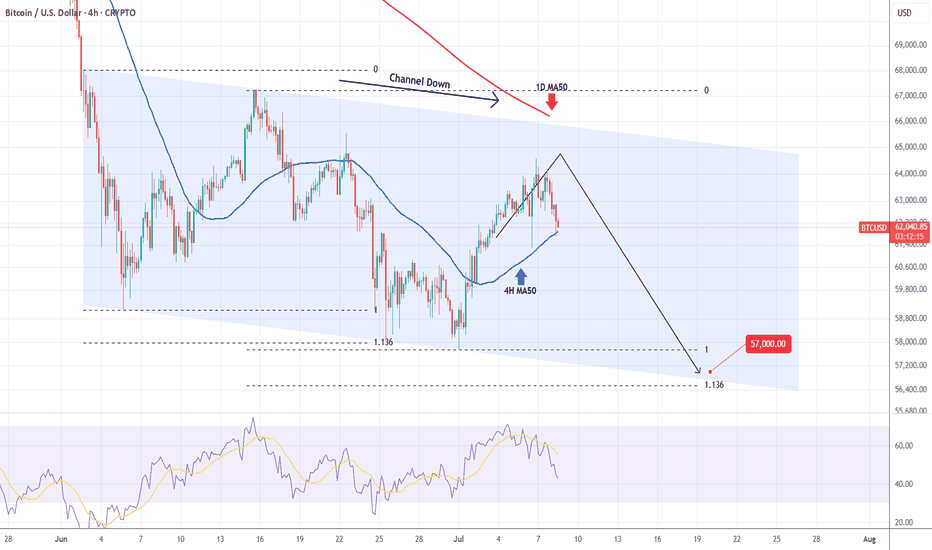
There is a sharp divide in the technical outlook for Bitcoin. One bearish setup identifies a "Channel Down" pattern that has persisted since June 2. The key level here is the 4-hour MA50. If Bitcoin closes a 4-hour candle below this line, the setup suggests a new selling sequence could target the 1.136 Fibonacci extension, which sits at $57,000. The fact that the price has failed to test the 1-day MA50 suggests the long-term trend is still heavily skewed to the downside.
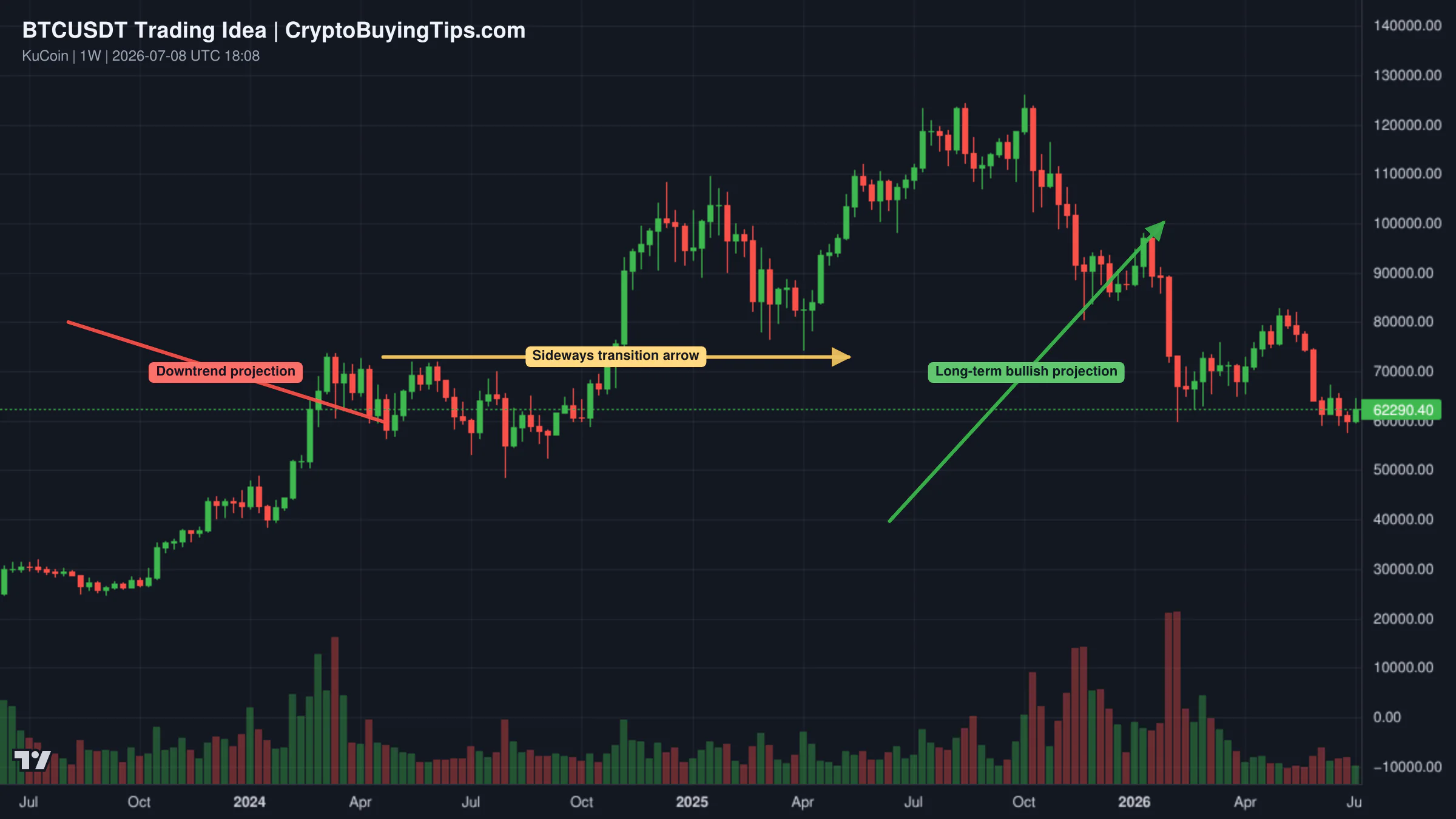
Conversely, a more bullish read suggests we are in an "extreme opportunity buy-zone" between $58,000 and $68,000. This analysis argues that the bear market ended when the sideways action lasted longer than the previous bearish impulse. This view identifies a double-bottom around $58,000 to $60,000. For those with a longer time horizon, any price below $70,000 is viewed as a spot accumulation area.
A third perspective focuses on a "Channel Expansion" toward $66,000. This view is bolstered by historical seasonality, noting that July is often one of the strongest months for Bitcoin, even in down-cycles. The macro backdrop here is the internal division within the Fed. While some officials want rates steady, others are pushing for hikes due to AI-driven structural pressures. This uncertainty creates a volatile floor for risk assets.
What to watch next
The immediate focus is on volume. We cannot trust a price recovery that happens in a vacuum. If the total market volume remains 20% below its recent averages, any move higher is likely a bull trap. We need to see a return of liquidity, particularly in the derivatives market, to confirm a trend reversal.
The MiCA 2.0 revisions are also a key watch point. If the EU successfully expands its reach to non-EU stablecoin issuers by 2027, it will force a massive reorganization of how stablecoins are issued and managed globally. This could either lead to a more stable, institutionalized market or a fragmented one where certain issuers simply exit the European market.
Finally, the Fed's internal struggle under Chair Kevin Warsh will dictate the liquidity environment. If the "rate hike" faction wins out, the pressure on risk assets will increase. If the "cooling inflation" narrative takes hold, the seasonal July tailwind could finally push Bitcoin out of its current sideways rut. For now, the market is a quiet place where fear persists despite the green candles.
Some links in this article may be affiliate links. We may earn a commission at no extra cost to you — this never influences our analysis or coverage.

Sigrid Voss
Crypto analyst and writer covering market trends, trading strategies, and blockchain technology.
More Articles

The $8 billion ETF bleed is over but the 10x leverage overhang is the real story
The market celebrates an end to institutional selling based on spot data alone; our read suggests the real risk lies in…
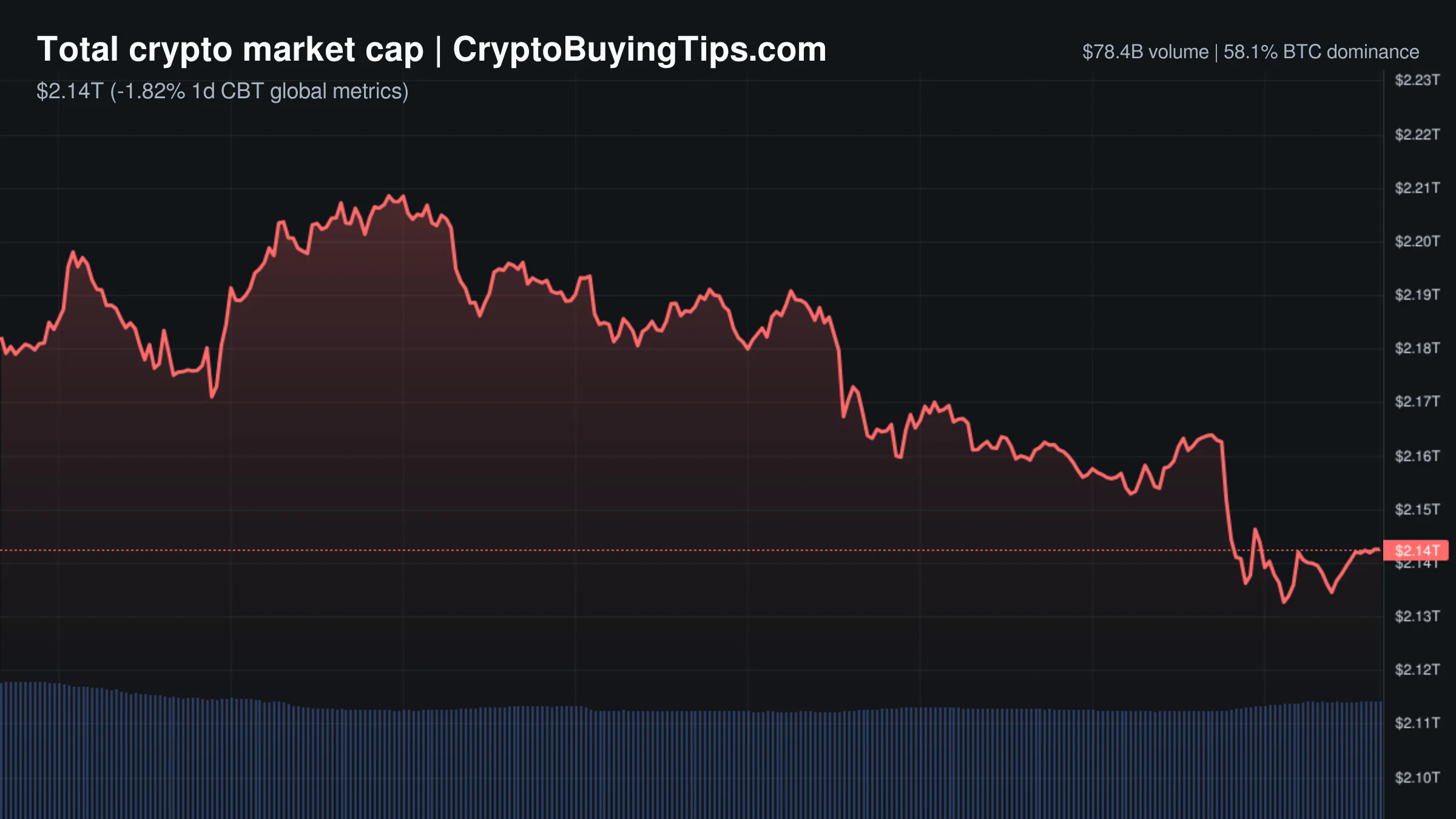
Crypto Market Overview | DeFi volume climbs amid broader market risk-off dip | July 8, 2026
Crypto market overview shows DeFi volume climbing amid a risk-off dip; see how BTC dominance rises despite falling total…

The SEC promises a safe harbor but the volume data shows a ghost town
The SEC promises regulatory clarity while trading volumes suggest everyone's taking an unscheduled holiday. Rising BTC…
Crypto Market Overview | leverage surge meets deep sentiment fear | July 7, 2026
The crypto market shows mixed signals with fear sentiment but surging leverage; see our overview for details on BTC and…